- [English]
- Effect of Low-Oxygen Atmosphere Sintering on TiO2 Powder Photoanodes for Fiber-Shaped Dye-Sensitized Solar Cells toward Carbon-Based Electrode Integration.
-
Yeonggwon Kim, Chae Young Woo, Sung Min Kim, Jiseong Park, Yongseon Jeong, Dabin Chun, Seungfeel Jeong, Hyung Woo Lee
-
Received September 11, 2026 Accepted October 24, 2026 Published online October 26, 2026
-
DOI: https://doi.org/10.4150/jpm.2026.00241
-
-
 Abstract
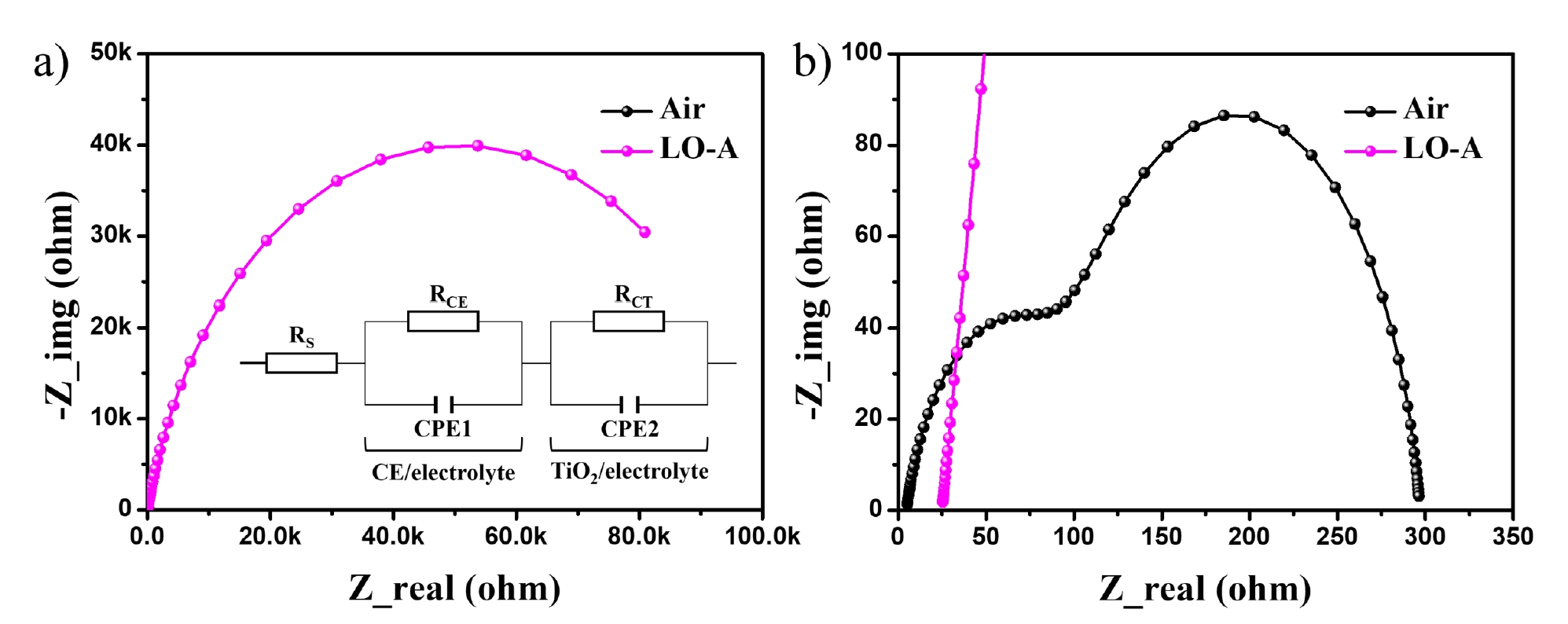
- Motivated by the goal of achieving high-temperature photoanode processing compatible with carbon-based current collectors, this study investigates the effect of sintering atmosphere on Ti wire/TiO2 photoanodes for fiber-shaped dye-sensitized solar cells. Photoanodes sintered under conventional air (Air) and a custom low-oxygen condition (LO, continuous Ar flow under reduced pressure at 500 °C) were compared, along with a subsequent low-temperature air-annealing treatment (LO-A). X-ray diffraction (XRD) and scanning electron microscopy (SEM) revealed no substantial difference between Air and LO, whereas X-ray photoelectron spectroscopy (XPS) showed a marked increase in reduced Ti species (Ti3+, Ti2+) and an approximately twofold higher C 1s signal for LO, accompanied by significantly reduced N719 dye adsorption. LO photoanodes exhibited short-circuit-like device behavior, precluding reliable photovoltaic characterization. Although LO-A eliminated this short-circuit behavior and largely restored dye adsorption, photovoltaic performance remained severely suppressed, and electrochemical impedance spectroscopy revealed a three-orders-of-magnitude increase in photoanode-related charge-transfer resistance relative to Air. These results indicate that dye-anchoring capacity and interfacial charge-transfer resistance are governed by at least partially distinct factors, possibly involving reduced Ti species, carbon residue, and leakage paths, whose contributions were not separated, and that low-temperature annealing alone is insufficient to restore the photoelectrochemical functionality compromised by LO sintering.
|
 KPMI