- [English]
- Microstructural Evolution and Tensile Response of a Fe–15Cr Oxide Dispersion Strengthened Steel after Hot Rolling and Heat Treatment
-
Trung Thanh Pham, Woo-Hyeok Kim, HyunCheol Kim, Jeoung Han Kim
-
Received May 27, 2026 Accepted June 25, 2026 Published online July 15, 2026
-
DOI: https://doi.org/10.4150/jpm.2026.00157
-
-
 Abstract Abstract
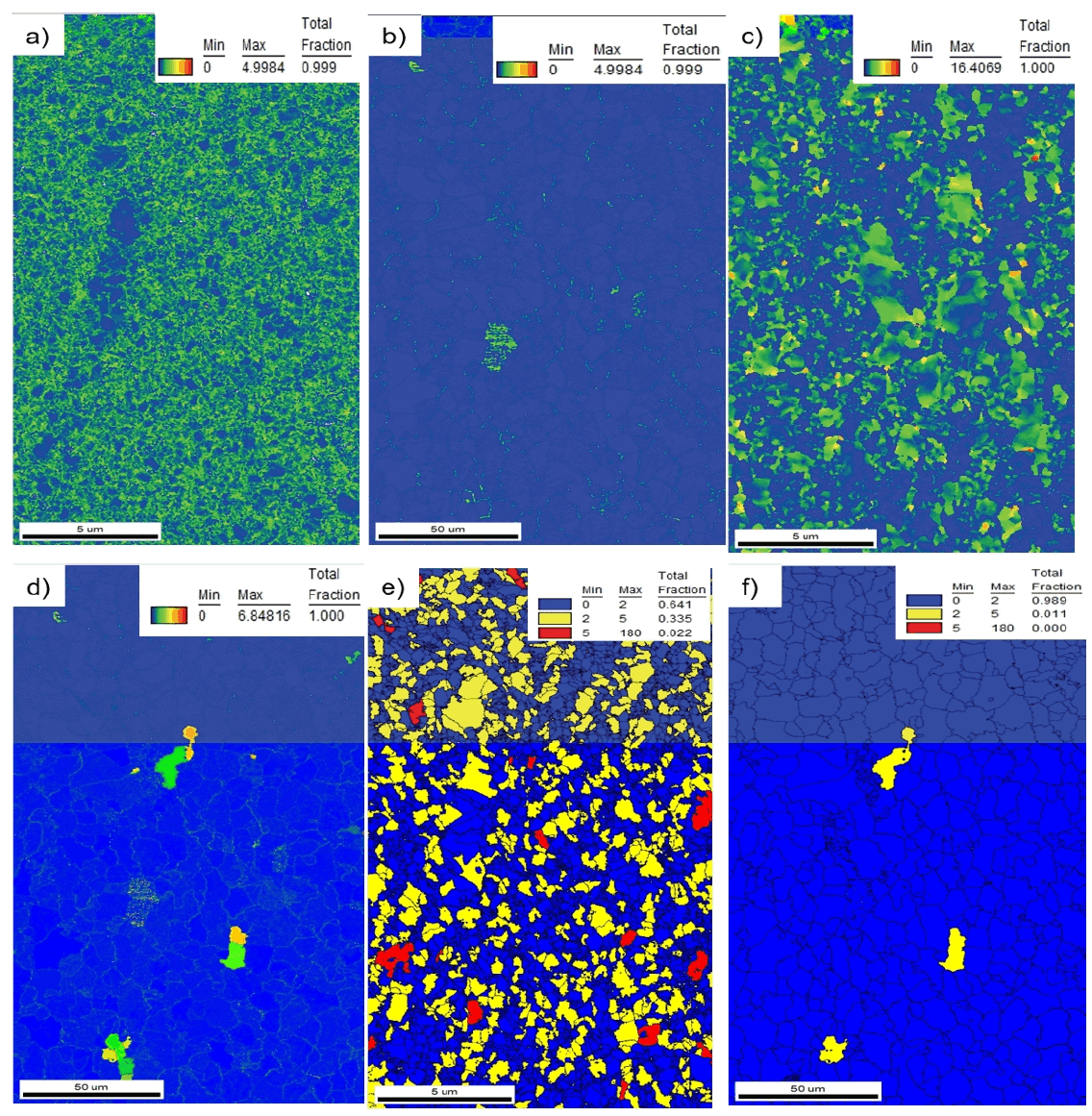
- Fe-based oxide dispersion-strengthened (ODS) are promising structural materials for Generation IV nuclear systems because of their high-temperature strength, radiation tolerance, and microstructural stability. However, their mechanical performance is difficult to optimize because it depends on a coupled relationship among alloy composition, powder processing, consolidation, thermo-mechanical treatment, oxide dispersion, and deformation substructure. In this study, a machine learning (ML) screening workflow was used to prioritize multi-component Fe–15Cr-based ODS candidates based on predicted yield strength, ultimate tensile strength, and total elongation, followed by experimental validation of the selected alloy. The investigated alloy was processed by mechanical alloying, hot isostatic pressing, hot rolling, and post-rolling heat treatment at 1100 °C for 24 h. Electron backscatter diffraction (EBSD) showed that the hot-rolled condition contained an ultrafine, heterogeneous, and sub-structured ferritic matrix, whereas heat treatment produced substantial grain coarsening, recovery, and a high-angle grain-boundary-dominated structure. The hot-rolled alloy exhibited very high room-temperature strength, with a yield strength of 820 MPa and an ultimate tensile strength of 2079 MPa, but limited elongation of 2.3%. At 650 °C, elongation increased markedly to 34.9%. After heat treatment, room-temperature elongation improved to 13.9%, although the yield and ultimate tensile strengths decreased to 680 MPa and 935 MPa, respectively.
|
 KPMI
KPMI