 KPMI
KPMI

Search
- Page Path
- HOME > Search
Research Article
- [English]
- Effect of the Cross-rolling Process on the Microstructures and Mechanical Properties of 9Cr-1W ODS Steel
- Bu-An Kim, Sanghoon Noh
- J Powder Mater. 2025;32(1):37-42. Published online February 28, 2025
- DOI: https://doi.org/10.4150/jpm.2024.00332
- 1,867 View
- 42 Download
- 1 Citations
-
 Abstract
 PDF
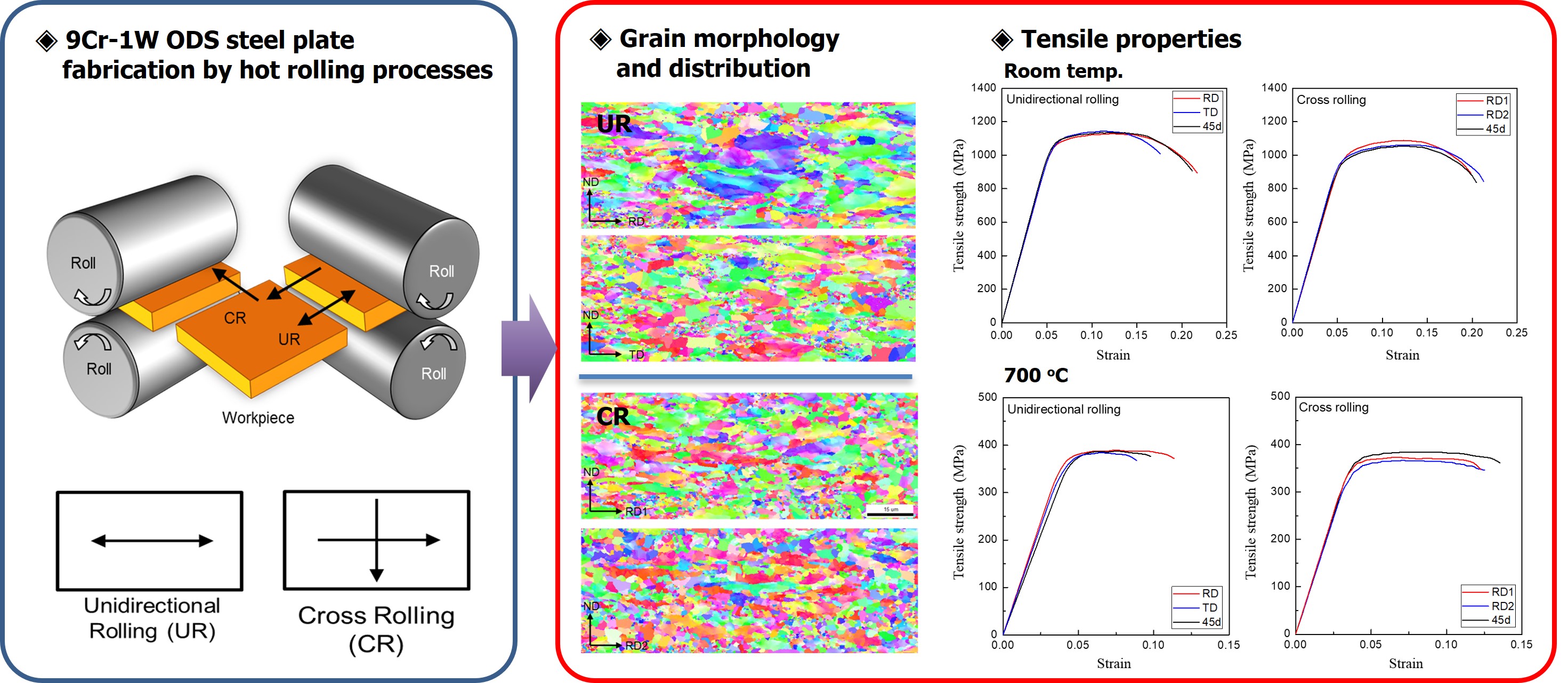
PDF - This study employed a cross-rolling process to fabricate oxide dispersion strengthened (ODS) steel plates and investigated their microstructures and mechanical properties. The 9Cr-1W ODS ferritic steel was fabricated using mechanical alloying and hot isostatic pressing. The hot cross-rolling process produced thick ODS ferritic steel plates with a well-extended rectangular shape. The working direction greatly affected the grain structure and crystal texture of the ODS ferritic steel. Cross-rolled plates showed fine micro-grains with random crystal orientation, while unidirectionally rolled plates exhibited a strong orientation with larger, elongated grains. Transmission electron microscopy revealed a uniform distribution of nano-oxide particles in both rolling methods, with no major differences. Tensile tests of the ODS ferritic steel plates showed that the unidirectional rolled plates had anisotropic elongation, while cross-rolled plates exhibited isotropic behavior with uniform elongation. Cross-rolling produced finer, more uniform grains, reducing anisotropy and improving mechanical properties, making it ideal for manufacturing wide ODS steel components.
-
Citations
Citations to this article as recorded by
- Transverse Cold Rolling-Induced Microstructural Modification and Mechanical and Electrochemical Responses of UNS S32304 Lean Duplex Stainless Steel
Victor Hugo Mafra Monfredo Ferreira, Arthur Ecard Guimarães, Mauricio dos Santos Azevedo, Guilherme Yuuki Koga, Ivan Napoleão Bastos, Luis Cesar Rodríguez Aliaga, Leandro de Amorim Ratamero, Francisco Gil Coury, Verona Biancardi Aguiar
Journal of Materials Engineering and Performance.2026;[Epub] CrossRef
- Transverse Cold Rolling-Induced Microstructural Modification and Mechanical and Electrochemical Responses of UNS S32304 Lean Duplex Stainless Steel
 First
First Prev
Prev

TOP

