 KPMI
KPMI

Search
- Page Path
- HOME > Search
Research Article
- [English]
- Phase Formation Behavior and Piezocatalytic Properties of Sodium Bismuth Titanate-Based Perovskite Fine Powders Prepared by Ultrasonic Spray Pyrolysis
- Hee Yeon Jeon, Jae Min Park, Ju Eun You, Young-In Lee
- J Powder Mater. 2026;33(3):239-248. Published online June 30, 2026
- DOI: https://doi.org/10.4150/jpm.2026.00129
- 1,185 View
- 11 Download
-
 Abstract
 PDF
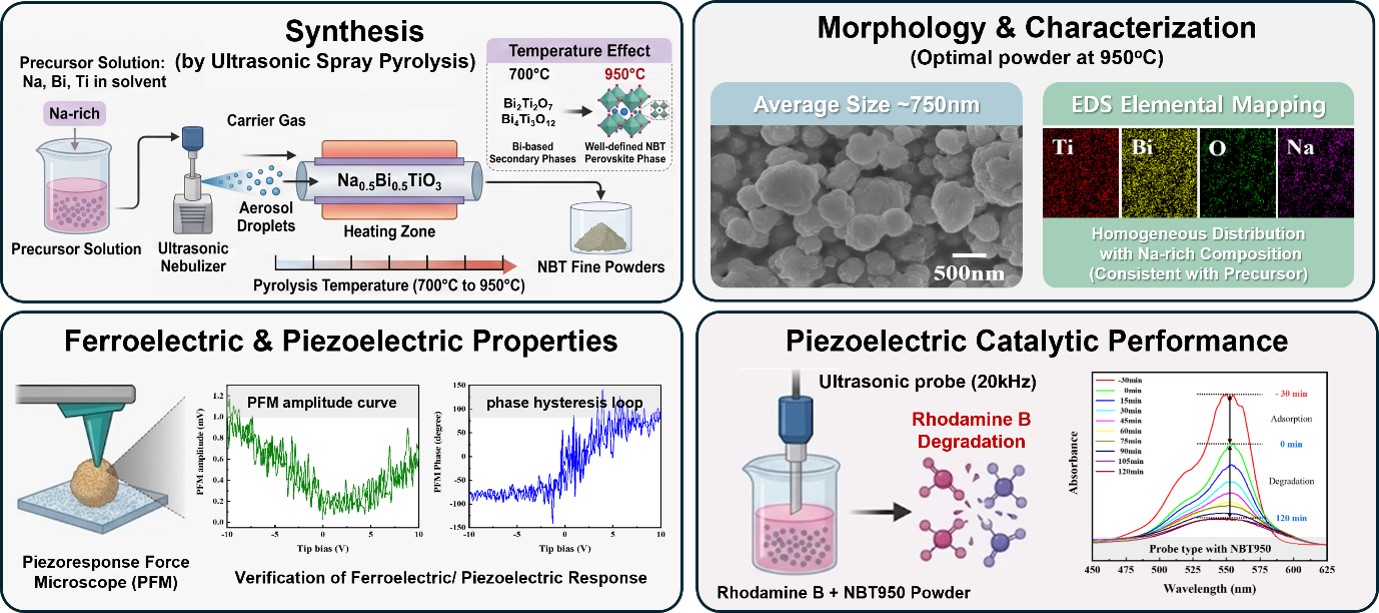
PDF - Sodium bismuth titanate (Na0.5Bi0.5TiO3, NBT) is a representative lead-free piezoelectric ceramic with ferroelectric and piezoelectric properties, promising candidate for piezocatalytic applications driven by mechanical vibration. In this study, NBT-based perovskite fine powders were prepared by ultrasonic spray pyrolysis (USP), a continuous aerosol process based on droplet-level reaction control. The effect of pyrolysis temperature, varied from 700oC to 950oC, on phase formation and particle morphology was investigated. At lower temperatures, Bi-based secondary phases predominated, whereas the perovskite phase gradually developed with increasing temperature. The powder synthesized at 950oC exhibited a well-defined perovskite crystal structure with improved crystallinity. FE-SEM analysis showed that the powders consisted of spherical particles with an average size of approximately 750 nm, without severe interparticle agglomeration. EDS analysis confirmed a relatively homogeneous distribution of Na, Bi, Ti, and O, with Na-rich composition, consistent with Na-rich precursor condition. Piezoresponse force microscope (PFM) measurements verified the ferroelectric and piezoelectric responses of the powder synthesized at 950oC. In Rhodamine B degradation tests under probe-type ultrasonication, adding the NBT-based powder increased the reaction rate constant from 7.96×10⁻³ to 1.16×10⁻² min-1. These results suggest that USP is a feasible continuous process for preparing NBT-based perovskite fine powders for lead-free piezocatalytic applications.
 First
First Prev
Prev

TOP

