 KPMI
KPMI

Search
- Page Path
- HOME > Search
- [English]
- Effect of Compositional Trade-off Between Cr and Mo on the Corrosion Resistance of Additively Manufactured Co-Cr-Fe-Ni-Mo High-Entropy Alloys
- Jeongmin Lee, Yeonghwan Song, Jae Hyuk Lee, Sung-Jae Jo, Minho Shin, Hyunbin Lim, Soon-Jik Hong, Soo-Hyun Joo
- J Powder Mater. 2026;33(2):137-144. Published online April 30, 2026
- DOI: https://doi.org/10.4150/jpm.2026.00087
- 4,007 View
- 36 Download
-
 Abstract
 PDF
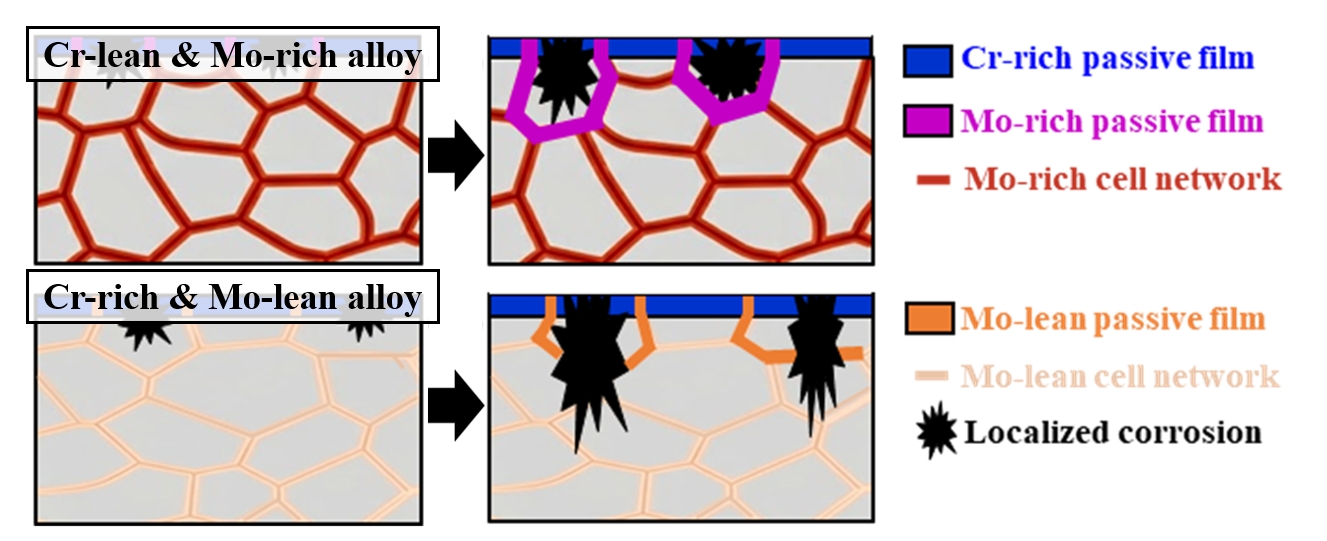
PDF - In this study, the corrosion behavior of Co-Cr-Fe-Ni-Mo high-entropy alloys additively manufactured via direct energy deposition was investigated according to the compositional trade-off between Cr and Mo elements. Two distinct alloy compositions were fabricated by adjusting the feeding rate of two powders with different chemical compositions through a dual nozzle. Electrochemical testing in a 3.5 wt% NaCl solution revealed that the Cr-rich and Mo-lean alloy exhibited inferior corrosion resistance compared to the Cr-lean and Mo-rich alloy. Specifically, the corrosion potential of the Cr-rich and Mo-lean alloy shifted negatively by approximately 200 mV compared to the Cr-lean and Mo-rich alloy, accompanied by an increase in corrosion current density and the pronounced initiation of localized pitting. This deterioration is attributed to a lack of passivation caused by the small amount of Mo in the Cr-rich and Mo-lean alloy. The passive film of the Cr-lean and Mo-rich alloy was more robust, characterized by a higher concentration of Mo, which effectively inhibited pit propagation through repassivation. These findings demonstrate that maintaining a critical Cr-Mo balance is more vital for the electrochemical stability of additively manufactured high-entropy alloys than unilateral Cr enrichment.
- [English]
- Ultrasonic Nanocrystal Surface Modification of 3D Interconnected Heterostructured Complex Concentrated Alloys Produced by Liquid Metal Dealloying: Microstructural Evolution and Wear Behavior
- Jumi Choi, Yeji Kim, Munsu Choi, Jae Hyuk Lee, Dong Jun Lee, Auezhan Amanov, Soo-Hyun Joo, Hyoung Seop Kim
- J Powder Mater. 2026;33(2):91-103. Published online April 30, 2026
- DOI: https://doi.org/10.4150/jpm.2026.00045
- 1,458 View
- 24 Download
-
Abstract
PDF
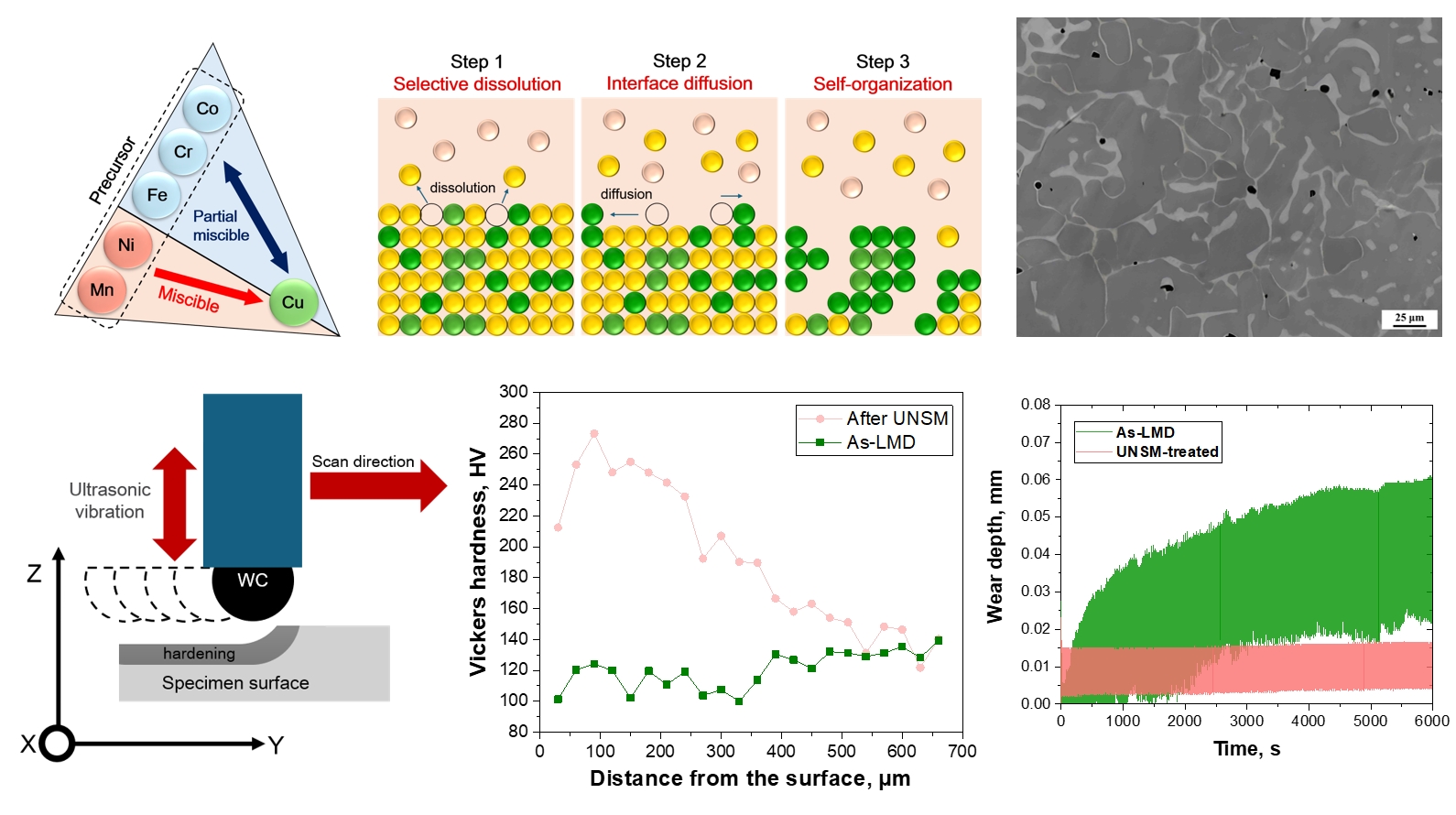
- This study investigates the effects of ultrasonic nanocrystal surface modification (UNSM) on the microstructural evolution and tribological performance of a three-dimensional interconnected heterostructured compositionally complex alloy fabricated by liquid metal dealloying (LMD). The as-LMD microstructure comprises an interconnected Cu-rich phase and a CoCrFe-rich ligament phase. Electron backscatter diffraction reveals pronounced severe plastic deformation near the surface after UNSM, characterized by subgrain formation and increased intragranular misorientation. The kernel average misorientation distribution reveals a pronounced depth-dependent deformation gradient, with dislocations preferentially accumulating at the interphase boundaries. Vickers hardness increases from approximately 100–120 HV in the as-LMD condition to greater than 270 HV at the surface after UNSM, and the hardening effect remains detectable to a depth of approximately 500 μm. Compressive residual stresses are concentrated within the surface-adjacent ~50 μm. The solid ligament phase exhibits higher compressive residual stress than the Cu-rich phase, reflecting phase-dependent deformation accommodation and stress partitioning. Reciprocating wear tests show a narrower wear track, a markedly reduced wear depth, and a lower and more stable friction coefficient after UNSM. Microscopy shows oxide-layer cracking and delamination in the as-LMD condition, whereas the UNSM-treated surface exhibits minor abrasive wear of the tribo-film without delamination.
- [Korean]
- Effect of Core-Shell Structure on Compaction Behavior of Harmonic Powder
- Soo-Hyun Joo, Hyo Wook Park, Soo Young Kang, Eon Sik Lee, Hee-Soo Kang, Hyong Seop Kim
- J Korean Powder Metall Inst. 2015;22(2):105-110. Published online April 1, 2015
- DOI: https://doi.org/10.4150/KPMI.2015.22.2.105
- 1,086 View
- 3 Download
-
Abstract
PDF
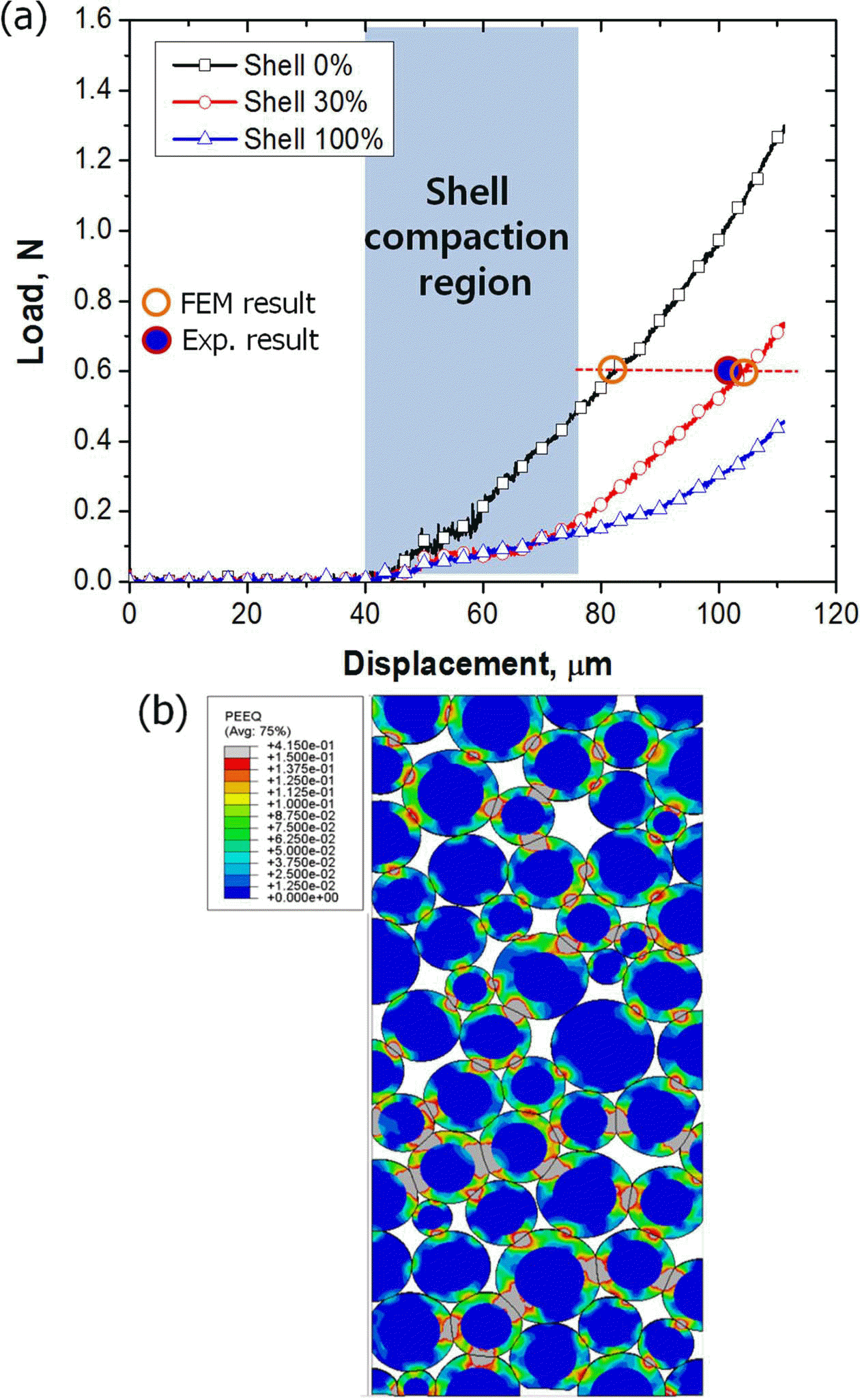
In this study, effect of core-shell structure on compaction behavior of harmonic powder is investigated. Harmonic powders are made by electroless plating method on Fe powders. Softer Cu shell encloses harder Fe core, and the average size of Fe core and thickness of Cu shell are 34.3 μm and 3.2 μm, respectively. The powder compaction procedure is processed with pressure of 600 MPa in a cylindrical die. Due to the low strength of Cu shell regions, the harmonic powders show better densification behavior compared with pure Fe powders. Finite element method (FEM) is performed to understand the roll of core-shell structure. Based on stress and strain distributions of FEM results, it is concluded that the early stage of powder compaction of harmonic powders mainly occurs at the shell region. FEM results also well predict porosity of compacted materials.
- [Korean]
- Prediction of Martensite Fraction in the Sintering Hardening Process of Ni/Mo Alloy Powder (FLC-4608) Using the Finite Element Method
- Hyo Wook Park, Soo-Hyun Joo, Eon Sik Lee, Ki Hyuk Kwon, Hyong Seop Kim
- J Korean Powder Metall Inst. 2015;22(1):10-14. Published online February 1, 2015
- DOI: https://doi.org/10.4150/KPMI.2015.22.1.10

- 1,173 View
- 1 Download
-
Abstract
PDF
In recent years, industrial demands for superior mechanical properties of powder metallurgy steel components with low cost are rapidly growing. Sinter hardening that combines sintering and heat treatment in continuous one step is cost-effective. The cooling rate during the sinter hardening process dominates material microstructures, which finally determine the mechanical properties of the parts. This research establishes a numerical model of the relation between various cooling rates and microstructures in a sinter hardenable material. The evolution of a martensitic phase in the treated microstructure during end quench tests using various cooling media of water, oil, and air is predicted from the cooling rate, which is influenced by cooling conditions, using the finite element method simulations. The effects of the cooling condition on the microstructure of the sinter hardening material are found. The obtained limiting size of the sinter hardening part is helpful to design complicate shaped components.
- [Korean]
- Microstructure and Mechanical Behavior of Ultrafine Grained Bulk Al Processed by High Pressure Torsion of the Al Powders
- Soo-Hyun Joo, Seung-Chae Yoon, Chong-Soo Lee, Hyong-Seop Kim
- J Korean Powder Metall Inst. 2010;17(1):52-58.
- DOI: https://doi.org/10.4150/KPMI.2010.17.1.052
- 1,416 View
- 0 Download
- 3 Citations
-
Abstract
PDF
- Bulk nanostructured metallic materials are generally synthesized by bottom-up processing which starts from powders for assembling bulk materials. In this study, the bottom-up powder metallurgy and High Pressure Torsion (HPT) approaches were combined to achieve both full density and grain refinement at the same time. After the HPT process at 473K, the disk samples reached a steady state condition when the microstructure and properties no longer evolve, and equilibrium boundaries with high angle grain boundaries (HAGBs) were dominant. The well dispersed alumina particles played important role of obstacles to dislocation glide and to grain growth, and thus, reduced the grain size at elevated temperature. The small grain size with HAGBs resulted in high strength and good ductility.
-
Citations
Citations to this article as recorded by
- Ultrafine Grained Cu-diamond Composites using High Pressure Torsion
Eun-Yoo Yoon, Dong-Jun Lee, Taek-Soo Kim, Hyoung-Seop Kim
Journal of Korean Powder Metallurgy Institute.2012; 19(3): 204. CrossRef - Densification of Copper Powders using High-pressure Torsion Process
Dong-Jun Lee, Eun-Yoo Yoon, Soo-Young Kang, Jung-Hwan Lee, Hyoung-Seop Kim
Journal of Korean Powder Metallurgy Institute.2012; 19(5): 333. CrossRef - Densification and Nanocrystallization of Water-Atomized Pure Iron Powder Using High Pressure Torsion
Eun-Yoo Yoon, Dong-Jun Lee, Ha-Neul Kim, Hee-Soo Kang, Eon-Sik Lee, Hyoung-Seop Kim
Journal of Korean Powder Metallurgy Institute.2011; 18(5): 411. CrossRef
- Ultrafine Grained Cu-diamond Composites using High Pressure Torsion
 First
First Prev
Prev

TOP

