 KPMI
KPMI

Search
- Page Path
- HOME > Search
- [Korean]
- Smelting and Recycling of Niobium
- Ho-Sang Sohn
- J Powder Mater. 2025;32(6):517-528. Published online December 31, 2025
- DOI: https://doi.org/10.4150/jpm.2025.00367
- 4,517 View
- 26 Download
- 2 Citations
-
 Abstract
 PDF
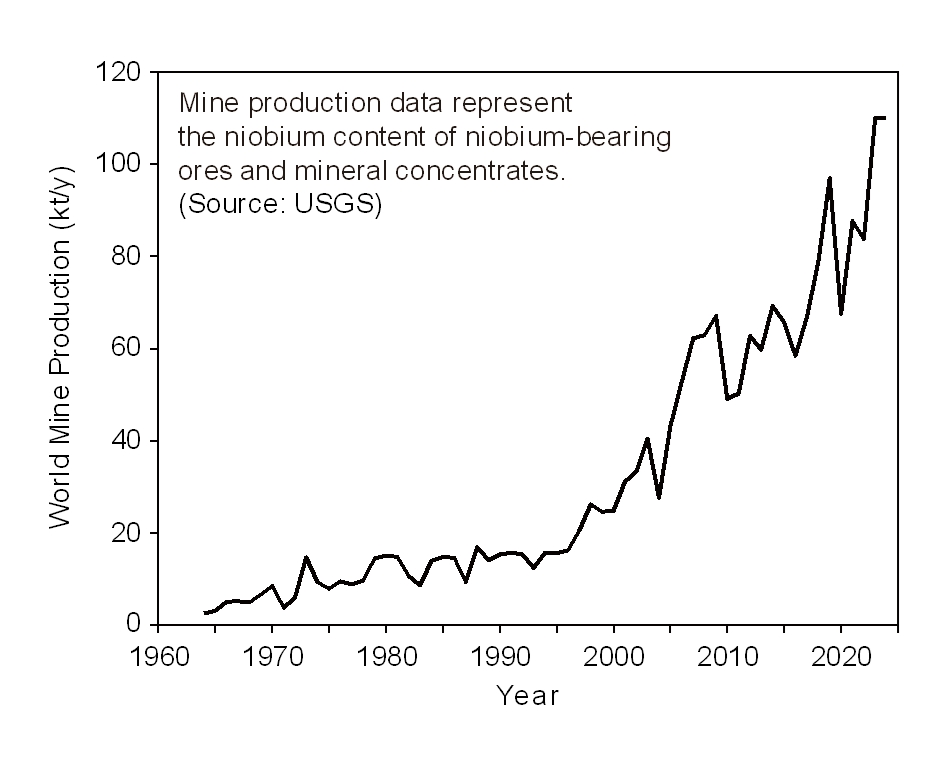
PDF - Global annual production of niobium is only around 100,000 tonnes; however, it is a critical metal for modern industry and is mined in only a limited number of regions. This study reviews the current status of niobium smelting and recycling technologies. Approximately 90% of niobium is produced as ferroniobium (FeNb) for use in steel alloys, although niobium is also utilized in superalloys, superconductors, capacitors, semiconductors, and other applications. Niobium coexists with tantalum in columbite and tantalite ores. These ores are decomposed by hydrofluoric acid digestion or alkali fusion, followed by solvent extraction to separate Nb2O5 and Ta2O5. Niobium metal and FeNb are produced from Nb2O5 primarily via aluminothermic reduction, although metallic niobium can also be manufactured by thermal reduction using Mg, Ca, or C, as well as by molten salt electrolysis. Crude niobium is subsequently refined into high-purity niobium through molten salt electrolytic refining, high-temperature vacuum treatment, and electron beam melting. Because most niobium is used as an alloying element in stainless steel and high-strength low-alloy steel, recycling practices for niobium remain poorly documented.
-
Citations
Citations to this article as recorded by
- [Korean]
- Effect of Hot Isostatic Pressing on the Microstructure and Properties of Kinetic Sprayed Nb Coating Material
- Ji-Hye Lee, Sangsun Yang, Kee-Ahn Lee
- J Korean Powder Metall Inst. 2016;23(1):15-20. Published online February 1, 2016
- DOI: https://doi.org/10.4150/KPMI.2016.23.1.15
- 946 View
- 8 Download
- 1 Citations
-
Abstract
PDF
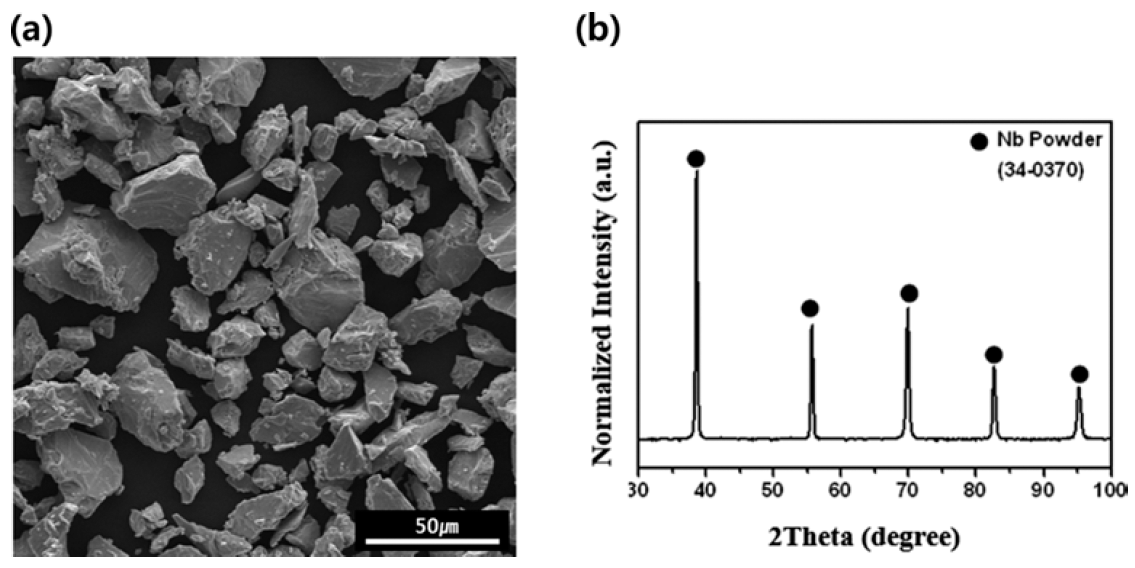
Niobium is one of the most important and rarest metals, and is used in the electronic and energy industries. However, it’s extremely high melting point and oxygen affinity limits the manufacture of Nb coating materials. Here, a Nb coating material is manufactured using a kinetic spray process followed by hot isotactic pressing to improve its properties. OM (optical microscope), XRD (X-ray diffraction), SEM (scanning electron microscopy), and Vickers hardness and EPMA (electron probe micro analyzer) tests are employed to investigate the macroscopic properties of the manufactured Nb materials. The powder used to manufacture the material has angular-shaped particles with an average particle size of 23.8 μm. The porosity and hardness of the manufactured Nb material are 0.18% and 221 Hv, respectively. Additional HIP is applied to the manufactured Nb material for 4 h under an Ar atmosphere after which the porosity decreases to 0.08% and the hardness increases to 253 Hv. Phase analysis after the HIP shows the presence of only pure Nb. The study also discusses the possibility of using the manufactured Nb material as a sputtering target.
-
Citations
Citations to this article as recorded by- Microstructure evolution and superior high temperature strength of cold spray additive manufactured Nb
Young-Kyun Kim, Soobin Kim, Kee-Ahn Lee
International Journal of Refractory Metals and Hard Materials.2026; 138: 107747. CrossRef
- Microstructure evolution and superior high temperature strength of cold spray additive manufactured Nb
 First
First Prev
Prev

TOP

