- [Korean]
- Microstructure and Mechanical Properties of AA3003 Tube for Heat Exchanger Processed by Floating Plug Drawing
-
Hyeon-Jun Heo, Sung Jun Oh, Seong-Hee Lee
-
J Powder Mater. 2025;32(6):459-465. Published online December 31, 2025
-
DOI: https://doi.org/10.4150/jpm.2025.00346
-
-
 Abstract Abstract
 PDF PDF
- An AA3003 tube was severely deformed by cold floating plug drawing, and then annealed at temperatures from 210 to 460℃. The as drawn Al tube exhibited a typical deformation structure in which the grains were greatly elongated along the drawing direction. The hardness increased with increasing the reduction of cross-sectional area (RA), became 68Hv after RA= 99%. Up to 310℃, the Al tube still mainly exhibited a deformed structure. While complete recrystallization occurred at temperatures above 360℃. The hardness decreased with increasing the annealing temperature, and it became 33Hv after annealing at 410℃. Both the tensile and yield strengths also decreased with increasing the annealing temperature, but the decrease was larger in yield strength than in tensile strength. The elongation increased with increasing the annealing temperature. The changes in the strength and the elongation with the annealing temperature were the largest at 360℃, in which the complete recrystallization occurred.
- [Korean]
- Microstructure and Mechanical Properties of CNT/Al Composite Fabricated by a Powder-in-Sheath Rolling Method utilizing Copper Tube as a Sheath
-
Seong-Hee Lee
-
J Korean Powder Metall Inst. 2014;21(5):343-348. Published online October 1, 2014
-
DOI: https://doi.org/10.4150/KPMI.2014.21.5.343
-
-
Abstract
PDF
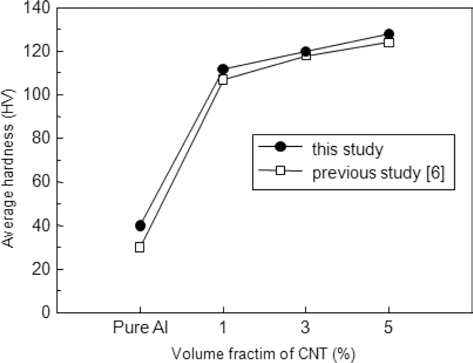
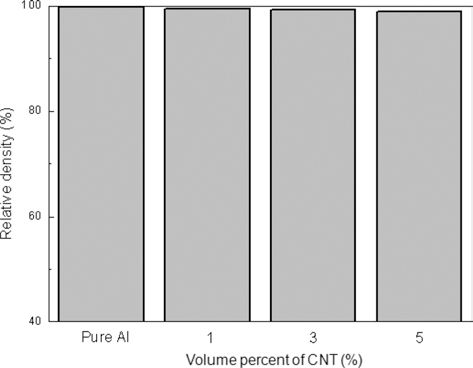
A powder-in-sheath rolling (PSR) process utilizing a copper alloy tube was applied to a fabrication of a multi-walled carbon nanotube (CNT) reinforced aluminum matrix composite. A copper tube with an outer diameter of 30 mm and a wall thickness of 2 mm was used as a sheath material. A mixture of pure aluminum powders and CNTs with the volume contents of 1, 3, 5 vol% was filled in the tube by tap filling and then processed to 93.3% height reduction by a rolling mill. The relative density of the CNT/Al composite fabricated by the PSR decreased slightly with increasing of CNTs content, but showed high value more than 98%. The average hardness of the 5%CNT/Al composite increased more than 3 times, compared to that of unreinforced pure Al powder compaction. The hardness of the CNT/Al composites was some higher than that of the composites fabricated by PSR using SUS304 tube. Therefore, it is concluded that the type of tube affects largely on the mechanical properties of the CNT/Al composites in the PSR process.
- [Korean]
- Fabrication and Evaluation of Carbon Nanotube Reinforced Al Matrix Composite by a Powder-in-sheath Rolling Method
-
Seong-Hee Lee, Dongmin Hong
-
J Korean Powder Metall Inst. 2014;21(1):50-54. Published online February 1, 2014
-
DOI: https://doi.org/10.4150/KPMI.2014.21.1.50
-
-
1,500
View
-
1
Download
-
5
Citations
-
Abstract
PDF
A powder-in-sheath rolling method was applied to a fabrication of a carbon nano tube (CNT) reinforced aluminum composite. A STS304 tube with an outer diameter of 34 mm and a wall thickness of 2 mm was used as a sheath material. A mixture of pure aluminum powders and CNTs with the volume contents of 1, 3, 5 vol was filled in the tube by tap filling and then processed to 73.5% height reduction by a rolling mill. The relative density of the CNT/ Al composite fabricated by the powder-in-sheath rolling decreased slightly with increasing of CNTs content, but exhibited high value more than 98. The grain size of the aluminum matrix was largely decreased with addition of CNTs; it decreased from 24 μm to 0.9 μm by the addition of only 1 volCNT. The average hardness of the composites increased by approximately 3 times with the addition of CNTs, comparing to that of unreinforced pure aluminum. It is concluded that the powder-in-sheath rolling method is an effective process for fabrication of CNT reinforced Al matrix composites. -
Citations
Citations to this article as recorded by  - Torsion Property of the Structure Bonded Aluminum Foam Due to Impact
G.W. Hwang, J.U. Cho
Archives of Metallurgy and Materials.2017; 62(2): 1353. CrossRef - A Fatigue Fracture Study on TDCB Aluminum Foam Specimen of Type Mode III Bonded with Adhesive
J.H. Lee, J.U. Cho
Archives of Metallurgy and Materials.2017; 62(2): 1359. CrossRef - Experimental Study On Fracture Property Of Double Cantilever Beam Specimen With Aluminum Foam
Y.C. Kim, H.K. Choi, J.U. Cho
Archives of Metallurgy and Materials.2015; 60(2): 1151. CrossRef - Experimental Study On Fracture Property Of Tapered Double Cantilever Beam Specimen With Aluminum Foam
Y.C. Kim, S.S. Kim, J.U. Cho
Archives of Metallurgy and Materials.2015; 60(2): 1459. CrossRef - Microstructure and Mechanical Properties of CNT/Al Composite Fabricated by a Powder-in-Sheath Rolling Method utilizing Copper Tube as a Sheath
Seong-Hee Lee
Journal of Korean Powder Metallurgy Institute.2014; 21(5): 343. CrossRef
- [Korean]
- Microstructure and Mechanical Properties of Al/SiCp Particle Reinforced Composite Severely Deformed by ARB Process
-
Seong-Hee Lee, Hyoung-Wook Kim
-
J Korean Powder Metall Inst. 2006;13(1):39-45.
-
DOI: https://doi.org/10.4150/KPMI.2006.13.1.039
-
-
Abstract
PDF
- The Al/SiC_p particle reinforced composite fabricated by a powder-in sheath rolling (PSR) method was severely. deformed by the accumulative roll-bonding (ARB) process. The ARB process was performed up to 8 cycles at ambient temperature without lubricant. The ARBed composite exhibited an ulbricant. grained structure similar to the other ARBed bulky materials. Tensile strength of the composite increased gradually with the number of ARB cycles, but from the 6th cycle it rather decreased slightly. These characteristics of the composite were somewhat different from those of Al powder compact fabricated by the same procedures. The difference in microstructure and mechanical properties between Al powder compact and the composite was discussed.
|
 KPMI
KPMI