- [Korean]
- Effect of Core-Shell Structure on Compaction Behavior of Harmonic Powder
-
Soo-Hyun Joo, Hyo Wook Park, Soo Young Kang, Eon Sik Lee, Hee-Soo Kang, Hyong Seop Kim
-
J Korean Powder Metall Inst. 2015;22(2):105-110. Published online April 1, 2015
-
DOI: https://doi.org/10.4150/KPMI.2015.22.2.105
-
-
 Abstract Abstract
 PDF PDF
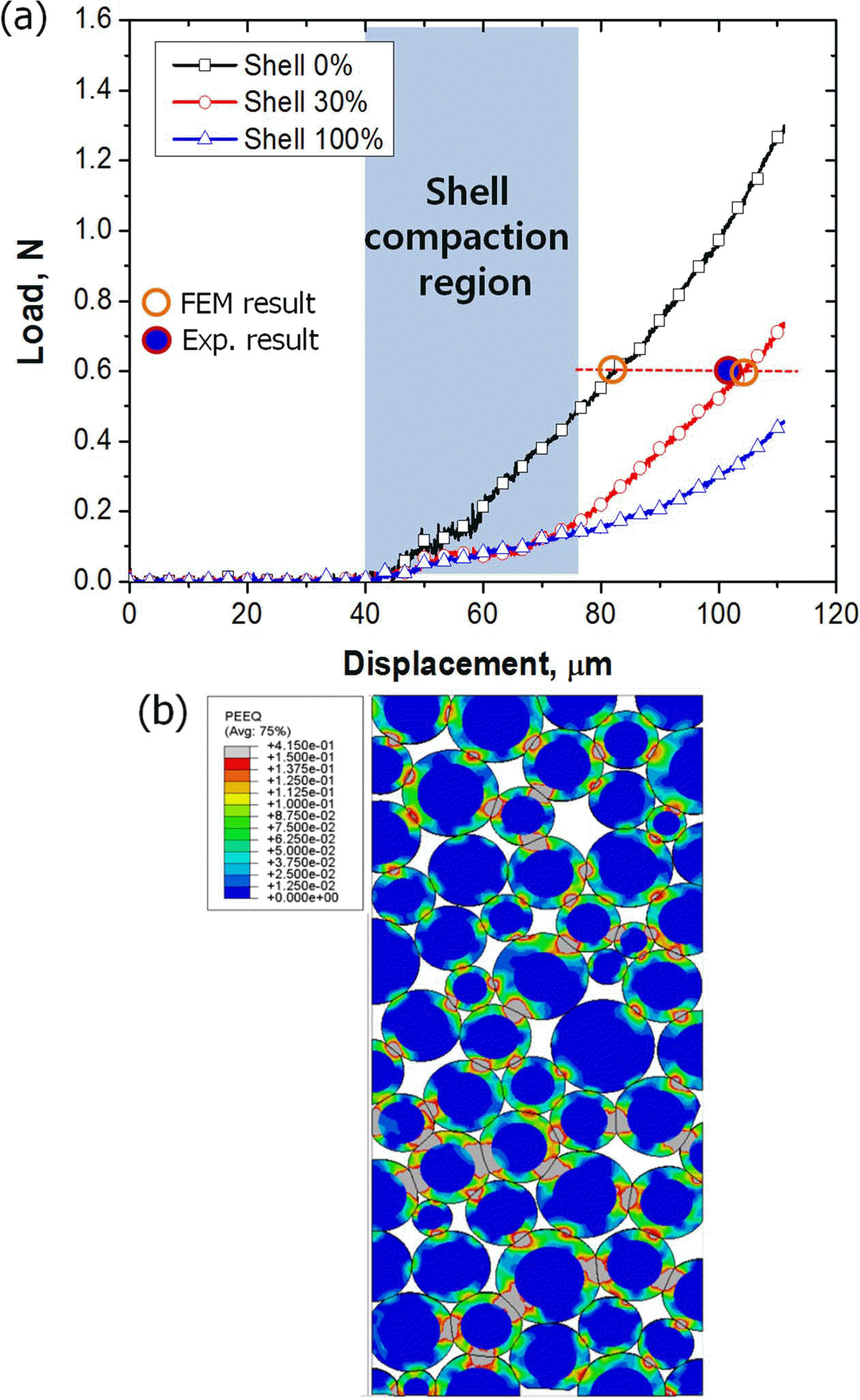
In this study, effect of core-shell structure on compaction behavior of harmonic powder is investigated. Harmonic powders are made by electroless plating method on Fe powders. Softer Cu shell encloses harder Fe core, and the average size of Fe core and thickness of Cu shell are 34.3 μm and 3.2 μm, respectively. The powder compaction procedure is processed with pressure of 600 MPa in a cylindrical die. Due to the low strength of Cu shell regions, the harmonic powders show better densification behavior compared with pure Fe powders. Finite element method (FEM) is performed to understand the roll of core-shell structure. Based on stress and strain distributions of FEM results, it is concluded that the early stage of powder compaction of harmonic powders mainly occurs at the shell region. FEM results also well predict porosity of compacted materials.
- [Korean]
- Prediction of Martensite Fraction in the Sintering Hardening Process of Ni/Mo Alloy Powder (FLC-4608) Using the Finite Element Method
-
Hyo Wook Park, Soo-Hyun Joo, Eon Sik Lee, Ki Hyuk Kwon, Hyong Seop Kim
-
J Korean Powder Metall Inst. 2015;22(1):10-14. Published online February 1, 2015
-
DOI: https://doi.org/10.4150/KPMI.2015.22.1.10
-
-
Abstract
PDF
In recent years, industrial demands for superior mechanical properties of powder metallurgy steel components with low cost are rapidly growing. Sinter hardening that combines sintering and heat treatment in continuous one step is cost-effective. The cooling rate during the sinter hardening process dominates material microstructures, which finally determine the mechanical properties of the parts. This research establishes a numerical model of the relation between various cooling rates and microstructures in a sinter hardenable material. The evolution of a martensitic phase in the treated microstructure during end quench tests using various cooling media of water, oil, and air is predicted from the cooling rate, which is influenced by cooling conditions, using the finite element method simulations. The effects of the cooling condition on the microstructure of the sinter hardening material are found. The obtained limiting size of the sinter hardening part is helpful to design complicate shaped components.
- [English]
- Ultrasonic Nanocrystal Surface Modification of 3D Interconnected Heterostructured Complex Concentrated Alloys Produced by Liquid Metal Dealloying: Microstructural Evolution and Wear Behavior
-
Jumi Choi, Yeji Kim, Munsu Choi, Jae Hyuk Lee, Dong Jun Lee, Auezhan Amanov, Soo-Hyun Joo, Hyoung Seop Kim
-
Received February 20, 2026 Accepted April 20, 2026 Published online April 21, 2026
-
DOI: https://doi.org/10.4150/jpm.2026.00045
-
-
Abstract
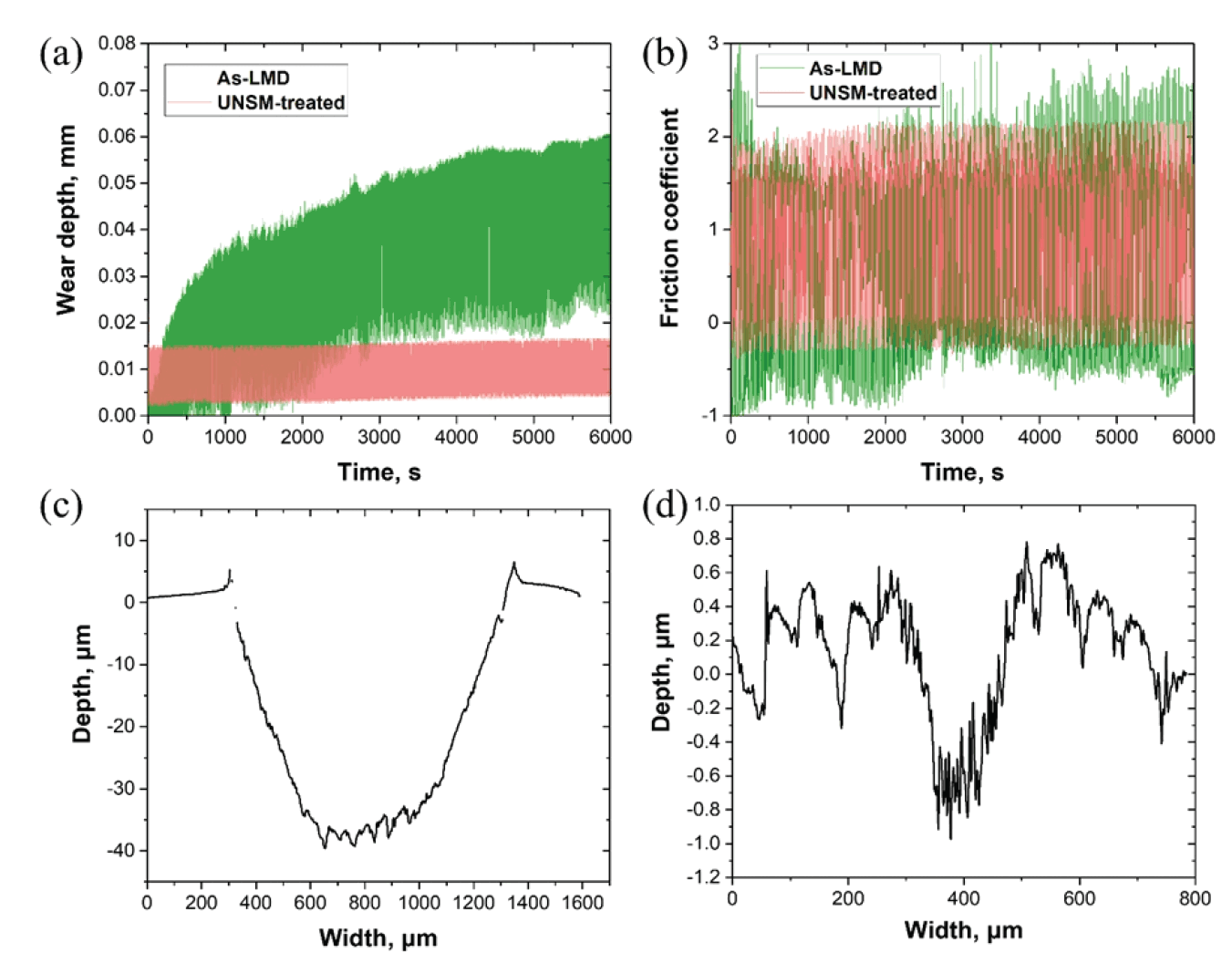
- This study investigates the effects of ultrasonic nanocrystal surface modification (UNSM) on the microstructural evolution and tribological performance of a three-dimensional interconnected heterostructured compositionally complex alloy fabricated by liquid metal dealloying (LMD). The as-LMD microstructure comprises an interconnected Cu-rich phase and a CoCrFe-rich ligament phase. Electron backscatter diffraction reveals pronounced severe plastic deformation near the surface after UNSM, characterized by subgrain formation and increased intragranular misorientation. The kernel average misorientation distribution reveals a pronounced depth-dependent deformation gradient, with dislocations preferentially accumulating at the interphase boundaries. Vickers hardness increases from approximately 100–120 HV in the as-LMD condition to greater than 270 HV at the surface after UNSM, and the hardening effect remains detectable to a depth of approximately 500 μm. Compressive residual stresses are concentrated within the surface-adjacent ~50 μm. The solid ligament phase exhibits higher compressive residual stress than the Cu-rich phase, reflecting phase-dependent deformation accommodation and stress partitioning. Reciprocating wear tests show a narrower wear track, a markedly reduced wear depth, and a lower and more stable friction coefficient after UNSM. Microscopy shows oxide-layer cracking and delamination in the as-LMD condition, whereas the UNSM-treated surface exhibits minor abrasive wear of the tribo-film without delamination.
|
 KPMI
KPMI