 KPMI
KPMI

Search
- Page Path
- HOME > Search
Research Articles
- [English]
- Ultrasonic Nanocrystal Surface Modification of 3D Interconnected Heterostructured Complex Concentrated Alloys Produced by Liquid Metal Dealloying: Microstructural Evolution and Wear Behavior
- Jumi Choi, Yeji Kim, Munsu Choi, Jae Hyuk Lee, Dong Jun Lee, Auezhan Amanov, Soo-Hyun Joo, Hyoung Seop Kim
- J Powder Mater. 2026;33(2):91-103. Published online April 30, 2026
- DOI: https://doi.org/10.4150/jpm.2026.00045
- 1,458 View
- 24 Download
-
 Abstract
 PDF
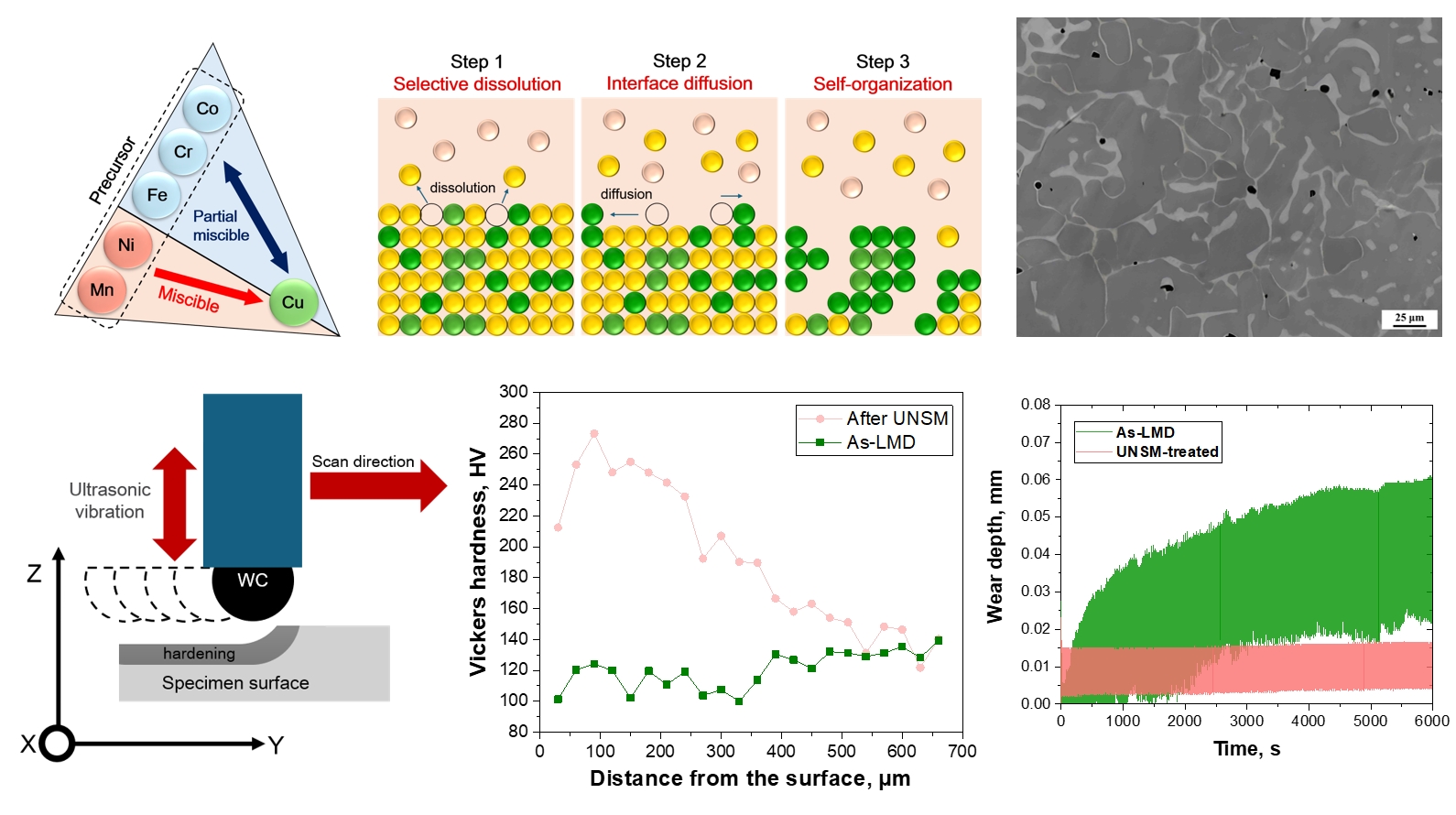
PDF - This study investigates the effects of ultrasonic nanocrystal surface modification (UNSM) on the microstructural evolution and tribological performance of a three-dimensional interconnected heterostructured compositionally complex alloy fabricated by liquid metal dealloying (LMD). The as-LMD microstructure comprises an interconnected Cu-rich phase and a CoCrFe-rich ligament phase. Electron backscatter diffraction reveals pronounced severe plastic deformation near the surface after UNSM, characterized by subgrain formation and increased intragranular misorientation. The kernel average misorientation distribution reveals a pronounced depth-dependent deformation gradient, with dislocations preferentially accumulating at the interphase boundaries. Vickers hardness increases from approximately 100–120 HV in the as-LMD condition to greater than 270 HV at the surface after UNSM, and the hardening effect remains detectable to a depth of approximately 500 μm. Compressive residual stresses are concentrated within the surface-adjacent ~50 μm. The solid ligament phase exhibits higher compressive residual stress than the Cu-rich phase, reflecting phase-dependent deformation accommodation and stress partitioning. Reciprocating wear tests show a narrower wear track, a markedly reduced wear depth, and a lower and more stable friction coefficient after UNSM. Microscopy shows oxide-layer cracking and delamination in the as-LMD condition, whereas the UNSM-treated surface exhibits minor abrasive wear of the tribo-film without delamination.
- [English]
- Self-Assembled Monolayers in Area-Selective Atomic Layer Deposition and Their Challenges
- Si Eun Jung, Ji Woong Shin, Ye Jin Han, Byung Joon Choi
- J Powder Mater. 2025;32(3):179-190. Published online June 30, 2025
- DOI: https://doi.org/10.4150/jpm.2025.00094

- 9,159 View
- 336 Download
- 7 Citations
-
Abstract
PDF
- Area-selective atomic layer deposition (AS-ALD) is a bottom-up process that selectively deposits thin films onto specific areas of a wafer surface. The surface reactions of AS-ALD are controlled by blocking the adsorption of precursors using inhibitors such as self-assembled monolayers (SAMs) or small molecule inhibitors. To increase selectivity during the AS-ALD process, the design of both the inhibitor and the precursor is crucial. Both inhibitors and precursors vary in reactivity and size, and surface reactions are blocked through interactions between precursor molecules and surface functional groups. However, challenges in the conventional SAM-based AS-ALD method include thermal instability and potential damage to substrates during the removal of residual SAMs after the process. To address these issues, recent studies have proposed alternative inhibitors and process design strategies.
-
Citations
Citations to this article as recorded by
- Temperature-Dependent Surface Structural Change in Self-Assembled Monolayers Studied with Vibrational Sum-Frequency Generation and QM/MD Simulation
Hojeong Yoon, Saima Sadiq, Junhyeok Park, Kyungwon Kwak, Minhaeng Cho
The Journal of Physical Chemistry Letters.2026; 17(4): 1119. CrossRef - Vertically Aligned Micro‐ and Nanoneedles for Advanced Biomedical Applications: From Fabrication Strategies to Clinical Translation
Yerim Jang, Sowon Lee, Younghak Cho, Hyejeong Seong
Small Structures.2026;[Epub] CrossRef - Morphology dependent optical properties of inorganic–organic hybrid ZnO thin films
Saleem G. Rao, Muhammad B. Haider, Omar A. Saleh
The European Physical Journal Applied Physics.2026; 101: 5. CrossRef - Backbone‐Length‐Optimized Inhibitors Deliver Long‐Retention Selectivity in Area‐Selective ALD of VO2
Hae Lin Yang, Eun Chong Cho, Minchan Kim, Hye In Park, Ga‐young Lee, Seunghwan Lee, Beomseok Kim, Changhwa Jung, Youngkwon Kim, Jin‐Seong Park
Advanced Science.2026;[Epub] CrossRef - Inducing chemical selectivity in the atomic layer deposition (ALD) of oxide films via gas-phase silylation using N-(trimethylsilyl)dimethylamine (TMSDMA)
Mohammed Sadman Alam, Francisco Zaera
Applied Surface Science.2026; 746: 167569. CrossRef - Fabrication of Multilayer Core-Shell Structure for High Power Factor in Bi2Te2.7Se0.3 Thermoelectrics
Su Min Eun, Jin Kyeong Shin, Se Been Jeong, Eui Seon Lee, Sung-Tag Oh, Byung Joon Choi
Journal of Powder Materials.2026; 33(4): 299. CrossRef - Engineering Chalcogenide Thin Films by Atomic Layer Deposition for Next-Generation Ovonic Threshold Switches
Hyun Wook Kim, Dong Hyun Kim, Yoon Jae Hong, Ju Hwan Park, Byung Joon Choi
Electronic Materials Letters.2026;[Epub] CrossRef
- Temperature-Dependent Surface Structural Change in Self-Assembled Monolayers Studied with Vibrational Sum-Frequency Generation and QM/MD Simulation
 First
First Prev
Prev

TOP

