 KPMI
KPMI

Search
- Page Path
- HOME > Search
- [Korean]
- Aging Temperature Effect on the Microstructure and Mechanical Properties of Directed Energy Deposited Inconel 939 Alloy
- Youngwoo Kim, Ye Chan Sung, Ho Seoung Kang, Jung Gi Kim
- J Powder Mater. 2026;33(3):203-213. Published online June 30, 2026
- DOI: https://doi.org/10.4150/jpm.2026.00115
- 1,271 View
- 35 Download
-
 Abstract
 PDF
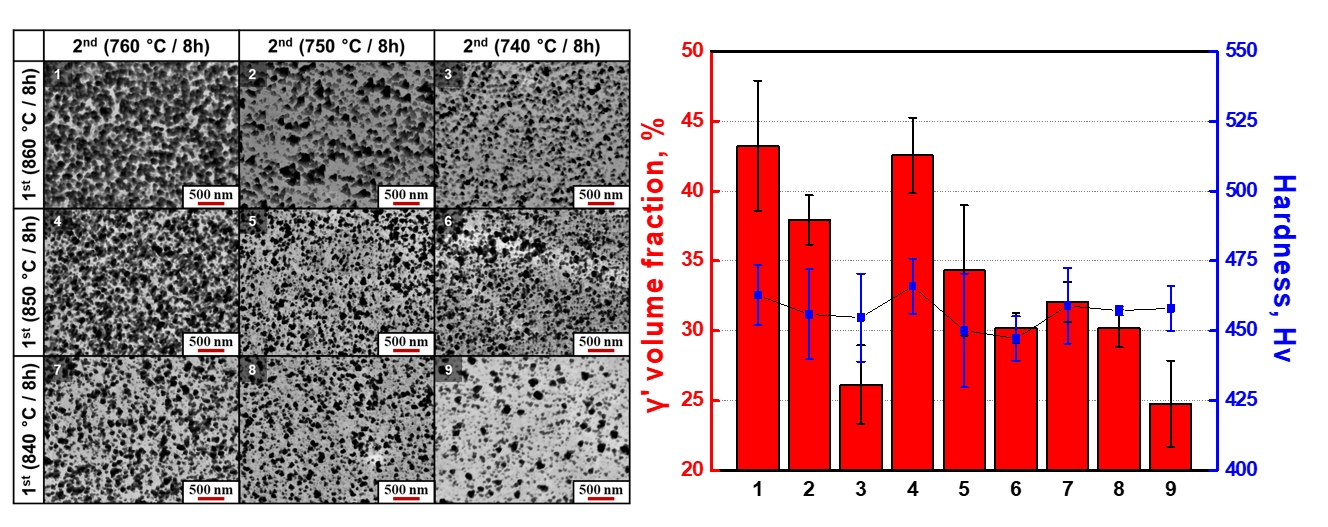
PDF - Directed energy deposition (DED) of Inconel 939 (IN939) alloy is useful for fabricating and repairing geometrically complex components used in gas turbine systems. Repeated laser scanning produces a non-equilibrium microstructure that can support high mechanical strength. However, because the microstructure of DED IN939 differs from that of conventionally manufactured IN939, it may evolve differently under the same post-heat-treatment conditions. Therefore, this study applied different aging temperatures to investigate the microstructural evolution and mechanical properties of DED IN939 alloys and to identify suitable post-heat-treatment conditions. Quantitative microstructural characterization showed that both the γ′ phase fraction and γ′ size increased as the first and second aging temperatures increased. Consistent with γ′ evolution under the different aging conditions, specimen strength was positively correlated with aging temperature, whereas elongation decreased because excessive γ′ formation and growth narrowed the γ′ channel width. Consequently, aging at 840 °C for 8 hours followed by aging at 740 °C for 8 hours provided the best combination of high strength and ductility in room-temperature tensile tests.
- [Korean]
- The Manufacturing Process of Clean Ni-Cr-Co-Based Superalloy Powder Using a Plasma Rotating Electrode
- Kyu-Sik Kim, Dae Woong Kim, Yeontae Kim, Jung Hyo Park
- J Powder Mater. 2025;32(3):222-231. Published online June 30, 2025
- DOI: https://doi.org/10.4150/jpm.2025.00171

- 2,100 View
- 53 Download
- 1 Citations
-
Abstract
PDF
- Ni-based superalloys are widely used for critical components in aerospace, defense, industrial power generation systems, and other applications. Clean superalloy powders and manufacturing processes, such as compaction and hot isostatic pressing, are essential for producing superalloy discs used in turbine engines, which operate under cyclic rotating loads and high-temperature conditions. In this study, the plasma rotating electrode process (PREP), one of the most promising methods for producing clean metallic powders, is employed to fabricate Ni-based superalloy powders. PREP leads to a larger powder size and narrower distribution compared to powders produced by vacuum induction melt gas atomization. An important finding is that highly spheroidized powders almost free of satellites, fractured, and deformed particles can be obtained by PREP, with significantly low oxygen content (approximately 50 ppm). Additionally, large grain size and surface inclusions should be further controlled during the PREP process to produce high-quality powder metallurgy parts.
-
Citations
Citations to this article as recorded by
- Characterization of Hf, Pt-doped NiCoCrAlY powders fabricated via plasma rotating electrode process
Chengxi Wang, Bochun Zhang, Jiale Tian, Peng Song, Taihong Huang, Jilin Lei, Wei Deng, Vincent Ji
Powder Technology.2026; 480: 122628. CrossRef
- Characterization of Hf, Pt-doped NiCoCrAlY powders fabricated via plasma rotating electrode process
- [Korean]
- Evaluation of Mechanical Properties and Microstructure Depending on Sintering Heating Rate of IN 939W Alloy
- Junhyub Jeon, Junho Lee, Namhyuk Seo, Seung Bae Son, Jae-Gil Jung, Seok-Jae Lee
- J Powder Mater. 2022;29(5):399-410. Published online October 1, 2022
- DOI: https://doi.org/10.4150/KPMI.2022.29.5.399
- 2,363 View
- 45 Download
-
Abstract
PDF
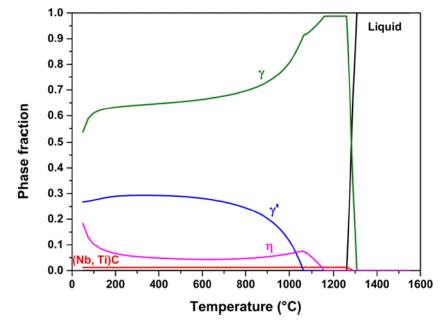
Changes in the mechanical properties and microstructure of an IN 939 W alloy according to the sintering heating rate were evaluated. IN 939 W alloy samples were fabricated by spark plasma sintering. The phase fraction, number density, and mean radius of the IN 939W alloy were calculated using a thermodynamic calculation. A universal testing machine and micro-Vickers hardness tester were employed to confirm the mechanical properties of the IN 939W alloy. X-ray diffraction, optical microscopy, field-emission scanning electron microscopy, Cs-corrected-field emission transmission electron microscopy, and energy dispersive X-ray spectrometry were used to evaluate the microstructure of the alloy. The rapid sintering heating rate resulted in a slightly dispersed γ' phase and chromium oxide. It also suppressed the precipitation of the η phase. These helped to reinforce the mechanical properties.
 First
First Prev
Prev

TOP

