 KPMI
KPMI

Search
- Page Path
- HOME > Search
Research Article
- [English]
- Fabrication of Multilayer Core-Shell Structure for High Power Factor in Bi2Te2.7Se0.3 Thermoelectrics
- Su Min Eun, Jin Kyeong Shin, Se Been Jeong, Eui Seon Lee, Sung-Tag Oh, Byung Joon Choi
- J Powder Mater. 2026;33(4):299-309. Published online August 31, 2026
- DOI: https://doi.org/10.4150/jpm.2026.00192
- 438 View
- 7 Download
-
 Abstract
 PDF
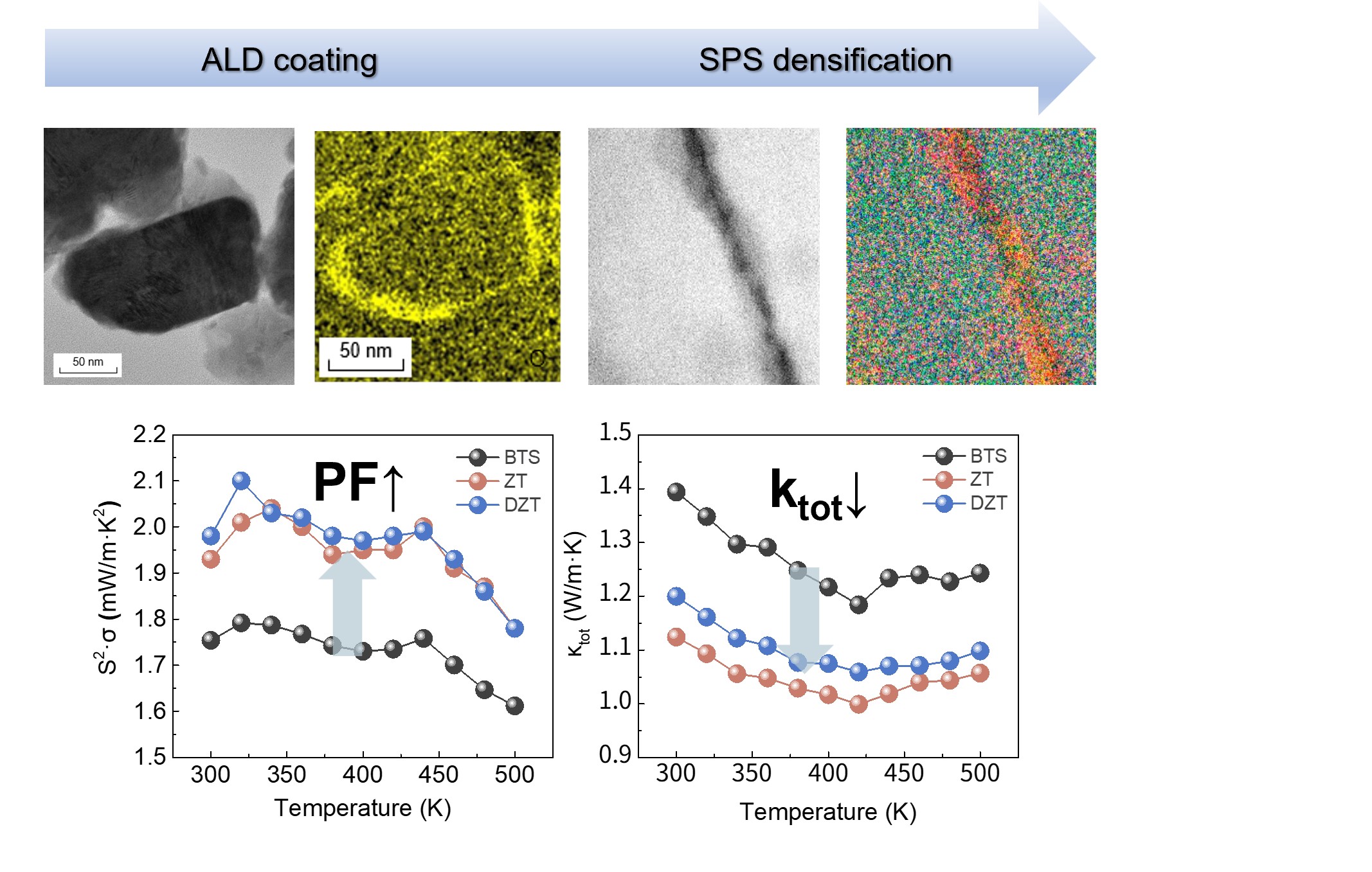
PDF - Bi₂Te₃-based thermoelectric materials are attractive near room temperature, but their performance is constrained by sensitive carrier-concentration control, strong crystallographic anisotropy, and compositional instability from volatile Te. Here, a multilayer core-shell structure was fabricated by conformally coating Bi₂Te₂.₇Se₀.₃ (BTS) powders with ZnO–TiO₂ layers using rotary-type powder atomic layer deposition (pALD), followed by spark plasma sintering. Two configurations with the same ~4 nm total oxide thickness were prepared: a ZnO/TiO₂ bilayer (ZT) and a ZnO/TiO₂/ZnO/TiO₂ multilayer (DZT), where multilayer denotes the deposition scheme rather than a directly imaged layered architecture. Electron microscopy confirmed uniform amorphous shells that were retained as continuous interfacial films after sintering. The oxide interfaces donated electrons to the matrix, raising the carrier concentration and effective mass while preserving mobility and thereby enhancing the electrical conductivity and power factor; simultaneously they scattered phonons and suppressed bipolar conduction, lowering the lattice thermal conductivity. DZT achieved the highest power factor, attributed to its different deposition configuration, whereas ZT exhibited the lowest thermal conductivity; the two coated specimens reached comparable figures of merit (zT) within the measurement uncertainty, both markedly exceeding uncoated BTS. ALD-based interface engineering thus decouples electronic and phononic transport in n-type Bi₂Te₃.
 First
First Prev
Prev

TOP

