 KPMI
KPMI

Search
- Page Path
- HOME > Search
- [English]
- Ultrasonic Nanocrystal Surface Modification of 3D Interconnected Heterostructured Complex Concentrated Alloys Produced by Liquid Metal Dealloying: Microstructural Evolution and Wear Behavior
- Jumi Choi, Yeji Kim, Munsu Choi, Jae Hyuk Lee, Dong Jun Lee, Auezhan Amanov, Soo-Hyun Joo, Hyoung Seop Kim
- J Powder Mater. 2026;33(2):91-103. Published online April 30, 2026
- DOI: https://doi.org/10.4150/jpm.2026.00045
- 1,458 View
- 24 Download
-
 Abstract
 PDF
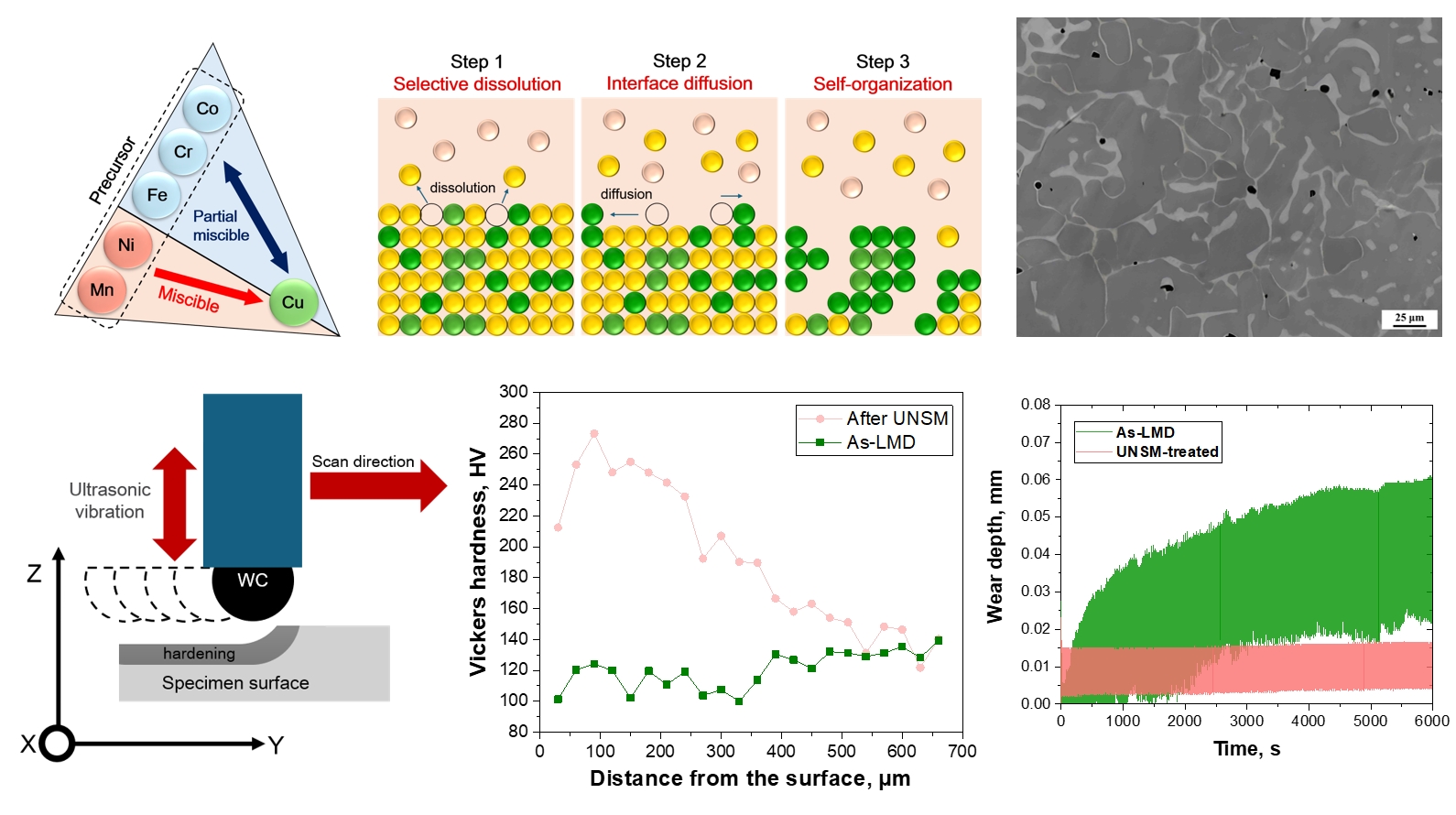
PDF - This study investigates the effects of ultrasonic nanocrystal surface modification (UNSM) on the microstructural evolution and tribological performance of a three-dimensional interconnected heterostructured compositionally complex alloy fabricated by liquid metal dealloying (LMD). The as-LMD microstructure comprises an interconnected Cu-rich phase and a CoCrFe-rich ligament phase. Electron backscatter diffraction reveals pronounced severe plastic deformation near the surface after UNSM, characterized by subgrain formation and increased intragranular misorientation. The kernel average misorientation distribution reveals a pronounced depth-dependent deformation gradient, with dislocations preferentially accumulating at the interphase boundaries. Vickers hardness increases from approximately 100–120 HV in the as-LMD condition to greater than 270 HV at the surface after UNSM, and the hardening effect remains detectable to a depth of approximately 500 μm. Compressive residual stresses are concentrated within the surface-adjacent ~50 μm. The solid ligament phase exhibits higher compressive residual stress than the Cu-rich phase, reflecting phase-dependent deformation accommodation and stress partitioning. Reciprocating wear tests show a narrower wear track, a markedly reduced wear depth, and a lower and more stable friction coefficient after UNSM. Microscopy shows oxide-layer cracking and delamination in the as-LMD condition, whereas the UNSM-treated surface exhibits minor abrasive wear of the tribo-film without delamination.
- [Korean]
- Tribological Behavior Analysis of WC-Ni-Cr + Cr3C2 and WC-Ni-Cr + YSZ Coatings Sprayed by HVOF
- Tae-Jun Park, Gye-Won Lee, Yoon-Suk Oh
- J Powder Mater. 2023;30(5):415-423. Published online October 1, 2023
- DOI: https://doi.org/10.4150/KPMI.2023.30.5.415
- 1,640 View
- 17 Download
-
Abstract
PDF
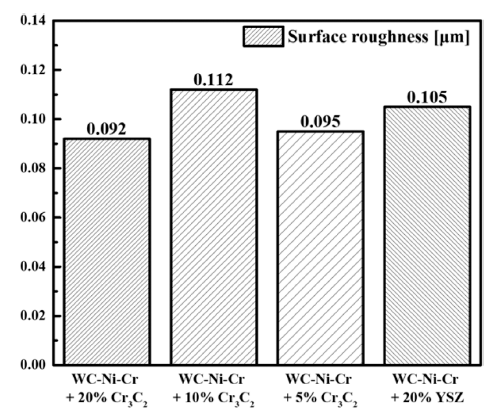
With the increasing attention to environmental pollution caused by particulate matter globally, the automotive industry has also become increasingly interested in particulate matter, especially particulate matter generated by automobile brake systems. Here, we designed a coating composition and analyzed its mechanical properties to reduce particulate matter generated by brake systems during braking of vehicles. We designed a composition to check the mechanical properties change by adding Cr3C2 and YSZ to the WC-Ni-Cr composite composition. Based on the designed composition, coating samples were manufactured, and the coating properties were analyzed by Vickers hardness and ball-on-disk tests. As a result of the experiments, we found that the hardness and friction coefficient of the coating increased as the amount of Cr3C2 added decreased. Furthermore, we found that the hardness of the coating layer decreased when YSZ was added at 20vol%, but the friction coefficient was higher than the composition with Cr3C2 addition.
 First
First Prev
Prev

TOP

