 KPMI
KPMI

Search
- Page Path
- HOME > Search
- [English]
- Fabrication of Multilayer Core-Shell Structure for High Power Factor in Bi2Te2.7Se0.3 Thermoelectrics
- Su Min Eun, Jin Kyeong Shin, Se Been Jeong, Eui Seon Lee, Sung-Tag Oh, Byung Joon Choi
- J Powder Mater. 2026;33(4):299-309. Published online August 31, 2026
- DOI: https://doi.org/10.4150/jpm.2026.00192
- 438 View
- 7 Download
-
 Abstract
 PDF
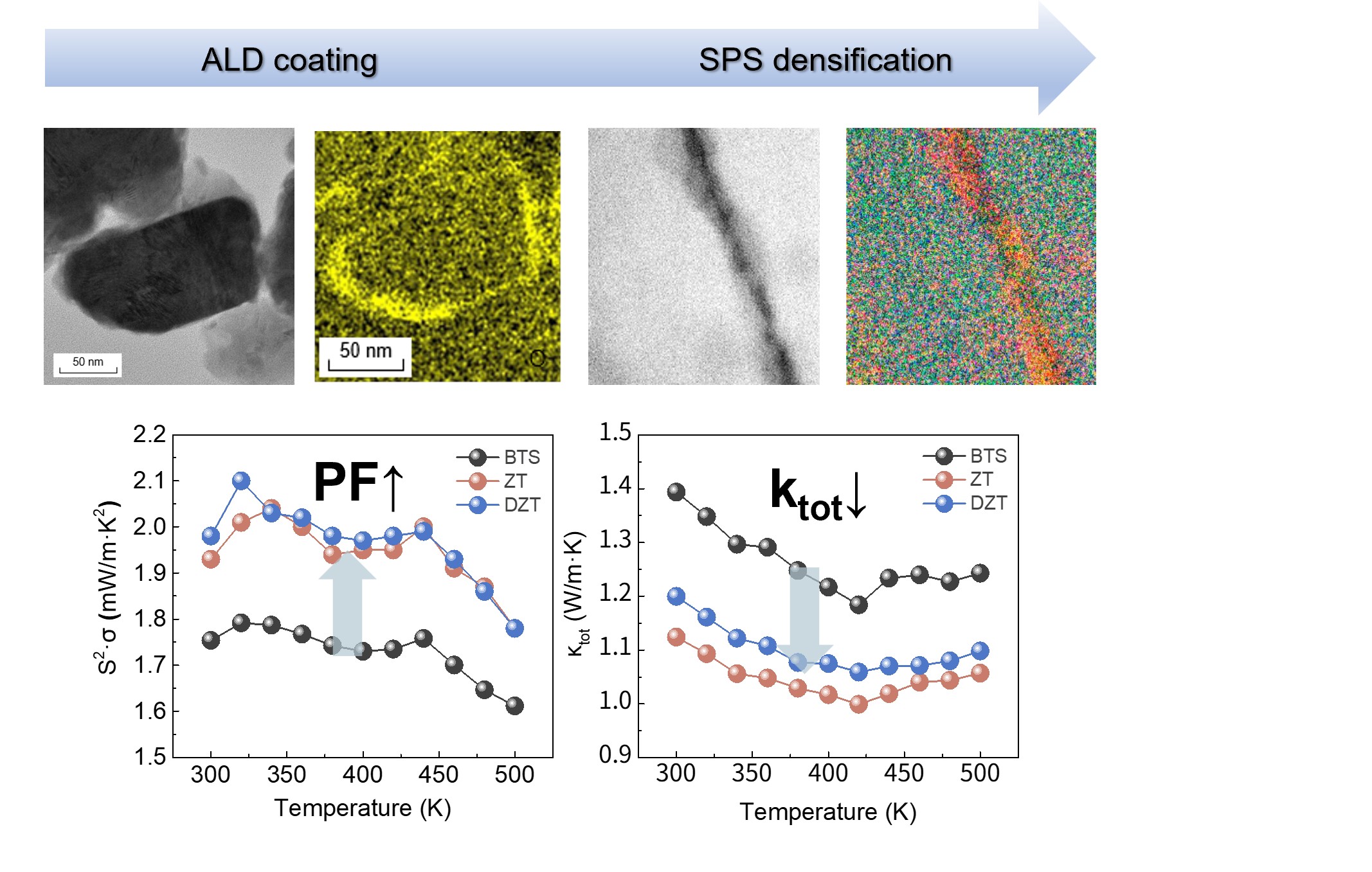
PDF - Bi₂Te₃-based thermoelectric materials are attractive near room temperature, but their performance is constrained by sensitive carrier-concentration control, strong crystallographic anisotropy, and compositional instability from volatile Te. Here, a multilayer core-shell structure was fabricated by conformally coating Bi₂Te₂.₇Se₀.₃ (BTS) powders with ZnO–TiO₂ layers using rotary-type powder atomic layer deposition (pALD), followed by spark plasma sintering. Two configurations with the same ~4 nm total oxide thickness were prepared: a ZnO/TiO₂ bilayer (ZT) and a ZnO/TiO₂/ZnO/TiO₂ multilayer (DZT), where multilayer denotes the deposition scheme rather than a directly imaged layered architecture. Electron microscopy confirmed uniform amorphous shells that were retained as continuous interfacial films after sintering. The oxide interfaces donated electrons to the matrix, raising the carrier concentration and effective mass while preserving mobility and thereby enhancing the electrical conductivity and power factor; simultaneously they scattered phonons and suppressed bipolar conduction, lowering the lattice thermal conductivity. DZT achieved the highest power factor, attributed to its different deposition configuration, whereas ZT exhibited the lowest thermal conductivity; the two coated specimens reached comparable figures of merit (zT) within the measurement uncertainty, both markedly exceeding uncoated BTS. ALD-based interface engineering thus decouples electronic and phononic transport in n-type Bi₂Te₃.
- [Korean]
- Thermoelectric Performance Enhancement of Sintered Bi-Te Pellets by Rotary-type Atomic Layer Deposition
- Myeong Jun Jung, Ji Young Park, Su Min Eun, Byung Joon Choi
- J Powder Mater. 2023;30(2):130-139. Published online April 1, 2023
- DOI: https://doi.org/10.4150/KPMI.2023.30.2.130
- 2,567 View
- 18 Download
- 7 Citations
-
Abstract
PDF
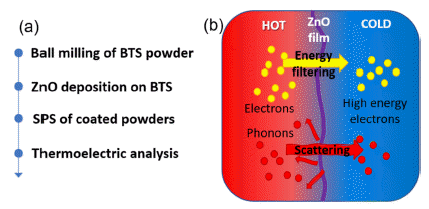
Thermoelectric materials and devices are energy-harvesting devices that can effectively recycle waste heat into electricity. Thermoelectric power generation is widely used in factories, engines, and even in human bodies as they continuously generate heat. However, thermoelectric elements exhibit poor performance and low energy efficiency; research is being conducted to find new materials or improve the thermoelectric performance of existing materials, that is, by ensuring a high figure-of-merit (zT) value. For increasing zT, higher σ (electrical conductivity) and S (Seebeck coefficient) and a lower к (thermal conductivity) are required. Here, interface engineering by atomic layer deposition (ALD) is used to increase zT of n-type BiTeSe (BTS) thermoelectric powders. ALD of the BTS powders is performed in a rotary-type ALD reactor, and 40 to 100 ALD cycles of ZnO thin films are conducted at 100°C. The physical and chemical properties and thermoelectric performance of the ALD-coated BTS powders and pellets are characterized. It is revealed that electrical conductivity and thermal conductivity are decoupled, and thus, zT of ALD-coated BTS pellets is increased by more than 60% compared to that of the uncoated BTS pellets. This result can be utilized in a novel method for improving the thermoelectric efficiency in materials processing.
-
Citations
Citations to this article as recorded by
- Interfacial Characterization of Al2O3-Coated p-Type Bi–Sb–Te Powders by Thermal and UV-assisted Atomic Layer Deposition
Jin Kyeong Shin, Yeongtae Choi, Byung Joon Choi
Journal of Powder Materials.2026; 33(3): 221. CrossRef - Decoupling carrier and phonon scattering in n-type Bi2Te2.7Se0.3 thermoelectrics via atomic layer deposition of TiO2 nanoshells
Su Min Eun, Eui Seon Lee, Sung-Tag Oh, Chanwon Jung, Byung Joon Choi
Journal of Materiomics.2026; 12(5): 101279. CrossRef - Fabrication of Multilayer Core-Shell Structure for High Power Factor in Bi2Te2.7Se0.3 Thermoelectrics
Su Min Eun, Jin Kyeong Shin, Se Been Jeong, Eui Seon Lee, Sung-Tag Oh, Byung Joon Choi
Journal of Powder Materials.2026; 33(4): 299. CrossRef - Highly deformable and hierarchical 3D composite sponge for versatile thermoelectric energy conversion
Jong Min Park, Changyeon Baek, Min-Ku Lee, Nagamalleswara Rao Alluri, Gyoung-Ja Lee, Kyung Tae Kim, Kwi-Il Park
Applied Surface Science.2025; 692: 162730. CrossRef - Thermal Confinement and Filtering Effect of SnSe by Insertion of Atomic-Layer-Deposited ZnO Interfacial Layer
Myeong Jun Jung, Su Min Eun, Hogyoung Kim, Seong Keun Kim, Jongmin Byun, Byung Joon Choi
Korean Journal of Chemical Engineering.2025; 42(14): 3545. CrossRef - Investigation of the Thermal-to-Electrical Properties of Transition Metal-Sb Alloys Synthesized for Thermoelectric Applications
Jong Min Park, Seungki Jo, Sooho Jung, Jinhee Bae, Linh Ba Vu, Kwi-Il Park, Kyung Tae Kim
journal of Korean Powder Metallurgy Institute.2024; 31(3): 236. CrossRef - Enhancing Electrical Properties of N-type Bismuth Telluride Alloys through Graphene Oxide Incorporation in Extrusion 3D Printing
Jinhee Bae, Seungki Jo, Kyung Tae Kim
journal of Korean Powder Metallurgy Institute.2023; 30(4): 318. CrossRef
- Interfacial Characterization of Al2O3-Coated p-Type Bi–Sb–Te Powders by Thermal and UV-assisted Atomic Layer Deposition
 First
First Prev
Prev

TOP

