 KPMI
KPMI

Articles
- Page Path
- HOME > J Powder Mater > Volume 33(3); 2026 > Article
-
Research Article
- A Powder-Metallurgical Route to Ag2(Te,S) Compounds and Their Thermoelectric Properties
- Seungki Jo,*,†, Yoojeong Ji,†, Linh Ba Vu, Kyung Tae Kim
-
Journal of Powder Materials 2026;33(3):214-220.
DOI: https://doi.org/10.4150/jpm.2026.00122
Published online: June 30, 2026
Nano Materials Division, Korea Institute of Materials Science, Changwon 51508, Republic of Korea
- *Corresponding author: Seungki Jo E-mail: seungkijo@kims.re.kr
- †These authors equally contributed to this work
© The Korean Powder Metallurgy & Materials Institute
This is an Open Access article distributed under the terms of the Creative Commons Attribution Non-Commercial License (http://creativecommons.org/licenses/by-nc/4.0/) which permits unrestricted non-commercial use, distribution, and reproduction in any medium, provided the original work is properly cited.
- 1,051 Views
- 16 Download

Abstract
- Silver chalcogenides have attracted considerable attention as promising materials for wearable power generation because they combine mechanical ductility with favorable thermoelectric properties. However, most reported synthesis methods rely on high-temperature melting and annealing, which offer limited microstructural control and therefore restrict opportunities for further performance improvement. In this study, Ag2S0.4Te0.6 compounds were synthesized through a powder-metallurgical route that combined mechanical alloying with rapid densification by spark plasma sintering. Ball milling produced amorphized microscale powders, which were successfully consolidated at different sintering temperatures. The sample sintered at 600 °C exhibited the highest power factor, mainly because of its optimized electrical transport properties, and achieved zT values of approximately 0.32 near room temperature and approximately 0.50 at 473 K. These results indicate that powder-metallurgical processing is a viable strategy for tailoring transport properties and improving the thermoelectric performance of silver chalcogenide materials for wearable applications.
- Silver chalcogenides have emerged as a unique class of inorganic semiconductors that simultaneously exhibit favorable electronic transport properties and exceptional mechanical deformability. This rare combination distinguishes them from conventional brittle inorganic semiconductors and opens new opportunities for flexible and wearable electronics [1-5]. In particular, Ag2(S,Se,Te)-based compounds have attracted increasing attention as promising thermoelectric (TE) materials for self-powered wearable electronics [6-10]. For wearable applications, room-temperature TE performance is especially important. However, the room-temperature TE properties of Ag2(S,Se,Te) compounds remain insufficient, while their peak TE performance is typically achieved in the mid-temperature range of 700–800 K [11, 12].
- The performance of a TE material is evaluated by the dimensionless figure of merit, zT = S2σT/(κe+ κL), where S, σ, T, κe and κL are the Seebeck coefficient, electrical conductivity, absolute temperature, electronic thermal conductivity, and lattice thermal conductivity, respectively. An ideal thermoelectric material should generate a large electrical power output from a small temperature difference while maintaining the temperature gradient within the material. However, improving zT is not straightforward because the key transport parameters of S, σ and κe are strongly coupled through carrier density [13, 14]. A broad range of design strategies have been developed to address this intrinsic trade-off, including energy-dependent carrier scattering [15-17], modulation doping [18-20], nanostructuring [21-23], and hierarchical structuring [24-26]. These strategies aim to selectively manipulate carrier and phonon transport, thereby improving the power factor and/or reducing lattice thermal conductivity without offsetting the performance gain through the deterioration of other transport parameters. Although such approaches have been successfully applied to a wide range of TE material systems, their use in silver chalcogenide-based materials remains underexplored. This is closely associated with the conventional melting-annealing synthesis route, which makes bottom-up structural design challenging. Consequently, previous studies on Ag2(S,Se,Te)-based materials have mainly relied on compositional tuning to optimize TE performance and mechanical ductility [27-29].
- In contrast, powder-based processing offers a promising route to manipulate microstructures beyond simple compositional control. Through mesoscale powder synthesis and subsequent sintering, key microstructural features such as grain size, grain-boundary density, defect distribution, and secondary phases can be systematically introduced and controlled [30, 31]. In this regard, establishing a reliable powder synthesis and consolidation route for Ag chalcogenides is not merely an alternative to conventional melting-based processing; rather, it may provide a new pathway for enhancing TE performance. In this study, we develop a powder metallurgical route to Ag2(Te,S) compounds and investigate their TE properties. Mechanical alloying by ball milling enables the synthesis of powders with an average particle size of ~10 μm. The as-milled powders mainly consist of an amorphous phase with a minor Ag2Te phase, which subsequently transforms into a cubic Ag2S-based phase after heat treatment. The powders are successfully consolidated via spark plasma sintering and the TE properties of the sintered Ag2(Te,S) compounds are investigated as a function of sintering temperature. As the sintering temperature increases, the TE performance improves, with the sample sintered at 600 °C showing the highest zT values of ~0.33 near room temperature and ~0.5 at 500 K. These results demonstrate that powder-based processing provides an additional degree of freedom for tailoring TE transport properties, offering a viable pathway toward performance enhancement in silver chalcogenide materials through microstructure engineering.
1. Introduction
- 2.1 Synthesis
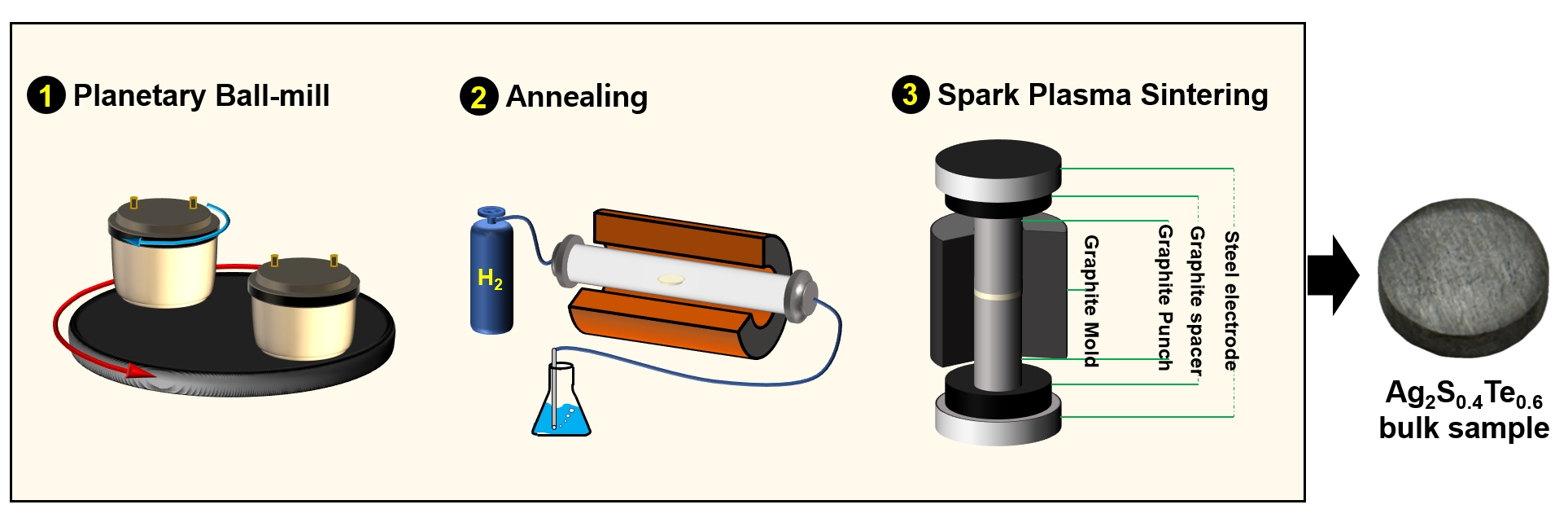
- Ag2Te0.6S0.4 powders were prepared by mechanical alloying using elemental powers of Ag (99.9%, Alfa-Aesar, USA), Te (99.999%, Taewon Scientific, Korea), and S (99.99%, Kojundo Chemical, Japan). Planetary ball milling was performed at 310 rpm for 9 h using a Fritsch Pulverisette 5 (Germany). The milling process consisted of repeated cycles of 15 min milling followed by 2 min pause, for a total 31 cycles. To minimize oxidation during powder preparation, all procedures were carried out in a nitrogen-filled glove box. The as-synthesized powders were heat-treated at 350 °C for 3 hours under hydrogen atmosphere. The heat-treated powders were then sintered by spark plasma sintering (SPS) under a uniaxial pressure of 50 MPa at 400, 500, and 600 °C.
- 2.2 Measurement
- The particle size distribution of the powders was measured using a laser particle size analyzer (Partica LA-960V2, HORIBA, Japan). The particle morphology, microstructure, and composition of the powders were examined by field-emission scanning electron microscopy (FE-SEM, JIB-4601F, JEOL, Japan) equipped with energy-dispersive X-ray spectroscopy (EDS). The crystalline phases were identified by X-ray diffraction (XRD) using Cu Kα1 radiation (SmartLab XE 9 kW, Rigaku, Japan). The temperature-dependent Seebeck coefficient and electrical conductivity were measured using a commercial equipment system (SBA458 Nemesis, Netzsch, Germany). The Hall carrier concentration and Hall mobility were measured at room temperature using a van der Pauw configuration (AHT55T3, ECOPIA, Republic of Korea). The thermal diffusivity (D) was measured using laser flash method (LFA467, Netzsch, Germany). The density of the samples was determined using the Archimedes method, and the specific heat capacity (Cp) was determined based on the Dulong-Petit approximation.
2. Experimental Section
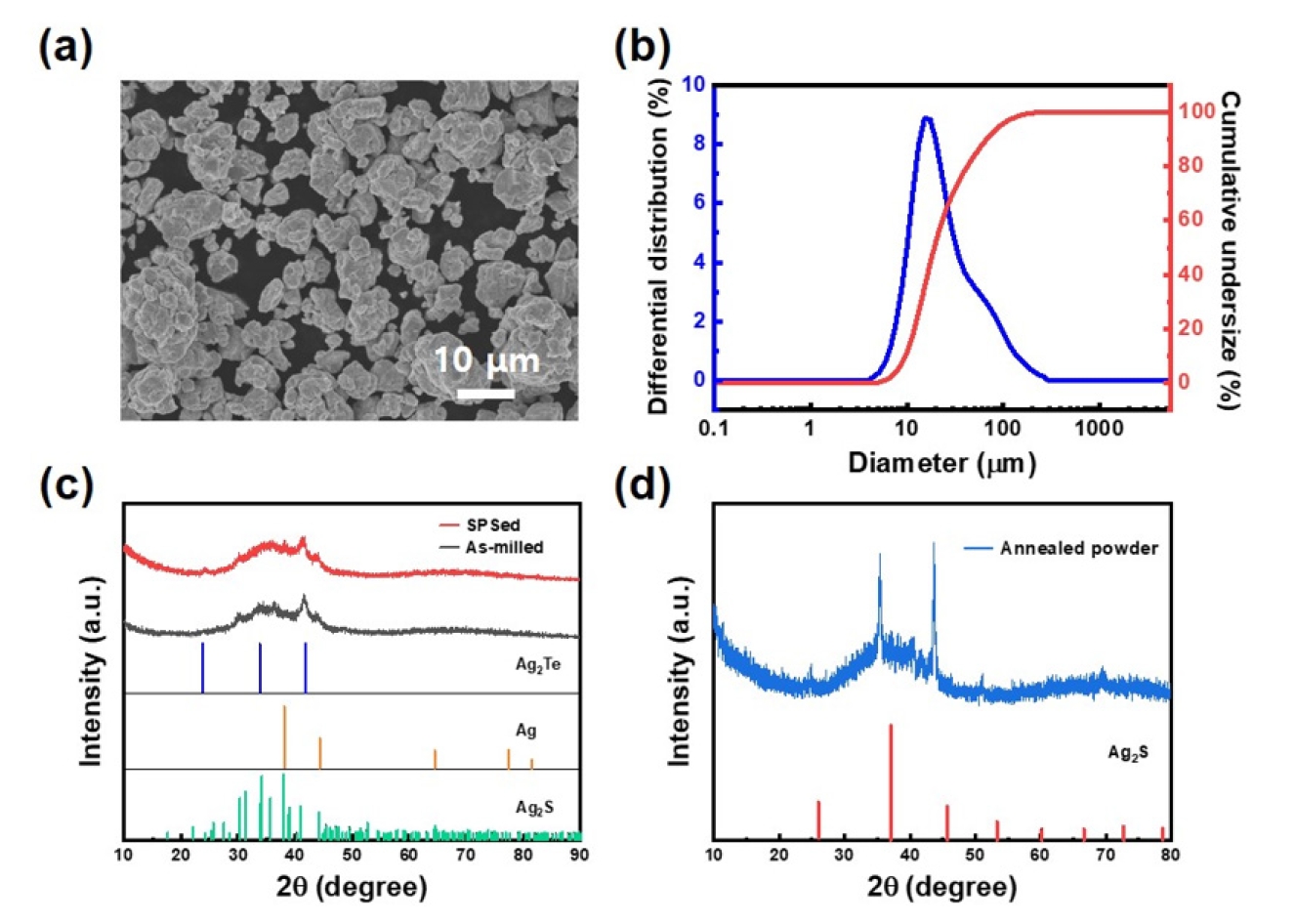
- Fig. 1(a) shows the SEM image of the Ag2Te0.6S0.4 powder prepared by ball-milling. The powder consists of irregularly shaped particles with sizes ranging from several micrometers to several tens of micrometers. The particles exhibit typical features of mechanically alloyed powders including rough surfaces and angular morphologies. SEM-EDS analysis revealed that the powder has an elemental composition of Ag 70.65 at.%, Te 18.23 at.%, and S 11.21 at.%. Compared with the nominal composition, the chalcogen content was slightly deficient, which might be attributed to partial loss during the ball-milling process. The particle size distribution in Fig. 1(b) further confirms that most of the ball-milled powder are distributed in the range of 10–100 μm. The distribution shows a unimodal profile, indicating that the milling process produced a relatively uniform powder population without distinct secondary particle-size groups. Such a narrow particle size distribution is beneficial for sintering because it can favor homogeneous packing and uniform consolidation [32]. The weak tail extending into the larger particle-size region is likely associated with incomplete pulverization or powder agglomeration. This behavior may originate from the ductile nature of the Ag2S-based compounds [1], which can undergo plastic deformation and cold welding rather than complete brittle fracture during ball milling. Fig. 1(c) presents the XRD pattern of the Ag2Te0.6S0.4 ball-milled powder. The as-milled powder mainly exhibits a broad diffuse diffraction feature, indicating that the powder is largely amorphized during the milling process. Only weak crystalline reflections corresponding to the Ag2Te phase were observed. This amorphization is attributed to the severe powder deformation caused by the intensive mechanical energy applied during ball-milling. This behavior is consistent with the sublattice-amorphization-mediated deformation mechanism, in which mechanically applied strain induces disordering of the Te/S sublattice, while diffusive Ag ions continue to bond with Te/S atoms, thereby accommodating plastic deformation [33]. After heat treatment, the amorphous phase crystallized, as confirmed by the XRD result in Fig. 1(d). The diffraction peaks after heat treatment are mainly indexed to the cubic Ag2S phase, indicating that thermal energy promotes structural rearrangement and crystallization [33, 34]. After consolidation by SPS, XRD pattern becomes amorphous again, which could be attributed to severe deformation induced by high uniaxial pressure applied during the sintering process.
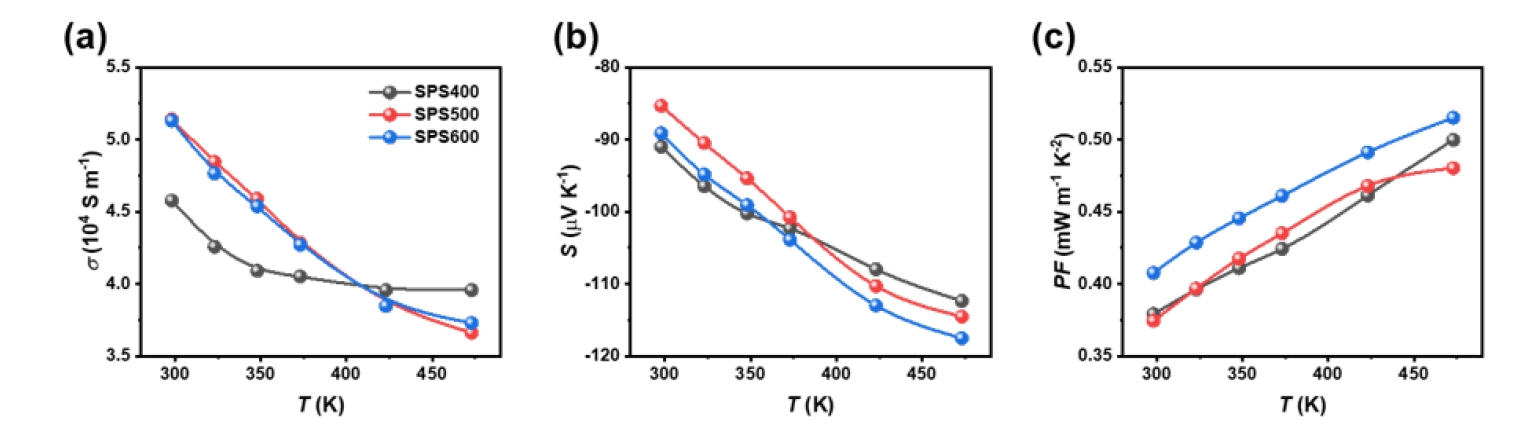
- The ball-milled powders were consolidated by SPS at temperatures ranging from 400 to 600 °C, and the electrical properties of the sintered samples were measured as a function of sintering temperature (Fig. 2). The samples sintered at 400, 500, and 600 °C are denoted as SPS400, SPS500, and SPS600, respectively. Fig. 2(a) shows the temperature-dependent electrical conductivity (σ) of the samples. The σ decreases with increasing temperature over the measured temperature range, which is typical behavior of degenerate semiconductors. As the sintering temperature increases from 400 to 500 °C, the σ increases noticeably. In contrast, the SPS600 sample exhibits σ comparable to that of SPS500. Fig. 2(b) presents the temperature-dependent Seebeck coefficients (S) of the sintered samples. The S are negative for all samples, indicating that electrons are the dominant charge carriers. The absolute values of the S are similar among the samples. The magnitude of the S gradually increases with increasing temperature, without a noticeable suppression at elevated temperature, suggesting that bipolar contribution to electrical transport properties is not significant within measured temperature range [35]. The calculated power factor (PF = S2σ) is shown in Fig. 2(c). The PF increases with increasing temperature for all samples and the SPS600 exhibits the highest PF, reaching ~0.51 mW m-1 K-2 at 475 K.
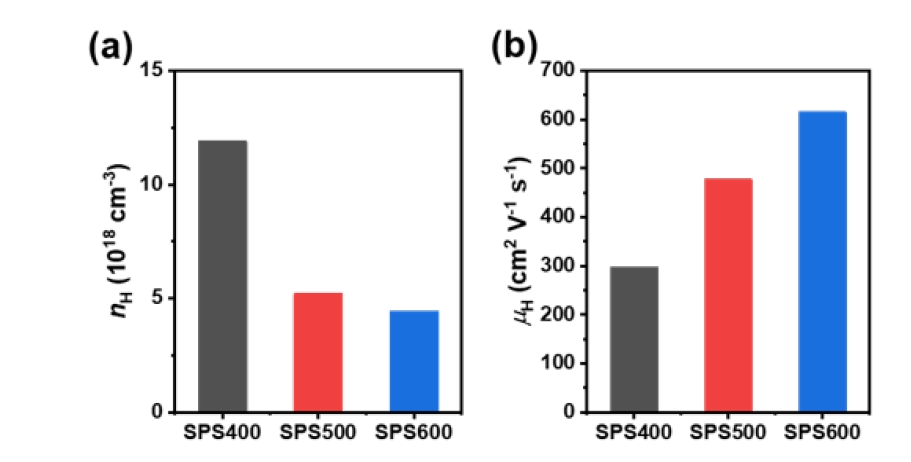
- To clarify the origin of the change in electrical properties, Hall measurements were performed at room temperature (Fig. 3). The Hall carrier concentration (nH) decreases with increasing sintering temperature, while the Hall carrier mobility (μH) increases. This trend indicates that the enhanced σ observed in Fig. 2 is attributed to the increase in μH, compensating for the reduced nH and lead to higher σ. Based on the decrease in nH, the magnitude of the S would generally be expected to increase with increasing sintering temperature. However, the SPS400 sample exhibits the largest S, suggesting that electronic band structure might be changed depending on the sintering temperature. The electrical properties are optimized in the SPS600 through a favorable balance among nH, μH, and S. The significant increase in μH leads to improved σ, while the S remains sufficiently high. Consequently, SPS600 exhibits the highest PF among the samples. These results demonstrate that sintering temperature plays an important role in optimizing the electronic transport properties of polycrystalline Ag2(Te,S) compounds.
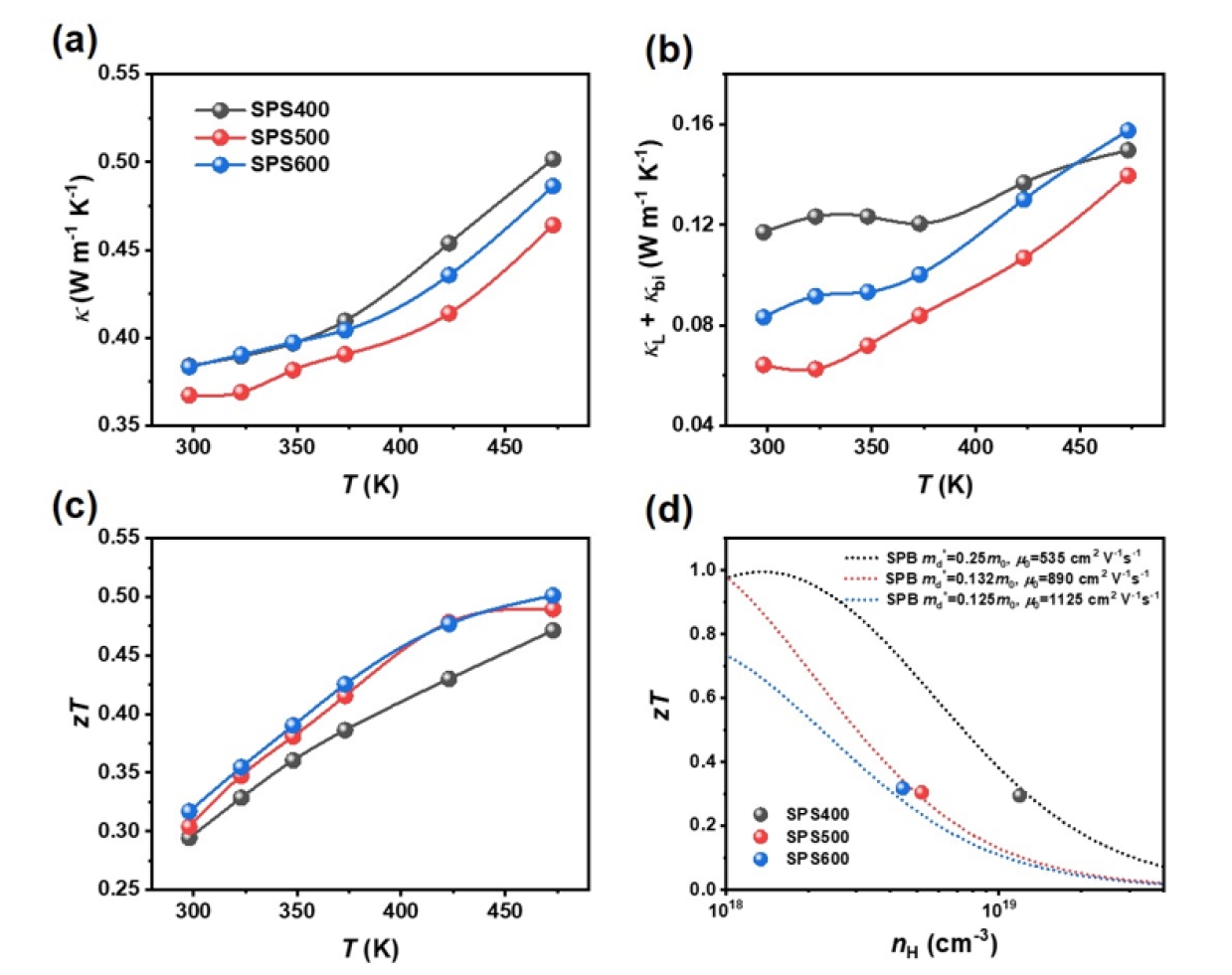
- The thermal properties of the SPSed Ag2Te0.6S0.4 samples were investigated as shown in Fig. 4. Fig. 4(a) presents the temperature-dependent κ of the samples. The κ shows no significant difference among samples and gradually increases with increasing temperature over the measured temperature range. To separate the lattice contribution from the κ, the electronic thermal conductivity (κe) was estimated using the Wiedemann-Franz law, κe = LσT, where L is the Lorenz number. L was determined using an equation proposed by Kim et al., where L is in 10‒8 W Ω K‒2 [36].
- The non-electronic thermal conductivity (κL + κbi), where κbi is bipolar thermal conductivity, was then calculated by subtracting the electronic contribution from the κ. Fig. 4(b) shows the resulting κL + κbi of the sintered samples. The SPS500 exhibits the lowest value over the measured temperature range. The differences in κL + κbi among the samples are relatively moderate, suggesting that the variation in TE performance is more strongly governed by the electrical properties than by thermal conductance.
- Fig. 4(c) shows the temperature-dependent zT values calculated from the experimentally obtained σ, S, and κ. The zT values increase with increasing temperature for all samples, primarily due to the increased PF at elevated temperatures. The SPS600 exhibits the highest zT over most of the measured temperature range, reaching ~0.32 at room temperature and ~0.50 at 473 K. This is mainly attributed to the optimized electronic transport properties of SPS600, particularly its enhanced μH and high PF, while maintaining a comparable κ to the others. To evaluate the nH dependence of TE performance, the relationship between nH and zT was analyzed using following equations based on a single parabolic band (SPB) model under the assumption of dominant acoustic phonon scattering (Fig. 4(d)).
- First, η, md⁎, and μ0 were estimated from equation (2)–(8) using the experimentally measured nH, μH, and S. The η was then varied over a wide range to calculate the corresponding nH, S, μH, σ, L, κe, and zT values, with κe = LσT and κL fixed to the experimentally measured value at room temperature. It should be noted that the L values used here were theoretically obtained from the SPB model and differ from those calculated using Eq. (1). Here, η, md⁎, μ0, kB, h and e are the reduced Fermi energy, density of state effective mass, non-degenerate mobility, Boltzmann constant, Planck’s constant and elementary charge, respectively. The Fermi integral of order n, Fn, is define as
- , where ε is reduce carrier energy. The calculated nH-zT curve indicates that the nH are far from the optimal range for maximizing zT. This result suggests that the present samples are not yet fully optimized in terms of carrier concentration. Therefore, precise control over carrier concentration are required to further enhance zT. Overall, powder-based processing successfully synthesized Ag2(Te,S) compounds with moderate zT values; however, carrier density optimization is necessary to achieve performance levels suitable for wearable TE applications. In particular, powder metallurgical processing may provide an effective route for further improving the room-temperature TE performance of silver chalcogenide-based materials.
3. Results and Discussion
- In this study, a powder metallurgical route was developed to synthesize Ag2(Te,S) compounds and their thermoelectric properties were investigated as a function of sintering temperature. The ball-milling process successfully produced amorphized Ag2Te0.6S0.4 powders with a particle size distributed in the range of 10–100 μm. The ball-milled powders were consolidated by SPS at different sintering temperatures, demonstrating the feasibility of powder-based processing for Ag chalcogenide compounds. Increasing the sintering temperature enhanced the Hall mobility, compensating for decrease in the Hall carrier concentration, resulting in improved electrical conductivity and power factor. The thermal conductivity showed no significant variation among the samples with different sintering temperatures. Consequently, the SPS600 sample achieved the highest zT values of ~0.32 near room temperature and ~0.50 at 473 K mainly due to optimized electrical properties. SPB model analysis indicated that the carrier concentration of the present samples deviates significant from the optimal range for maximum zT. Therefore, further optimization of carrier concentration is required to enhance the thermoelectric performance of powder-processed Ag2(Te,S) compounds.
4. Conclusion
-
Funding
This work was supported by the Principal R&D Program of the Korea Institute of Materials Science (KIMS) (Project No. PNKB270) and by a National Research Foundation of Korea (NRF) grant funded by the Korean government (RS-2024-00448499).
-
Conflict of Interest
K. T. Kim serves as an editor of the Journal of Powder Materials, but have no role in the decision to publish this article. Except for this, the authors have no conflicts of interest to declare.
-
Data Availability Statement
All dataset files used in this study are available on request.
-
Author Information and Contribution
Seungki Jo and Yoojeong Ji equally contributed to this work. Seungki Jo: Senior Researcher (Ph.D); Conceptualization, Methodology, Investigation, Writing–original draft, Writing – review&editing, Supervision, Yoojeong Ji: M.S. Candidate; Methodology, Investigation, Data Curation, Formal analysis, Writing – original draft, Linh Ba Vu: Investigation, Data Curation, Kyung Tae Kim: Principal Researcher (Ph.D); Funding acquisition, Supervision, Project administration, Writing – review & editing.
-
Acknowledgments
None.
Article information
- 1. X. Shi, H. Chen, F. Hao, R. Liu, T. Wang, P. Qiu, U. Burkhardt, Y. Grin and L. Chen: Nat. Mater., 17 (2018) 421.ArticlePDF
- 2. S. Jo, S. Cho, U. J. Yang, G.-S. Hwang, S. Baek, S.-H. Kim, S. H. Heo, J.-Y. Kim, M. K. Choi and J. S. Son: Adv. Mater., 33 (2021) 2100066.Article
- 3. D.-H. Kim and G. D. Cha: Nat. Mater., 17 (2018) 385.Article
- 4. A. Guo, K. Liu, Z. Wang, L. Yu, Y. Li, L. Liao, D. Yang, X. Su, X. Sang, X. Tang, Q. Zhang and J. Wu: Nat. Commun., 17 (2026) 2416.Article
- 5. E. Jiang, H. Wang, K. Fang, Z. Xia, C. Xiao, X. Feng, B. Duan, G. Li, P. Zhai and Q. Zhang: Scr. Mater., 276 (2026) 117205.Article
- 6. L. Wei, T. Dong, Y. Cui, S. Zhu and J. Si: J. Mater. Sci.: Mater. Electron., 35 (2024) 1965.Article
- 7. J. Liang, T. Wang, P. Qiu, S. Yang, C. Ming, H. Chen, Q. Song, K. Zhao, T.-R. Wei, D. Ren, Y.-Y. Sun, X. Shi, J. He and L. Chen: Energy Environ. Sci., 12 (2019) 2983.ArticlePDF
- 8. J. Liang, X. Zhang and C. Wan: ACS Appl. Mater. Interfaces, 14 (2022) 52017.ArticlePDF
- 9. Y. Fu, S. Kang, H. Gu, L. Tan, C. Gao, Z. Fang, S. Dai and C. Lin;: Adv. Sci., 10 (2023) 2207642.Article
- 10. Q. Yang, S. Yang, P. Qiu, L. Peng, T.-R. Wei, Z. Zhang, X. Shi and L. Chen: Science, 377 (2022) 854.Article
- 11. P. Qiu, T. Deng, L. Chen and X. Shi: Joule, 8 (2024) 622.Article
- 12. T.-R. Wei, P. Qiu, K. Zhao, X. Shi and L. Chen: Adv. Mater., 35 (2023) 2110236.Article
- 13. L. B. Vu, S.-h. Jung, J. Bae, J. M. Park, K. T. Kim, I. Son and S. Jo: J. Powder Mater., 31 (2024) 119.ArticlePDF
- 14. M. A. Okirigiti, C. M. Kim, H. Choi, N. R. Alluri and K.-I. Park: J. Powder Mater., 32 (2025) 1.ArticlePDF
- 15. S. Jo, S. H. Park, H. W. Ban, D. H. Gu, B.-S. Kim, J. H. Son, H.-K. Hong, Z. Lee, H.-S. Han, W. Jo, J. E. Lee and J. S. Son: J. Alloy. Compd., 689 (2016) 899.Article
- 16. Q. Cheng, H. Sun, Z. Yu, G. Luo, Y. Qi, Y. Yuan, B. Huang, Y. Wang and H. Zhou: Nano Energy, 146 (2025) 111560.Article
- 17. C. Gayner and Y. Amouyal: Adv. Funct. Mater., 30 (2020) 1901789.Article
- 18. J. Zheng, S. Wang, Z. Zhao, X. Gao, T. Hong and L.-D. Zhao: Adv. Funct. Mater., 33 (2023) 2300447.Article
- 19. Q. Xiong, G. Han, G. Wang, X. Lu and X. Zhou: Adv. Funct. Mater., 34 (2024) 2411304.Article
- 20. C.-L. Chen, T.-H. Wang, Z.-G. Yu, Y. Hutabalian, R. K. Vankayala, C.-C. Chen, W.-P. Hsieh, H.-T. Jeng, D.-H. Wei and Y.-Y. Chen: Adv. Sci., 9 (2022) 2201353.Article
- 21. F. Li, H. Wang, R. Huang, W. Chen and H. Zhang: Adv. Funct. Mater., 32 (2022) 2200516.Article
- 22. C. Gayner, L. T. Menezes, Y. Natanzon, Y. Kauffmann, H. Kleinke and Y. Amouyal: ACS Appl. Mater. Interfaces, 15 (2023) 13012.ArticlePDF
- 23. S. Chandra, U. Bhat, P. Dutta, A. Bhardwaj, R. Datta and K. Biswas: Adv. Mater., 34 (2022) 2203725.Article
- 24. Y.-Z. Li, Q. Zhang, K. Liu, Y.-J. Lin, N. Lin, Y. Yu, F. Liu, X.-B. Zhao, B.-H. Ge, O. Cojocaru-Miredin, C.-G. Fu and T.-J. Zhu: Mater. Today Nano, 22 (2023) 100340.Article
- 25. P. Kitthonbancha, W.-D. Liu, M. Li, S. Pinitsoontorn and Z.-G. Chen: Small, 21 (2025) 2411798.Article
- 26. S. Zulkifal, S. Siddique, Z. Wang, X. Zhang, X. Huang, Q. Xia, Q. Zhang, S. Li, P. Wang, D. Li, P. Ying, Y. Zhang and G. Tang: Small, 20 (2024) 2310123.Article
- 27. H. Wuliji, K. Zhao, H. Jing, R. Ouyang, Y. Yang, T.-R. Wei, H. Zhu and X. Shi: J. Materiomics., 10 (2024) 1270.Article
- 28. Z. Li, J. Zhang, P. Luo, J. Chen, B. Huang, Y. Sun and J. Luo: ACS Appl. Mater. Interfaces, 15 (2023) 33605.ArticlePDF
- 29. S. Yang, Z. Gao, P. Qiu, J. Liang, T.-R. Wei, T. Deng, J. Xiao, X. Shi and L. Chen: Adv. Mater., 33 (2021) 2007681.Article
- 30. J. Jeon, J. Kim and H. Choi: J. Powder Mater., 27 (2020) 203.Article
- 31. S. Choi, S. Kim, T.-Y. Ahn, Y.-S. Choi, J.-G. Jung, S. B. Son and S.-J. Lee: J. Powder Mater., 32 (2025) 232.ArticlePDF
- 32. R. Bjørk, V. Tikare, H. L. Frandsen and N. Pryds: J. Am. Ceram. Soc., 96 (2013) 103.ArticlePDF
- 33. Y. Wang, A. Li, Y. Hong, T. Deng, P. Deng, Y. Huang, K. Liu, J. Wang, C. Fu and T. Zhu: Nat. Mater., 24 (2025) 1545.ArticlePDF
- 34. Y. Wang, A. Li, H. Hu, C. Fu and T. Zhu: Adv. Funct. Mater., 33 (2023) 2300189.Article
- 35. S. Jo, H.-S. Kim, Y. Kim, S.-i. Kim and K. H. Lee: J. Alloys Compd., 884 (2021) 161030.Article
- 36. H.-S. Kim, Z. M. Gibbs, Y. Tang, H. Wang and G. J. Snyder: APL Mater., 3 (2015) 1.
References
Figure & Data
References
Citations

 ePub Link
 Cite this Article
 XML Download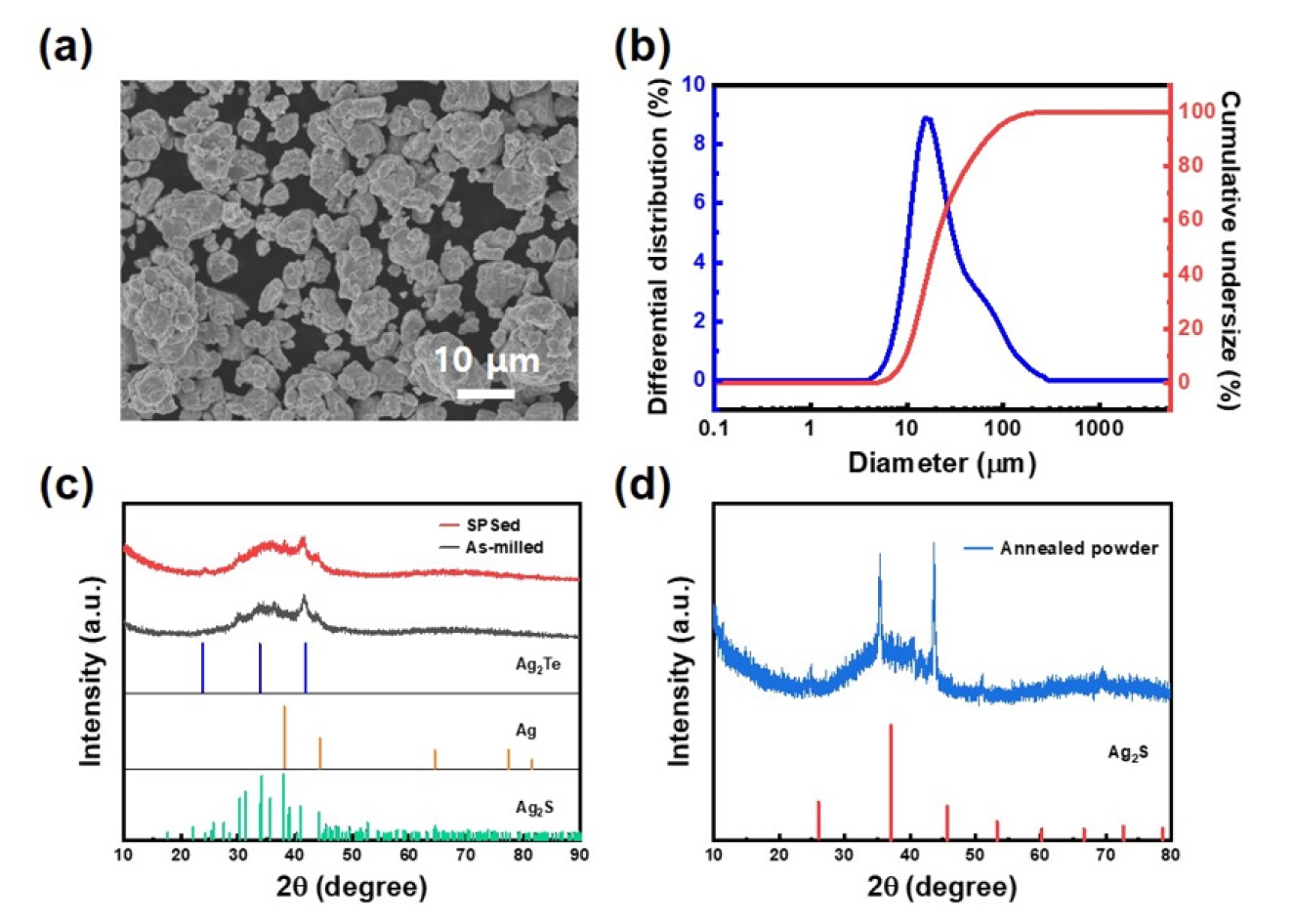
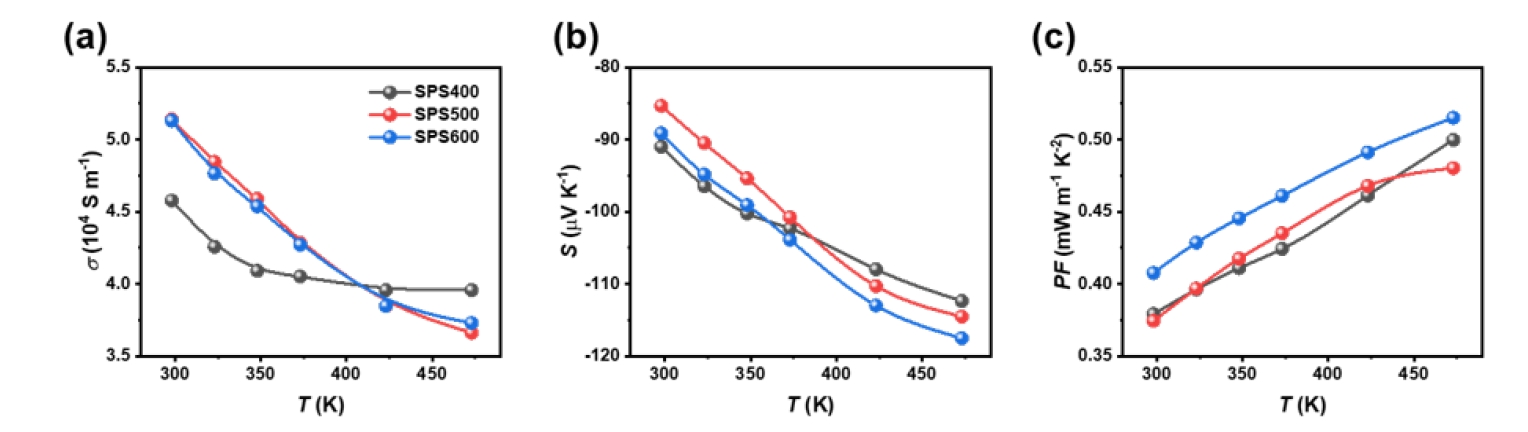
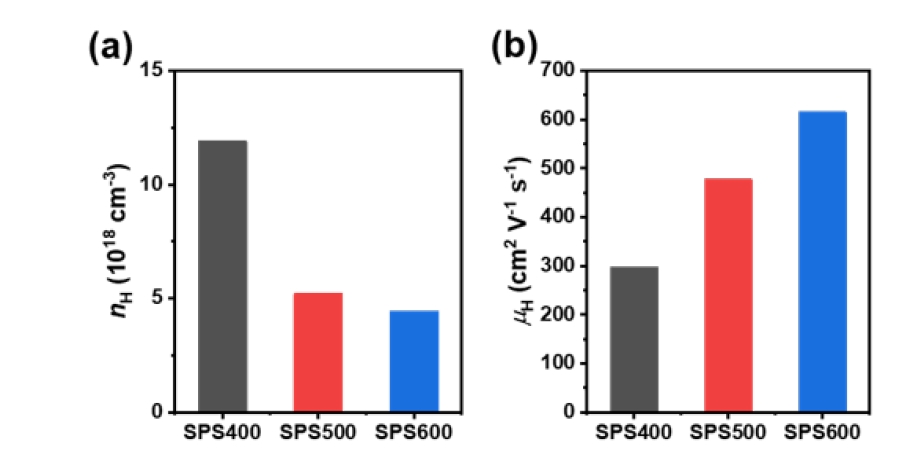
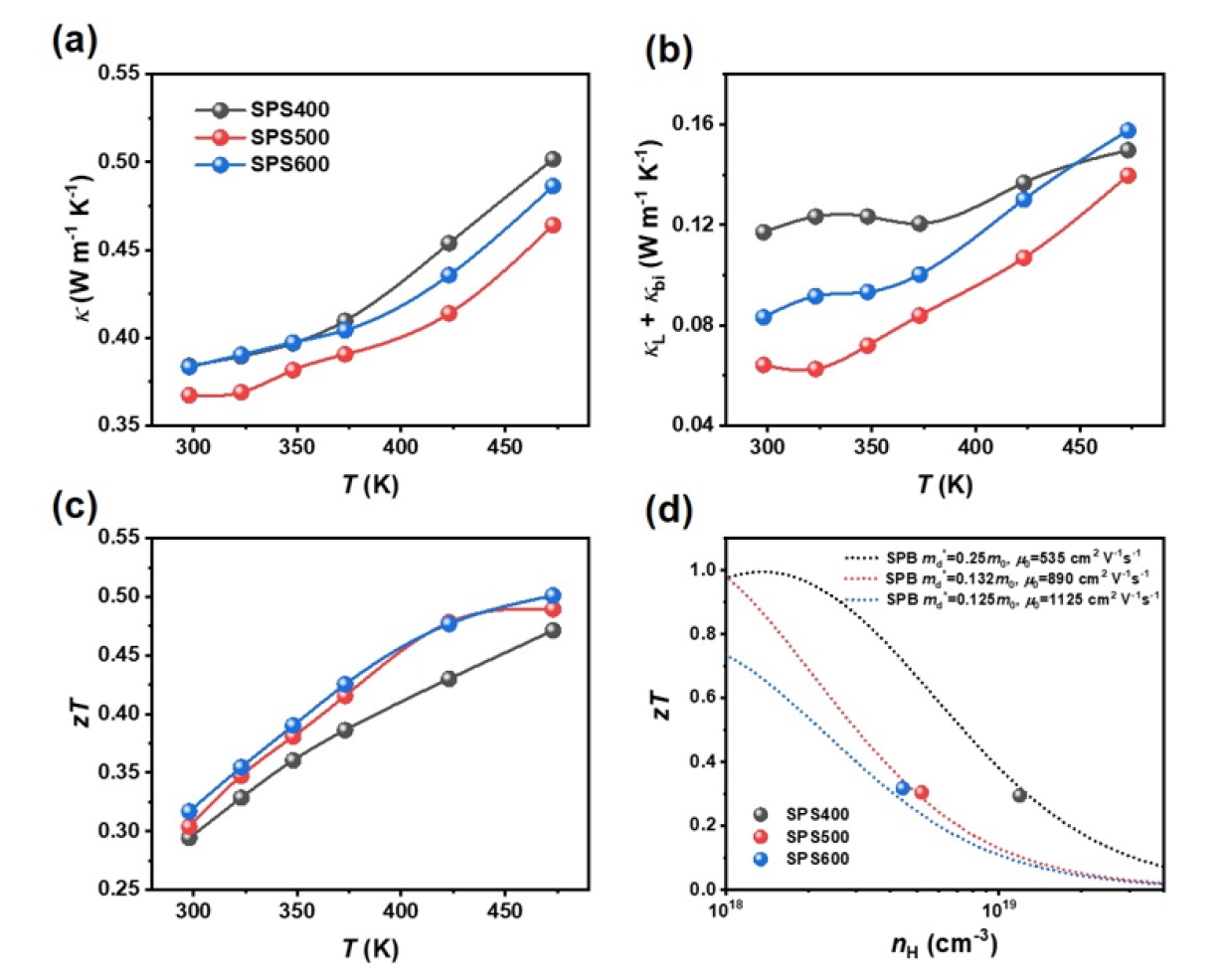
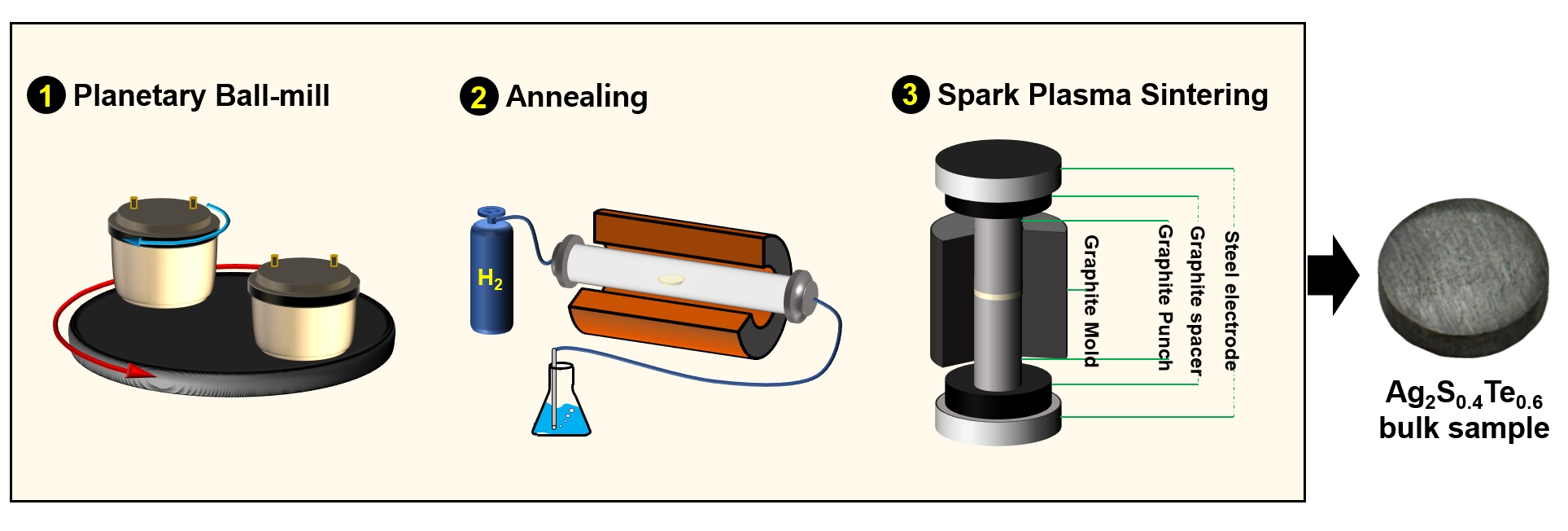





Fig. 1.
Fig. 2.
Fig. 3.
Fig. 4.
Graphical abstract
TOP

