- [English]
- Microstructure and Properties Comparison of Pure Cu and Cu-5 wt.% Al2O3 Composite Processed by Spark Plasma Sintering
-
Dinh Van Cong, Dong-Wan Lee, Su-Wan Lee, Nguyen Minh Thuyet, Nguyen Viet Hoang, Jin-Chun Kim
-
J Powder Mater. 2026;33(1):51-60. Published online February 28, 2026
-
DOI: https://doi.org/10.4150/jpm.2025.00472
-
-
 Abstract Abstract
 PDF PDF
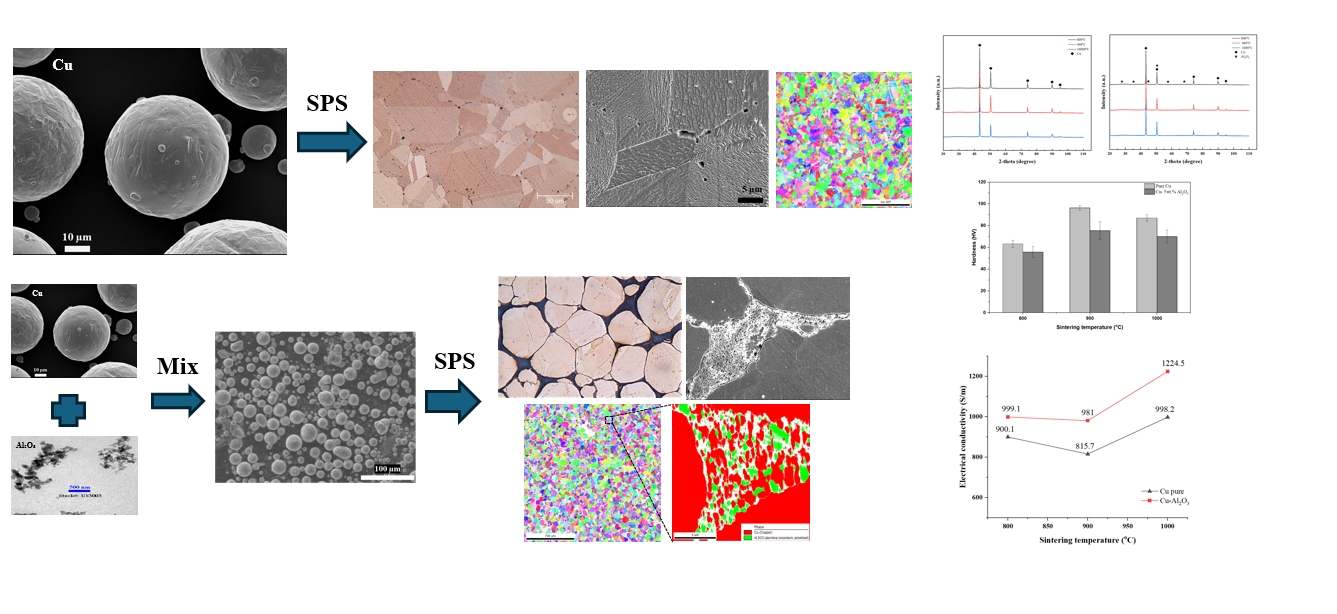
- This study compares the microstructure and properties of pure Cu and Cu-5 wt.% Al2O3 composites fabricated by spark plasma sintering under strictly identical processing conditions at 800-1000 °C. Pure Cu samples achieved near-full densification and exhibited a bimodal grain structure dominated by coarse grains with increasing sintering temperature. In contrast, the composite samples showed lower density and non-monotonic densification behavior, with a minimum relative density at 900 oC and significantly refined equiaxed grains due to strong grain-boundary pinning by nano Al2O3 particles. The higher fractions of high-angle boundaries and pronounced orientation disruption were observed in the composite samples, while high-resolution analysis confirmed the presence of grain-boundary Al2O3-rich regions that restricted Cu grain coalescence and continuity of grain boundary migration. X-ray diffraction results confirmed the absence of reaction phases in both materials. Hardness peaked at 900 °C for both samples, and the composite samples showed consistently lower hardness due to retained porosity. The apparent electrical conductivity of the composite displays a non-linear temperature dependence, reflecting the competing influences of densification, microstructural recovery, and the insulating nature of Al2O3.
- [English]
- Enhanced Compressive Strength of Fired Iron Ore Pellets: Effects of Blending Fine and Coarse Particle Concentrates
-
Ngo Quoc Dung, Tran Xuan Hai, Nguyen Minh Thuyet, Nguyen Quang Tung, Arvind Barsiwal, Nguyen Hoang Viet
-
J Powder Mater. 2025;32(4):315-329. Published online August 29, 2025
-
DOI: https://doi.org/10.4150/jpm.2025.00129
-
-
Abstract
PDF
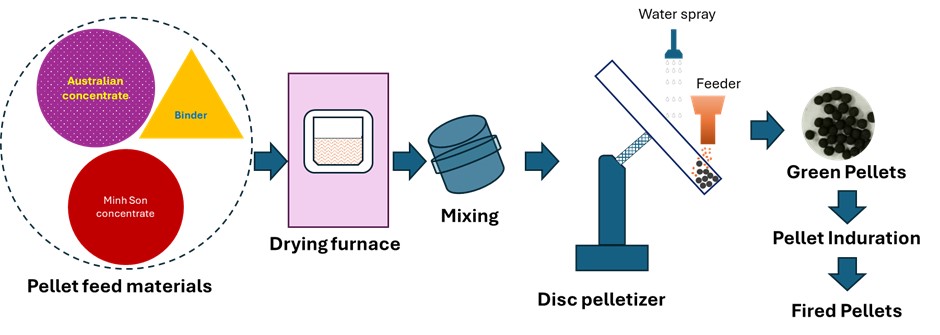
- This study investigated the effects of oxidative firing parameters and raw material characteristics on the pelletization of Australian and Minh Son (Vietnam) iron ore concentrates. The influence of firing temperature (1050°C–1150°C) and holding time (15–120 min) on pellet compressive strength was examined, focusing on microstructural changes during consolidation. Green pellets were prepared using controlled particle size distributions and bentonite as a binder. Scanning electron microscopy and energy-dispersive X-ray spectroscopy analyses revealed that grain boundary diffusion, liquid phase formation, and densification significantly improved mechanical strength. X-ray diffraction confirmed the complete oxidation of magnetite to hematite at elevated temperatures, a critical transformation for metallurgical performance. Optimal firing conditions for both single and blended ore compositions yielded compressive strengths above 250 kgf/pellet, satisfying the requirements for blast furnace applications. These results provide valuable guidance for improving pellet production, promoting the efficient utilization of diverse ore types, and enhancing the overall performance of ironmaking operations.
- [English]
- Fabrication and Characterization of Immiscible Fe-Cu Alloys using Electrical Explosion of Wire in Liquid
-
Chu Dac Phuc, Nguyen Minh Thuyet, Jin-Chun Kim
-
J Korean Powder Metall Inst. 2020;27(6):449-457. Published online December 1, 2020
-
DOI: https://doi.org/10.4150/KPMI.2020.27.6.449
-
-
2,311
View
-
13
Download
-
5
Citations
-
Abstract
PDF
Iron and copper are practically immiscible in the equilibrium state, even though their atomic radii are similar. As non-equilibrium solid solutions, the metastable Fe-Cu alloys can be synthesized using special methods, such as rapid quenching, vapor deposition, sputtering, ion-beam mixing, and mechanical alloying. The complexity of these methods (multiple steps, low productivity, high cost, and non-eco-friendliness) is a hinderance for their industrial applications. Electrical explosion of wire (EEW) is a well-known and effective method for the synthesis of metallic and alloy nanoparticles, and fabrication using the EEW is a simple and economic process. Therefore, it can be potentially employed to circumvent this problem. In this work, we propose the synthesis of Fe-Cu nanoparticles using EEW in a suitable solution. The powder shape, size distribution, and alloying state are analyzed and discussed according to the conditions of the EEW. -
Citations
Citations to this article as recorded by  - Scaling up plasma-derived metallic nanoalloys: A comprehensive review of production bottlenecks, manufacturing readiness, and AI-driven pathways to viability
Hugues Nkomba Museba, BongJu Lee
Journal of Alloys and Compounds.2026; 1054: 185926. CrossRef - Multiscale hierarchical Fe–Cu composites manufactured from recycled machining chips
E. Taherkhani, H. Rahimi, M.R. Sabour, G. Faraji
Journal of Materials Research and Technology.2026; 43: 5498. CrossRef - Identification of the reconstruction induced high-entropy spinel oxide nanosheets for boosting alkaline water oxygen evolution
Xuexue Wang, Runqing Lu, Shanhe Gong, Shaokang Yang, Wenbo Wang, Zhongti Sun, Xiaozhen Zhang, Jun Liu, Xiaomeng Lv
Chemical Engineering Journal.2025; 503: 158488. CrossRef - Trends in bimetallic nanomaterials and methods for the removal of p-nitrophenol and its derivatives from wastewater
M. S. Qatan, F. Arshad, M. Miskam, G. A. Naikoo
International Journal of Environmental Science and Technology.2024; 21(5): 5247. CrossRef - Control of cluster coalescence during formation of bimetallic nanoparticles and nanoalloys obtained via electric explosion of two wires
K.V. Suliz, A.Yu. Kolosov, V.S. Myasnichenko, N.I. Nepsha, N.Yu. Sdobnyakov, A.V. Pervikov
Advanced Powder Technology.2022; 33(3): 103518. CrossRef
|
 KPMI
KPMI