 KPMI
KPMI

Current issue
- Page Path
- HOME > Browse Articles > Current issue
- Volume 33(4); August 2026
-


 PDF
PDFResearch Articles
- [English]
- Mechanical Behavior of Aluminum Matrix Composites Reinforced with Nanoscale Carbon Nanotubes and Silicon Carbide
- Kanhu Charan Nayak, Jiwon Lee, Kon-Bae Lee, Ke Jiang, Hyunjoo Choi
- J Powder Mater. 2026;33(4):267-280. Published online August 31, 2026
- DOI: https://doi.org/10.4150/jpm.2026.00164
- 475 View
- 9 Download
-
 Abstract
 PDF
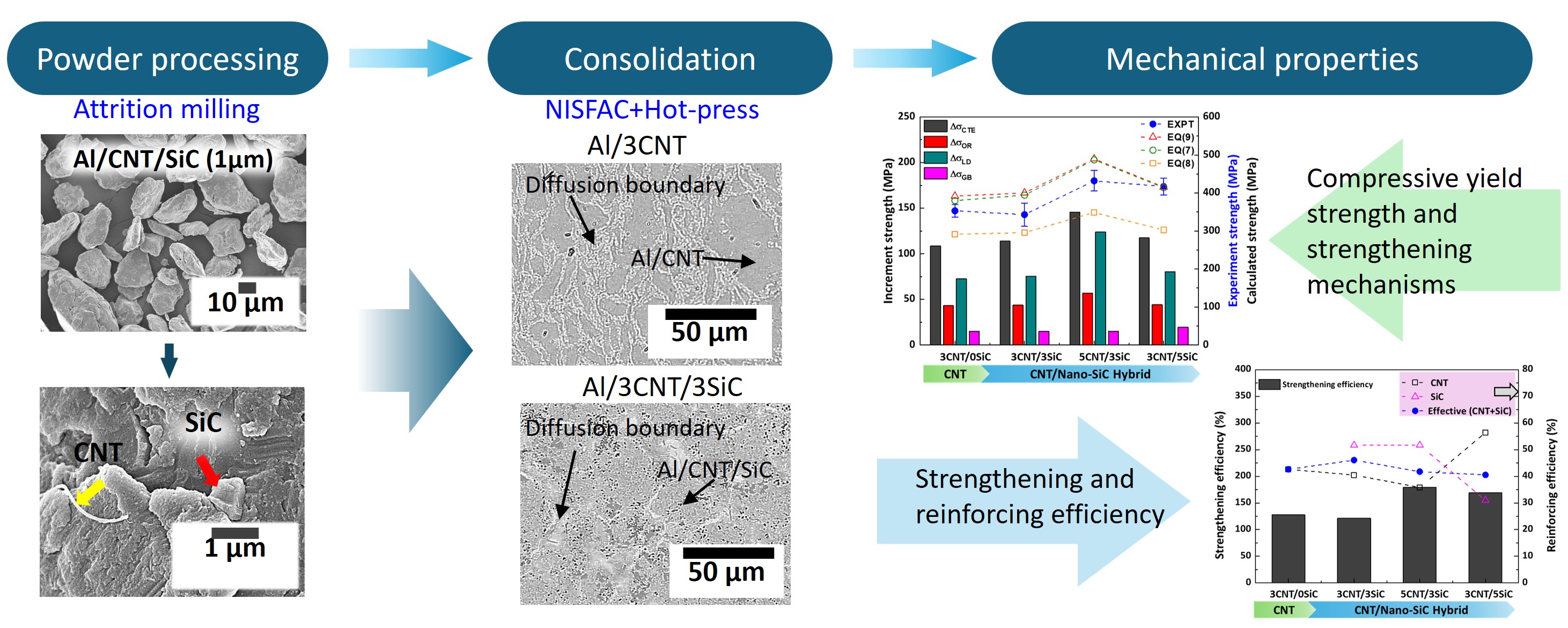
PDF - Lightweight aluminum (Al) matrix composites reinforced with carbon nanotubes (CNTs) and nanoscale silicon carbide (SiC) were fabricated using high-energy attrition milling, nitridation-induced self-forming consolidation (NISFAC), and hot pressing to improve mechanical performance through CNT/SiC hybrid reinforcement. Attrition milling refined the composite powders and promoted the incorporation of CNTs and SiC particles into the Al matrix, whereas NISFAC and hot pressing enabled near-full densification and effective interparticle bonding. Among the investigated compositions, Al/5CNT/3SiC showed the best mechanical performance, with a hardness of 197 HV, compressive yield strength of 432 MPa, compressive strength of 756 MPa, and Young’s modulus of 110 GPa. These improvements are attributed to the combined effects of load transfer, thermal-mismatch-induced dislocation strengthening, Orowan strengthening, and grain-boundary strengthening. Compared with values reported in the literature, the present composites showed competitive mechanical properties despite their relatively low reinforcement content. These findings indicate that CNT/SiC hybrid reinforcement combined with NISFAC and hot pressing is an effective route for producing dense, high-strength Al matrix composites.
- [English]
- Microstructural Evolution and Tensile Response of a Fe–15Cr Oxide Dispersion Strengthened Steel after Hot Rolling and Heat Treatment
- Trung Thanh Pham, Woo-Hyeok Kim, Hyun-Cheol Kim, Jeoung Han Kim
- J Powder Mater. 2026;33(4):281-290. Published online August 6, 2026
- DOI: https://doi.org/10.4150/jpm.2026.00157

- 710 View
- 10 Download
-
Abstract
PDF
- Fe-based oxide dispersion-strengthened (ODS) are promising structural materials for Generation IV nuclear systems because of their high-temperature strength, radiation tolerance, and microstructural stability. However, their mechanical performance is difficult to optimize because it depends on a coupled relationship among alloy composition, powder processing, consolidation, thermo-mechanical treatment, oxide dispersion, and deformation substructure. In this study, a machine learning (ML) screening workflow was used to prioritize multi-component Fe–15Cr-based ODS candidates based on predicted yield strength, ultimate tensile strength, and total elongation, followed by experimental validation of the selected alloy. The investigated alloy was processed by mechanical alloying, hot isostatic pressing, hot rolling, and post-rolling heat treatment at 1100 °C for 24 h. Electron backscatter diffraction (EBSD) showed that the hot-rolled condition contained an ultrafine, heterogeneous, and sub-structured ferritic matrix, whereas heat treatment produced substantial grain coarsening, recovery, and a high-angle grain-boundary-dominated structure. The hot-rolled alloy exhibited very high room-temperature strength, with a yield strength of 820 MPa and an ultimate tensile strength of 2079 MPa, but limited elongation of 2.3%. At 650 °C, elongation increased markedly to 34.9%. After heat treatment, room-temperature elongation improved to 13.9%, although the yield and ultimate tensile strengths decreased to 680 MPa and 935 MPa, respectively.
- [Korean]
- Effect of Milling-Time-Dependent Zirconia Contamination on the Microstructure and Mechanical Properties of Mechanically Alloyed Multicomponent Nb-Si-Ti Sintered Alloys
- Deokhyun Han, Seo-Yu Lee, Jin-Seo Park, Jeong-Sik Moon, Jungjoon Kim, Youngkyun Kim, Byungmin Ahn
- J Powder Mater. 2026;33(4):291-298. Published online August 31, 2026
- DOI: https://doi.org/10.4150/jpm.2026.00178
- 396 View
- 7 Download
-
Abstract
PDF
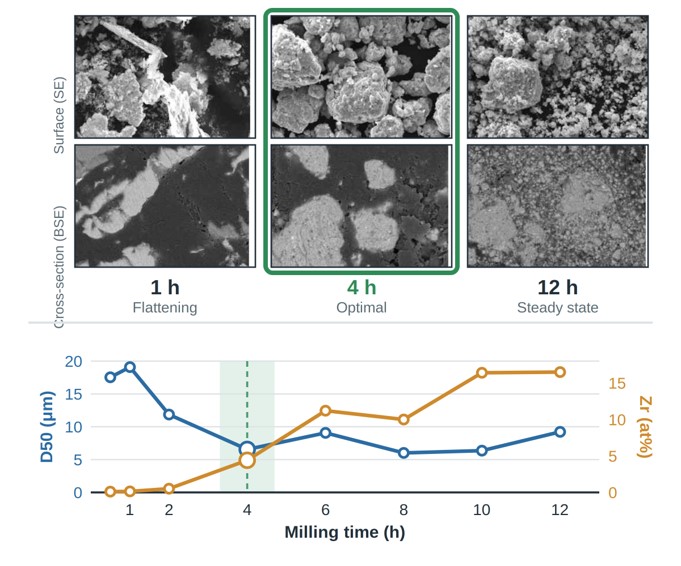
- Multicomponent Nb-15Si-23Ti-3Cr-2Sn-2Al-2Hf-1B-0.5Y alloy powders were synthesized by high-energy ball milling using a zirconia chamber and balls for milling times of 0.5–12 h, and the effects of milling time on powder evolution, contamination behavior, and the resulting microstructure and mechanical properties of hot-pressed sintered specimens were systematically investigated. The dominant deformation mechanism shifted from flattening to cold welding and then to a fracture- dominated steady state with increasing milling time, and the particle size decreased sharply up to 4 h before stabilizing. Yield and composition analyses showed that zirconia contamination remained limited up to 4 h but increased sharply beyond 6 h owing to severe wear of the milling chamber and balls. Sintered specimens from powder milled for 4 h exhibited a homogeneous microstructure with finely and stably dispersed Nb5Si3 intermetallic phases and moderate hardness, whereas insufficient milling for 2 h left coarse, unreacted phases, and excessive milling for 12 h introduced substantial zirconia contamination that lowered density while raising hardness. These results indicate that a milling time in the range of 4–6 h offers a favorable balance between alloying efficiency and contamination control, with 4 h being preferred owing to its comparatively minimal zirconia contamination.
- [English]
- Fabrication of Multilayer Core-Shell Structure for High Power Factor in Bi2Te2.7Se0.3 Thermoelectrics
- Su Min Eun, Jin Kyeong Shin, Se Been Jeong, Eui Seon Lee, Sung-Tag Oh, Byung Joon Choi
- J Powder Mater. 2026;33(4):299-309. Published online August 31, 2026
- DOI: https://doi.org/10.4150/jpm.2026.00192
- 437 View
- 7 Download
-
Abstract
PDF
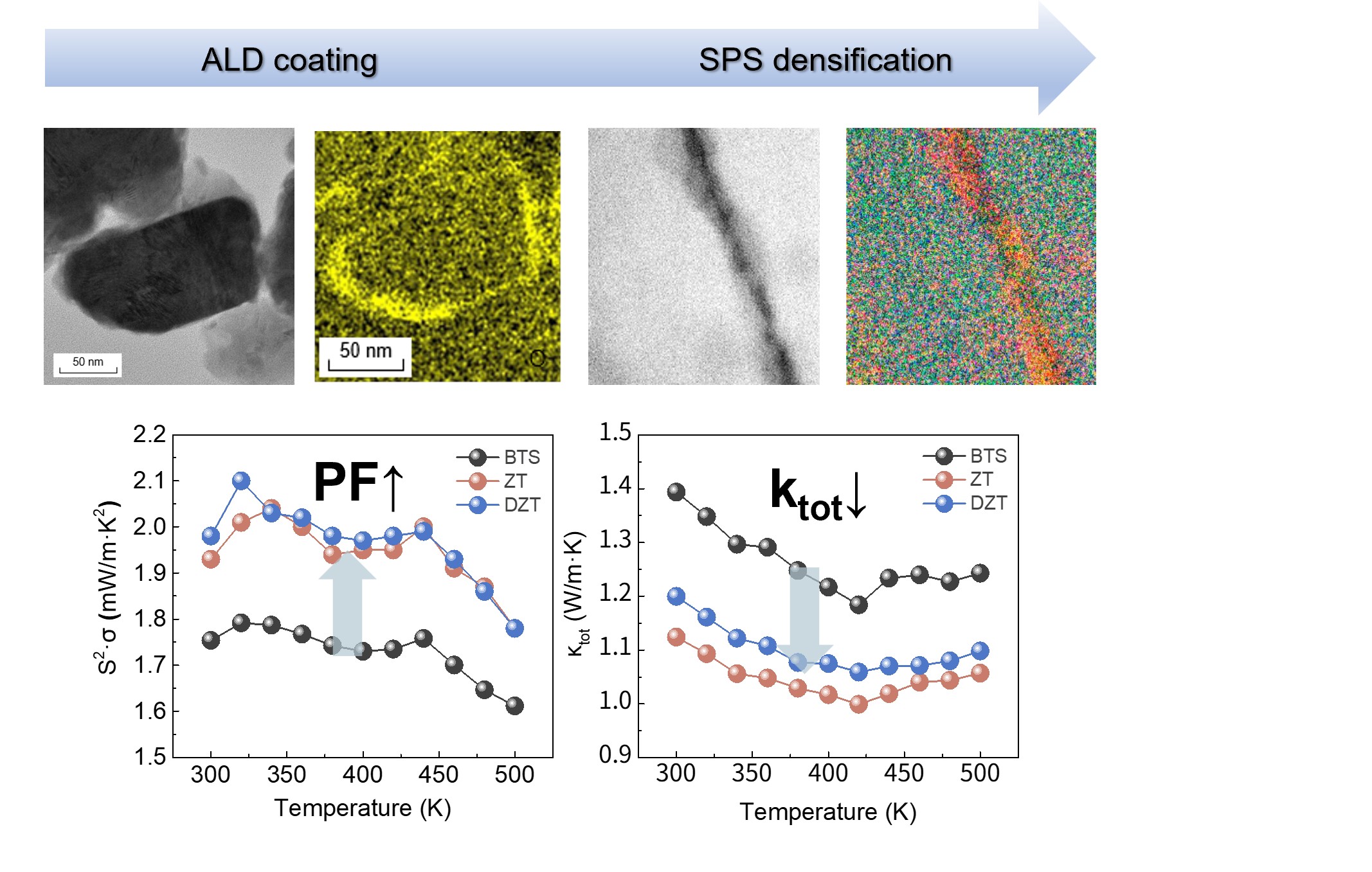
- Bi₂Te₃-based thermoelectric materials are attractive near room temperature, but their performance is constrained by sensitive carrier-concentration control, strong crystallographic anisotropy, and compositional instability from volatile Te. Here, a multilayer core-shell structure was fabricated by conformally coating Bi₂Te₂.₇Se₀.₃ (BTS) powders with ZnO–TiO₂ layers using rotary-type powder atomic layer deposition (pALD), followed by spark plasma sintering. Two configurations with the same ~4 nm total oxide thickness were prepared: a ZnO/TiO₂ bilayer (ZT) and a ZnO/TiO₂/ZnO/TiO₂ multilayer (DZT), where multilayer denotes the deposition scheme rather than a directly imaged layered architecture. Electron microscopy confirmed uniform amorphous shells that were retained as continuous interfacial films after sintering. The oxide interfaces donated electrons to the matrix, raising the carrier concentration and effective mass while preserving mobility and thereby enhancing the electrical conductivity and power factor; simultaneously they scattered phonons and suppressed bipolar conduction, lowering the lattice thermal conductivity. DZT achieved the highest power factor, attributed to its different deposition configuration, whereas ZT exhibited the lowest thermal conductivity; the two coated specimens reached comparable figures of merit (zT) within the measurement uncertainty, both markedly exceeding uncoated BTS. ALD-based interface engineering thus decouples electronic and phononic transport in n-type Bi₂Te₃.
 First
First Prev
Prev

TOP

