 KPMI
KPMI

Search
- Page Path
- HOME > Search
- [English]
- Fabrication and Pore Characteristics of Metal Powder Filters with a Cross-Sealed Honeycomb Shape Using Material Extrusion Additive Manufacturing
- Minji Kim, Min-Jeong Lee, Su-Jin Yun, Poong-Yeon Kim, Hyeon Ju Kim, Juyong Kim, Jung Woo Lee, Jung-Yeul Yun
- J Powder Mater. 2025;32(4):299-308. Published online August 29, 2025
- DOI: https://doi.org/10.4150/jpm.2025.00234
- 1,905 View
- 30 Download
-
 Abstract
 PDF
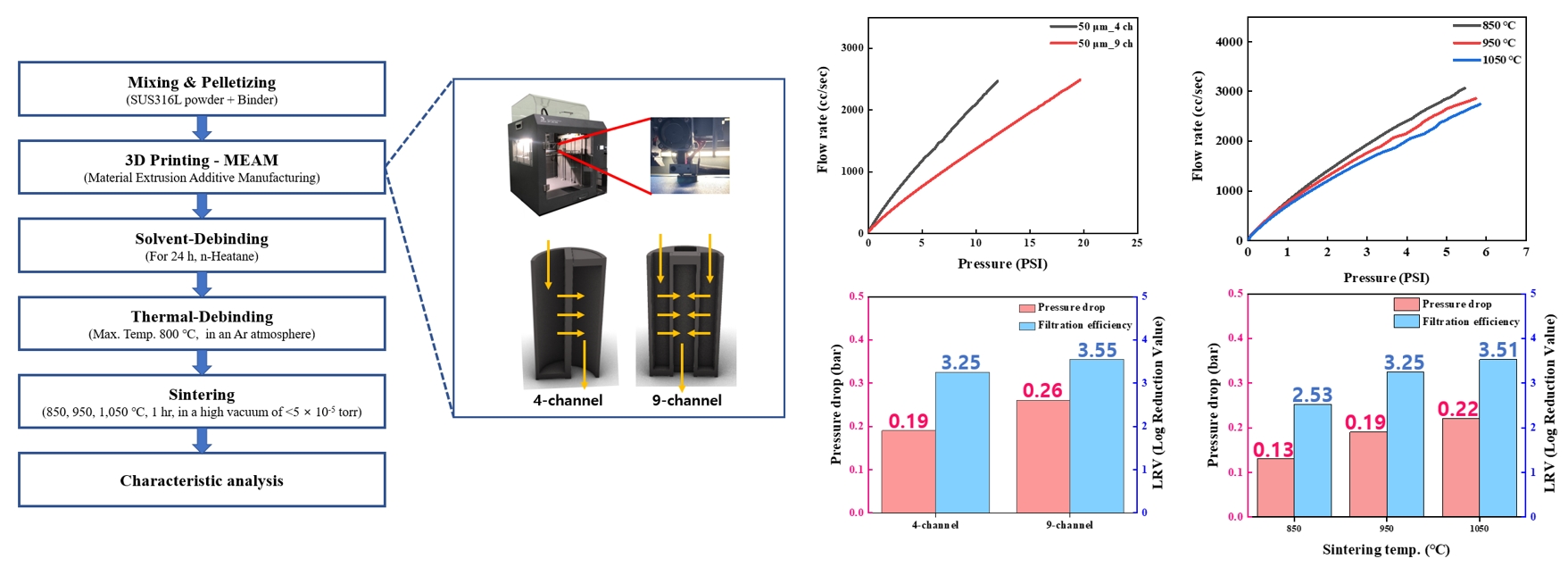
PDF - The development of high-performance metal filters is essential for maintaining ultra-clean environments in semiconductor manufacturing. In this study, cross-sealed honeycomb filters were fabricated using STS316L powder via material extrusion additive manufacturing (MEAM) for semiconductor gas filtration. The effects of filter geometry (4 or 9 channels) and sintering temperature (850°C, 950°C, or 1,050°C) on performance were examined. First, 4-channel and 9-channel filters sintered at the same temperature (950°C) exhibited similar porosities of 50.08% and 50.57%, but the 9-channel filter showed a higher pressure-drop (0.26 bar) and better filtration-efficiency (3.55 LRV) than the 4-channel filter (0.19 bar and 3.25 LRV, respectively). Second, for filters with the same geometry (4-channel) increasing the sintering temperature reduced porosity from 64.52% to 40.33%, while the pressure-drop increased from 0.13 bar to 0.22 bar and filtration-efficiency improved from 2.53 LRV to 3.51 LRV. These findings demonstrate that filter geometry and sintering temperature are key factors governing the trade-off between air permeability, pressure-drop, and filtration efficiency. This work provides insights and data for optimizing MEAM-based high-performance metal powder filter design.
- [Korean]
- A Study on the Microstructure and Magnetic Properties of Fe83.2Si5.33-0.33
x B10.67-0.67x Px Cu0.8 Nanocrystalline Soft Magnetic Alloys with varying P Content - Hyun Ah Im, Kyoung-Hoon Bae, Yeong gyun Nam, Subong An, Sangsun Yang, Yong-Jin Kim, Jung Woo Lee, Jae Won Jeong
- J Korean Powder Metall Inst. 2021;28(4):293-300. Published online August 1, 2021
- DOI: https://doi.org/10.4150/KPMI.2021.28.4.293

- 1,596 View
- 18 Download
- 1 Citations
-
Abstract
PDF
We investigate the effect of phosphorous content on the microstructure and magnetic properties of Fe83.2Si5.33-0.33
x B10.67-0.67x Px Cu0.8 (x = 1–4 at.%) nanocrystalline soft magnetic alloys. The simultaneous addition of Cu and P to nanocrystalline alloys reportedly decreases the nanocrystalline size significantly, to 10–20 nm. In the P-containing nanocrystalline alloy, P atoms are distributed in an amorphous residual matrix, which suppresses grain growth, increases permeability, and decreases coercivity. In this study, nanocrystalline ribbons with a composition of Fe83.2Si5.33-0.33x B10.67- 0.67x Px Cu0.8 (x = 1–4 at.%) are fabricated by rapid quenching melt-spinning and thermal annealing. It is demonstrated that the addition of a small amount of P to the alloy improves the glass-forming ability and increases the resistance to undesirable Fex(B,P) crystallization. Among the alloys investigated in this work, an Fe83.2Si5B10P1Cu0.8 nanocrystalline ribbon annealed at 460°C exhibits excellent soft-magnetic properties including low coercivity, low core loss, and high saturation magnetization. The uniform nanocrystallization of the Fe83.2Si5B10P1Cu0.8 alloy is confirmed by high-resolution transmission electron microscopy analysis.-
Citations
Citations to this article as recorded by
- Microstructure, Magnetic Properties, and Performance of Fe-6.5Si Soft Magnetic Core Produced by Laser Powder Bed Fusion
Ji Sang Yoon, Yeon Woo Kim, Gyu Hyun Park, Youk Jin Kim, Sang Heon Lee, Jeong Seok Kim, Sung Ho Yu, Jeong Min Park
Journal of Powder Materials.2026; 33(3): 177. CrossRef
- Microstructure, Magnetic Properties, and Performance of Fe-6.5Si Soft Magnetic Core Produced by Laser Powder Bed Fusion
 First
First Prev
Prev

TOP

