 KPMI
KPMI

Search
- Page Path
- HOME > Search
- [English]
- Structural, Electrical, and Optical Properties of Al–Mg Co-Doped ZnO Thin Films
- Jong-Mu Kim, Jun-Seo Park, Jun-Ha Lee, Min-Woo Kim, Jung-Woo Lee
- J Powder Mater. 2026;33(1):44-50. Published online February 28, 2026
- DOI: https://doi.org/10.4150/jpm.2026.00031
- 1,791 View
- 29 Download
-
 Abstract
 PDF
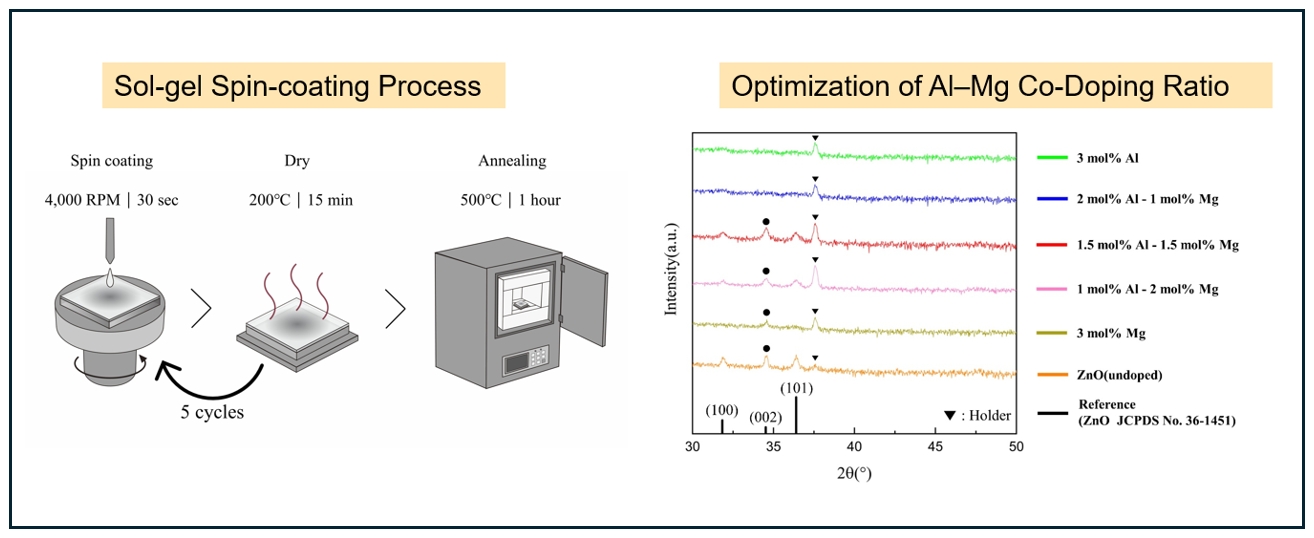
PDF - Al–Mg co-doped ZnO thin films were fabricated by a sol–gel spin-coating process to investigate the effect of dopant ratio on their structural, electrical, and optical properties. The total dopant concentration was fixed at 3 mol%, while the Al-to-Mg ratio was systematically varied in AlₓMg₀.₀₃₋ₓZn₀.₉₇O (0 ≤ x ≤ 0.03). X-ray diffraction analysis showed that the films maintained a hexagonal wurtzite structure with a preferred (002) orientation up to an Al concentration of 1.5 mol%, whereas higher Al contents resulted in a degradation of crystallinity due to exceeding the solid solubility limit of Al in the ZnO lattice. Hall effect measurements revealed a decrease in carrier mobility with increasing Al content, attributed to enhanced ionized impurity scattering, while the carrier concentration and electrical conductivity reached optimal values at an Al–Mg co-doping ratio of 1.5 mol%–1.5 mol%. All films exhibited high optical transmittance in the visible region, with the highest average transmittance of approximately 83% observed at the same composition. These results demonstrate that controlling the Al/Mg dopant ratio is crucial for optimizing the performance of ZnO-based transparent conducting oxide thin films.
- [Korean]
- Comparison Study of Compact Titanium Oxide (c-TiO2) Powder Electron Transport Layer Fabrication for Carbon Electrode-based Perovskite Solar Cells
- Chae Young Woo, Hyung Woo Lee
- J Powder Mater. 2022;29(4):297-302. Published online August 1, 2022
- DOI: https://doi.org/10.4150/KPMI.2022.29.4.297
- 1,221 View
- 9 Download
-
Abstract
PDF
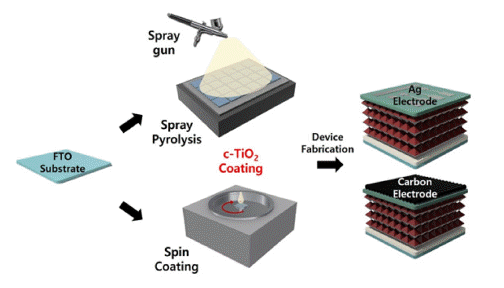
This study compares the characteristics of a compact TiO2 (c-TiO2) powdery film, which is used as the electron transport layer (ETL) of perovskite solar cells, based on the manufacturing method. Additionally, its efficiency is measured by applying it to a carbon electrode solar cell. Spin-coating and spray methods are compared, and spraybased c-TiO2 exhibits superior optical properties. Furthermore, surface analysis by scanning electron microscopy (SEM) and atomic force microscopy (AFM) exhibits the excellent surface properties of spray-based TiO2. The photoelectric conversion efficiency (PCE) is 14.31% when applied to planar perovskite solar cells based on metal electrodes. Finally, carbon nanotube (CNT) film electrode-based solar cells exhibits a 76% PCE compared with that of metal electrodebased solar cells, providing the possibility of commercialization.
- [Korean]
- Fabrication of Porous Polytetrafluoroethylene thin Film from Powder Dispersion-solution for Energy Nanogenerator Applications
- Il-Kyu Park
- J Korean Powder Metall Inst. 2017;24(2):102-107. Published online April 1, 2017
- DOI: https://doi.org/10.4150/KPMI.2017.24.2.102
- 1,780 View
- 16 Download
- 1 Citations
-
Abstract
PDF
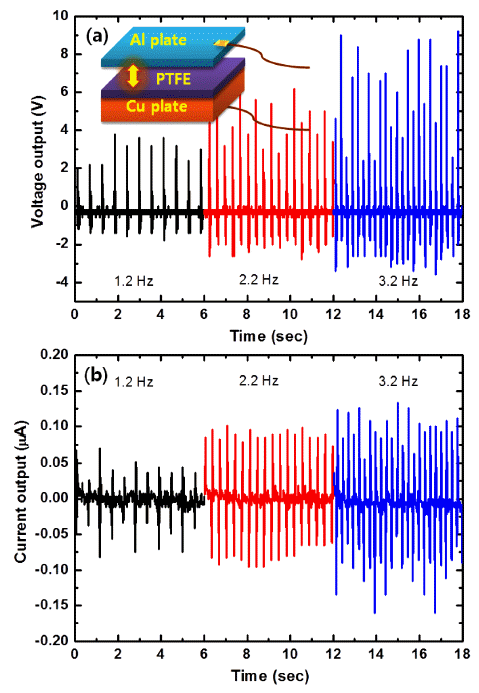
Porous polytetrafluoroethylene (PTFE) thin films are fabricated by spin-coating using a dispersion solution containing PTFE powders, and their crystalline properties are investigated after thermal annealing at various temperatures ranging from 300 to 500°C. Before thermal annealing, the film is densely packed and consists of many granular particles 200-300 nm in diameter. However, after thermal annealing, the film contains many voids and fibrous grains on the surface. In addition, the film thickness decreases after thermal annealing owing to evaporation of the surfactant, binder, and solvent composing the PTFE dispersion solution. The film thickness is systematically controlled from 2 to 6.5 μm by decreasing the spin speed from 1,500 to 500 rpm. A triboelectric nanogenerator is fabricated by spin-coating PTFE thin films onto polished Cu foils, where they act as an active layer to convert mechanical energy to electrical energy. A triboelectric nanogenerator consisting of a PTFE layer and Al metal foil pair shows typical output characteristics, exhibiting positive and negative peaks during applied strain and relief cycles due to charging and discharging of electrical charge carriers. Further, the voltage and current outputs increase with increasing strain cycle owing to accumulation of electrical charge carriers during charge-discharge.
-
Citations
Citations to this article as recorded by
- Recent Development in Performance Enhancement of PVDF-Nanopowder Composite-based Energy Harvesting Devices
Geon-Ju Choi, Il-Kyu Park
Journal of Korean Powder Metallurgy Institute.2020; 27(3): 247. CrossRef
- Recent Development in Performance Enhancement of PVDF-Nanopowder Composite-based Energy Harvesting Devices
 First
First Prev
Prev

TOP

