 KPMI


Search
- Page Path
- HOME > Search
- [English]
- Structural, Electrical, and Optical Properties of Al–Mg Co-Doped ZnO Thin Films
- Jong-Mu Kim, Jun-Seo Park, Jun-Ha Lee, Min-Woo Kim, Jung-Woo Lee
- J Powder Mater. 2026;33(1):44-50. Published online February 28, 2026
- DOI: https://doi.org/10.4150/jpm.2026.00031
- 1,901 View
- 29 Download
-
 Abstract
 PDF
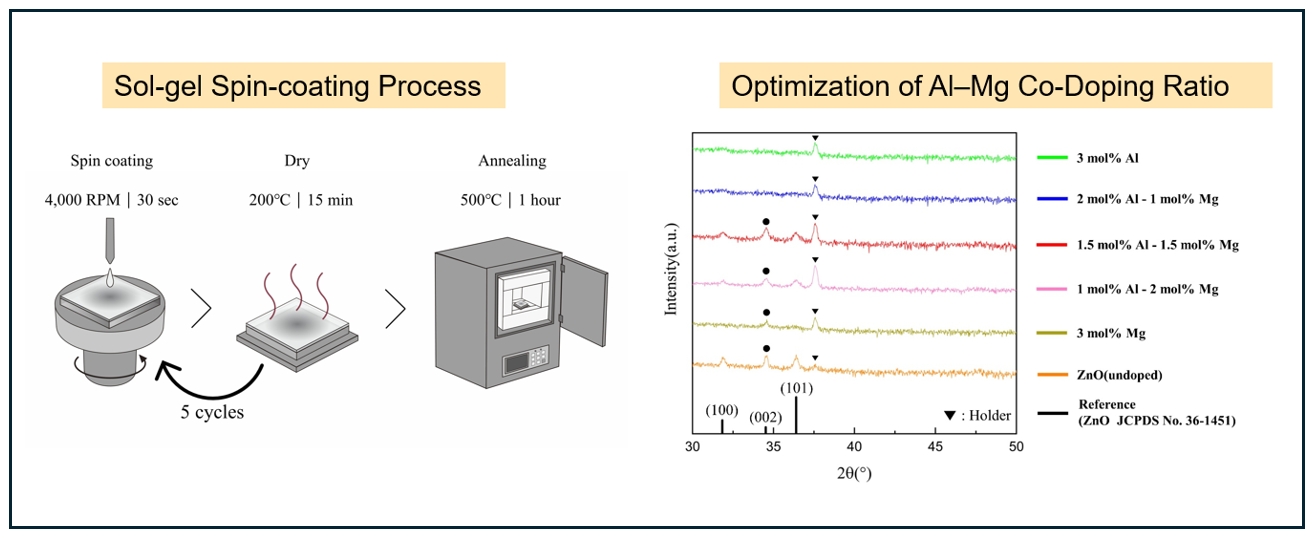
- Al–Mg co-doped ZnO thin films were fabricated by a sol–gel spin-coating process to investigate the effect of dopant ratio on their structural, electrical, and optical properties. The total dopant concentration was fixed at 3 mol%, while the Al-to-Mg ratio was systematically varied in AlₓMg₀.₀₃₋ₓZn₀.₉₇O (0 ≤ x ≤ 0.03). X-ray diffraction analysis showed that the films maintained a hexagonal wurtzite structure with a preferred (002) orientation up to an Al concentration of 1.5 mol%, whereas higher Al contents resulted in a degradation of crystallinity due to exceeding the solid solubility limit of Al in the ZnO lattice. Hall effect measurements revealed a decrease in carrier mobility with increasing Al content, attributed to enhanced ionized impurity scattering, while the carrier concentration and electrical conductivity reached optimal values at an Al–Mg co-doping ratio of 1.5 mol%–1.5 mol%. All films exhibited high optical transmittance in the visible region, with the highest average transmittance of approximately 83% observed at the same composition. These results demonstrate that controlling the Al/Mg dopant ratio is crucial for optimizing the performance of ZnO-based transparent conducting oxide thin films.
- [Korean]
- Enhanced H2S Gas Sensing Using ZnO Porous Nanorod Synthesized via a Rotational Hydrothermal Method
- Jimyeong Park, Changyu Kim, Minseo Kim, Jiyeon Shin, Jae-Hyoung Lee, Myung Sik Choi
- J Powder Mater. 2025;32(5):406-415. Published online October 31, 2025
- DOI: https://doi.org/10.4150/jpm.2025.00262
- 1,268 View
- 24 Download
-
Abstract
PDF
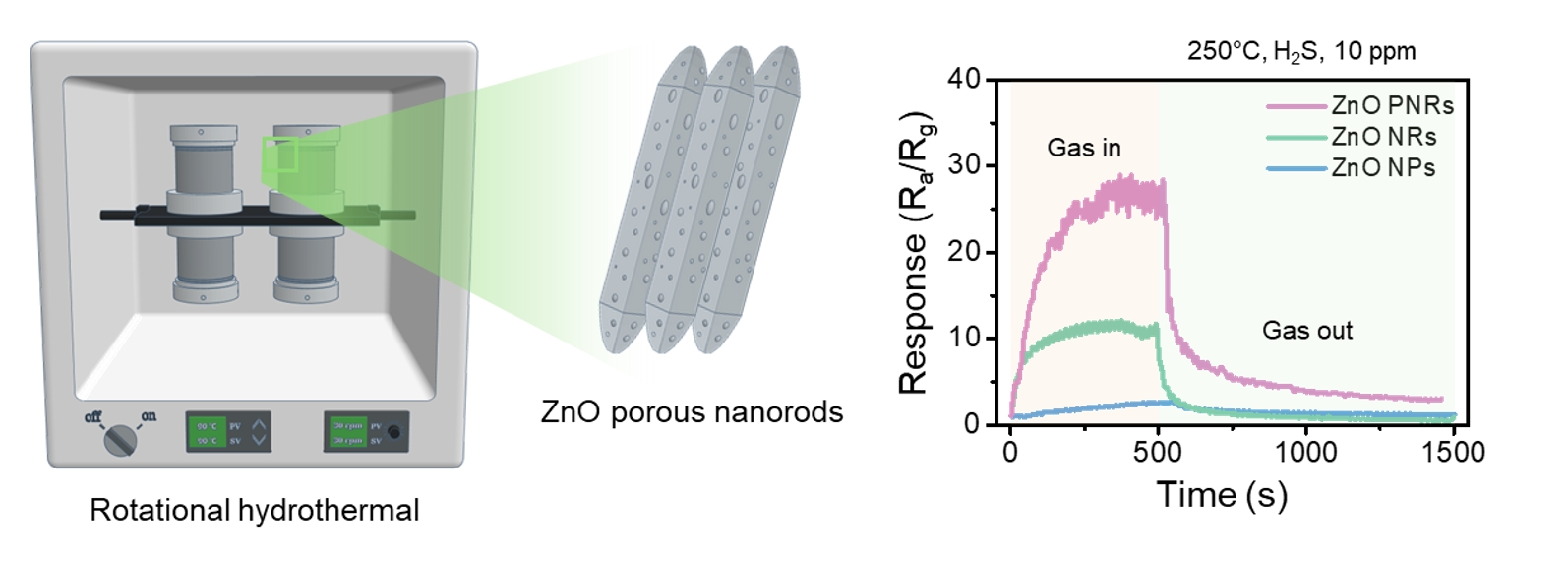
- In this study, ZnO porous nanorods were synthesised using a rotational hydrothermal process, and their performance as hydrogen sulphide (H2S) gas sensors was analysed. Compared to commercial ZnO nanoparticles and conventionally hydrothermally synthesised ZnO nanorods, the ZnO porous nanorods exhibited a more uniform structure and improved crystal growth in the (002) plane, with surfaces rich in porosity and oxygen vacancies. These structural and chemical characteristics significantly improved the sensitivity toward H2S, showing high detection performance at 250°C across various concentrations of H2S gas. Additionally, the sensor demonstrated excellent selectivity against other gases such as C2H5OH, C6H6, C7H8, and NH3. This study indicated that the rotational hydrothermal process is an effective method for developing high-performance ZnO-based gas sensors and suggests its applicability to other metal oxide materials.
- [Korean]
- Rotation Speed Dependence of ZnO Coating Layer on SnSe powders by Rotary Atomic Layer Deposition Reactor
- Myeong Jun Jung, Ye Jun Yun, Jongmin Byun, Byung Joon Choi
- J Korean Powder Metall Inst. 2021;28(3):239-245. Published online June 1, 2021
- DOI: https://doi.org/10.4150/KPMI.2021.28.3.239
- 1,335 View
- 4 Download
- 2 Citations
-
Abstract
PDF
The SnSe single crystal shows an outstanding figure of merit (
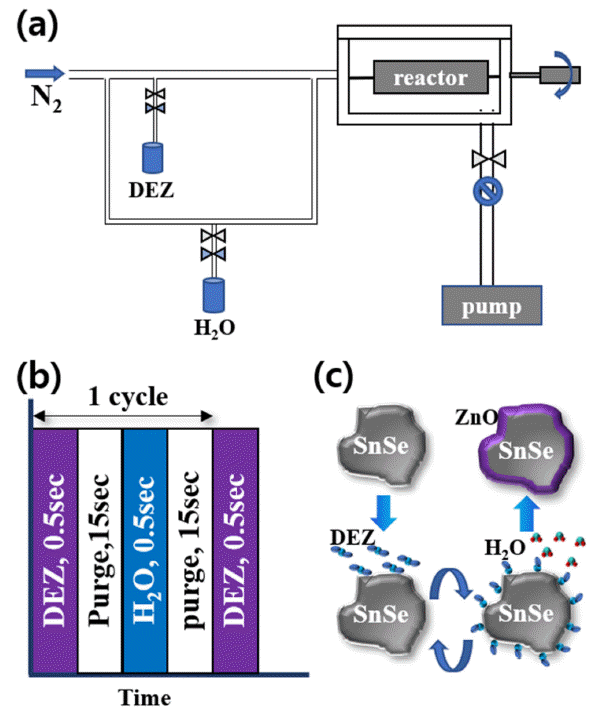
ZT ) of 2.6 at 973 K; thus, it is considered to be a promising thermoelectric material. However, the mass production of SnSe single crystals is difficult, and their mechanical properties are poor. Alternatively, we can use polycrystalline SnSe powder, which has better mechanical properties. In this study, surface modification by atomic layer deposition (ALD) is chosen to increase theZT value of SnSe polycrystalline powder. SnSe powder is ground by a ball mill. An ALD coating process using a rotary-type reactor is adopted. ZnO thin films are grown by 100 ALD cycles using diethylzinc and H2O as precursors at 100°C. ALD is performed at rotation speeds of 30, 40, 50, and 60 rpm to examine the effects of rotation speed on the thin film characteristics. The physical and chemical properties of ALD-coated SnSe powders are characterized by scanning and tunneling electron microscopy combined with energy-dispersive spectroscopy. The results reveal that a smooth oxygenrich ZnO layer is grown on SnSe at a rotation speed of 30 rpm. This result can be applied for the uniform coating of a ZnO layer on various powder materials.-
Citations
Citations to this article as recorded by
- Fabrication of Multilayer Core-Shell Structure for High Power Factor in Bi2Te2.7Se0.3 Thermoelectrics
Su Min Eun, Jin Kyeong Shin, Se Been Jeong, Eui Seon Lee, Sung-Tag Oh, Byung Joon Choi
Journal of Powder Materials.2026; 33(4): 299. CrossRef - Thermal Confinement and Filtering Effect of SnSe by Insertion of Atomic-Layer-Deposited ZnO Interfacial Layer
Myeong Jun Jung, Su Min Eun, Hogyoung Kim, Seong Keun Kim, Jongmin Byun, Byung Joon Choi
Korean Journal of Chemical Engineering.2025; 42(14): 3545. CrossRef
- Fabrication of Multilayer Core-Shell Structure for High Power Factor in Bi2Te2.7Se0.3 Thermoelectrics
- [Korean]
- Synthesis and Optical Property of (GaN)1-x(ZnO)x Nanoparticles Using an Ultrasonic Spray Pyrolysis Process and Subsequent Chemical Transformation
- Jeong Hyun Kim, Cheol-Hui Ryu, Myungjun Ji, Yomin Choi, Young-In Lee
- J Korean Powder Metall Inst. 2021;28(2):143-149. Published online April 1, 2021
- DOI: https://doi.org/10.4150/KPMI.2021.28.2.143
- 1,381 View
- 3 Download
-
Abstract
PDF
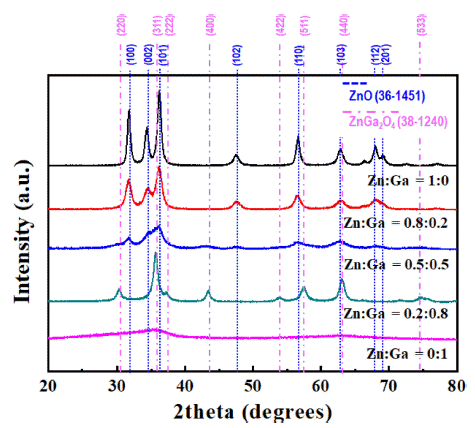
In this study, (GaN)1-x(ZnO)x solid solution nanoparticles with a high zinc content are prepared by ultrasonic spray pyrolysis and subsequent nitridation. The structure and morphology of the samples are investigated by X-ray diffraction (XRD), field-emission scanning electron microscopy, and energy-dispersive X-ray spectroscopy. The characterization results show a phase transition from the Zn and Ga-based oxides (ZnO or ZnGa2O4) to a (GaN)1-x (ZnO)x solid solution under an NH3 atmosphere. The effect of the precursor solution concentration and nitridation temperature on the final products are systematically investigated to obtain (GaN)1-x(ZnO)x nanoparticles with a high Zn concentration. It is confirmed that the powder synthesized from the solution in which the ratio of Zn and Ga was set to 0.8:0.2, as the initial precursor composition was composed of about 0.8-mole fraction of Zn, similar to the initially set one, through nitriding treatment at 700°C. Besides, the synthesized nanoparticles exhibited the typical XRD pattern of (GaN)1-x(ZnO)x, and a strong absorption of visible light with a bandgap energy of approximately 2.78 eV, confirming their potential use as a hydrogen production photocatalyst.
- [Korean]
- Morphology Control of ZnO Nanostructures by Surfactants During Hydrothermal Growth
- Il-Kyu Park
- J Korean Powder Metall Inst. 2016;23(4):270-275. Published online August 1, 2016
- DOI: https://doi.org/10.4150/KPMI.2016.23.4.270
- 1,613 View
- 3 Download
- 1 Citations
-
Abstract
PDF
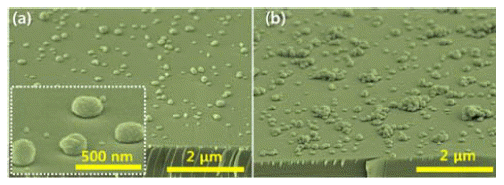
We report on an all-solution-processed hydrothermal method to control the morphology of ZnO nanostructures on Si substrates from three-dimensional hemispherical structures to two-dimensional thin film layers, by controlling the seed layer and the molar contents of surfactants during their primary growth. The size and the density of the seed layer, which is composed of ZnO nanodots, change with variation in the solute concentration. The ZnO nanodots act as heterogeneous nucleation sites for the main ZnO nanostructures. When the seed layer concentration is increased, the ZnO nanostructures change from a hemispherical shape to a thin film structure, formed by densely packed ZnO hemispheres. In addition, the morphology of the ZnO layer is systematically controlled by using trisodium citrate, which acts as a surfactant to enhance the lateral growth of ZnO crystals rather than a preferential one-dimensional growth along the c-direction. X-ray diffraction and energy dispersive X-ray spectroscopy results reveal that the ZnO structure is wurtzite and did not incorporate any impurities from the surfactants used in this study.
-
Citations
Citations to this article as recorded by- La-doped p-type ZnO nanowire with enhanced piezoelectric performance for flexible nanogenerators
Leeseung Kang, HyeLan An, Ji Young Park, Myung Hwan Hong, Sahn Nahm, Chan Gi Lee
Applied Surface Science.2019; 475: 969. CrossRef
- La-doped p-type ZnO nanowire with enhanced piezoelectric performance for flexible nanogenerators
- [Korean]
- Fabrication of ZnO Nanorod/polystyrene Nanosphere Hybrid Nanostructures by Hydrothermal Method for Energy Generation Applications
- Seong-Ho Baek, Il-Kyu Park
- J Korean Powder Metall Inst. 2015;22(6):391-395. Published online December 1, 2015
- DOI: https://doi.org/10.4150/KPMI.2015.22.6.391

- 1,741 View
- 3 Download
- 4 Citations
-
Abstract
PDF
We report on the successful fabrication of ZnO nanorod (NR)/polystyrene (PS) nanosphere hybrid nanostructure by combining drop coating and hydrothermal methods. Especially, by adopting an atomic layer deposition method for seed layer formation, very uniform ZnO NR structure is grown on the complicated PS surfaces. By using zinc nitrate hexahydrate [Zn(NO3)2 ·6H2O] and hexamine [(CH2)6N4] as sources for Zn and O in hydrothermal process, hexagonal shaped single crystal ZnO NRs are synthesized without dissolution of PS in hydrothermal solution. X-ray diffraction results show that the ZnO NRs are grown along c-axis with single crystalline structure and there is no trace of impurities or unintentionally formed intermetallic compounds. Photoluminescence spectrum measured at room temperature for the ZnO NRs on flat Si and PS show typical two emission bands, which are corresponding to the band-edge and deep level emissions in ZnO crystal. Based on these structural and optical investigations, we confirm that the ZnO NRs can be grown well even on the complicated PS surface morphology to form the chestnut-shaped hybrid nanostructures for the energy generation and storage applications.
-
Citations
Citations to this article as recorded by- Synthesis of Planar-Type ZnO Powder in Non-Nano Scale Dimension and Its Application in Ultraviolet Protection Cosmetics
Jung-Hwan Lee, Gun-Sub Lee, Eung-Nam Park, Dong-Hyeon Jo, So-Won Kim, Hee-Chul Lee
Materials.2023; 16(5): 2099. CrossRef - Rapid consolidation of nanostuctured WC-FeAl3 by pulsed current activated heating and its mechanical properties
In-Jin Shon, Seok-Jae Lee
International Journal of Refractory Metals and Hard Materials.2017; 65: 69. CrossRef - Fabrication of a Graphene/ZnO based p-n junction device and its ultraviolet photoresponse properties
Young-Tae Kwon, Sung-Oong Kang, Ji-Ae Cheon, Yoseb Song, Jong-Jin Lee, Yong-Ho Choa
Applied Surface Science.2017; 415: 2. CrossRef - Morphology Control of ZnO Nanostructures by Surfactants During Hydrothermal Growth
Il-Kyu Park
Journal of Korean Powder Metallurgy Institute.2016; 23(4): 270. CrossRef
- Synthesis of Planar-Type ZnO Powder in Non-Nano Scale Dimension and Its Application in Ultraviolet Protection Cosmetics
- [Korean]
- Fabrication of ZnO Nanorod based Robust Nanogenerator Metal Substrate
- Seong-Ho Baek, Il-Kyu Park
- J Korean Powder Metall Inst. 2015;22(5):331-336. Published online October 1, 2015
- DOI: https://doi.org/10.4150/KPMI.2015.22.5.331

- 9,901 View
- 6 Download
- 4 Citations
-
Abstract
PDF
We report on the succesful fabrication of ZnO nanorod (NR)-based robust piezoelectric nanogenerators (PNGs) by using Cu foil substrate. The ZnO NRs are successfully grown on the Cu foil substrate by using all solution based method, a two step hydrothermal synthesis. The ZnO NRs are grown along c-axis well with an average diameter of 75~80 nm and length of 1~1.5 μm. The ZnO NRs showed abnormal photoluminescence specrta which is attributed from surface plasmon resonance assistant enhancement at specific wavelength. The PNGs on the SUS substrates show typical piezoelectric output performance which showing a frequency dependent voltage enhancement and polarity dependent charging and discharging characteristics. The output voltage range is 0.79~2.28 V with variation of input strain frequency of 1.8~3.9 Hz. The PNG on Cu foil shows reliable output performance even at the operation over 200 times without showing degradation of output voltage. The current output from the PNG is 0.7 μA/cm2 which is a typical output range from the ZnO NR-based PNGs. These performance enhancement is attributed from the high flexibility, high electrical conductivity and excellent heat dissipation properties of the Cu foil as a substrate.
-
Citations
Citations to this article as recorded by- Fabrication of a Graphene/ZnO based p-n junction device and its ultraviolet photoresponse properties
Young-Tae Kwon, Sung-Oong Kang, Ji-Ae Cheon, Yoseb Song, Jong-Jin Lee, Yong-Ho Choa
Applied Surface Science.2017; 415: 2. CrossRef - Fabrication of Porous Polytetrafluoroethylene thin Film from Powder Dispersion-solution for Energy Nanogenerator Applications
Il-Kyu Park
Journal of Korean Powder Metallurgy Institute.2017; 24(2): 102. CrossRef - Morphology Control of ZnO Nanostructures by Surfactants During Hydrothermal Growth
Il-Kyu Park
Journal of Korean Powder Metallurgy Institute.2016; 23(4): 270. CrossRef - Fabrication of ZnO Nanorod/polystyrene Nanosphere Hybrid Nanostructures by Hydrothermal Method for Energy Generation Applications
Seong-Ho Baek, Il-Kyu Park
Journal of Korean Powder Metallurgy Institute.2015; 22(6): 391. CrossRef
- Fabrication of a Graphene/ZnO based p-n junction device and its ultraviolet photoresponse properties
 First
 Prev


TOP

