 KPMI
KPMI
Articles
- Page Path
- HOME > J Powder Mater > Volume 33(2); 2026 > Article
-
Research Article
W-7Ni-3Cu 중합금 소결체의 미세조직 특성에 미치는 분말제조 공정의 영향 - 김영민, 김지영, 손민주, 권원용, 이의선, 오승탁*
- Effect of Powder Preparation Method on the Microstructural Characteristics of Sintered W-7Ni-3Cu Heavy Alloy
- Youngmin Kim, Ji Young Kim, Minju Son, Wonyong Kwon, Eui Seon Lee, Sung-Tag Oh*
-
Journal of Powder Materials 2026;33(2):113-118.
DOI: https://doi.org/10.4150/jpm.2026.00038
Published online: April 30, 2026
서울과학기술대학교 신소재공학과
Department of Materials Science and Engineering, Seoul National University of Science and Technology, Seoul 01811, Republic of Korea
- *Corresponding Author: Sung-Tag Oh E-mail: stoh@seoultech.ac.kr
© The Korean Powder Metallurgy & Materials Institute
This is an Open Access article distributed under the terms of the Creative Commons Attribution Non-Commercial License (http://creativecommons.org/licenses/by-nc/4.0/) which permits unrestricted non-commercial use, distribution, and reproduction in any medium, provided the original work is properly cited.
- 1,075 Views
- 15 Download

Abstract
- The effect of powder characteristics and sintering temperature on the properties of W-7Ni-3Cu is investigated. The heavy alloy powders were prepared by ball milling and hydrogen reduction of elemental metal or metal oxide powders. Microstructural analysis revealed that the powder mixtures reduced by hydrogen at 800°C consist of a trace amount of Ni4W phase along with the metal W phase and Ni-Cu solid solution. Additionally, compared to metal powder, the powder mixture using oxide as raw material exhibited a relatively fine particle size. The W-7Ni-3Cu alloys sintered using oxide powders had relative density of over 99%, whereas the specimens using metal powders as a raw material showed relatively low values of 87.8~98.2%. The Vickers hardness of the sintered specimens using oxide powder was 3.34–3.92 GPa, which was higher than that of 2.39–3.22 GPa measured when using metal powders. The observed results can be attributed to the relatively high density and the reduced grain size.
- 텅스텐 중합금(tungsten heavy alloy)은 고융점 및 고강도를 가진 W과 우수한 연성을 지닌 Ni-Fe 또는 Ni-Cu의 바인더로 구성되어 있어 고온 기계적 성질, 내식성과 연신율이 우수하다는 장점을 가지고 있다[1, 2]. 또한 저융점의 바인더 상이 소결 중에 액상으로 존재하기 때문에 액상소결 방법에 의해 고밀도의 합금제조가 가능하다[3]. 이러한 우수한 특성을 이용하여 W 중합금은 방사선 차폐재, 운동에너지 관통탄, 고속회전자용 균형추 및 방열판 등 다양한 분야에서 사용되고 있다.
- 일반적으로 중합금의 기계적 특성은 W/W 및 W/바인더의 계면상태와 분율에 의존하며 제조 공정에 따라 성능이 결정된다. 특히 가장 취약한 부분인 W/W 계면 면적을 줄이면 연신율과 충격에너지를 향상시키는데 도움이 되므로, W 입자의 미세화와 성분원소들의 균일한 혼합이 요구된다[4, 5]. 따라서 균일한 중합금 미세분말을 제조하기 위해 기계적 합금화 및 화학적 방법을 이용하는 다양한 공정들이 적용되고 있다[6-8]. 기계적 합금화는 고에너지 볼 밀링을 통해 원료분말을 균일하게 혼합하고 미세하게 분쇄하여 합금분말로 제조하는 공정이나, 밀링 시간이 길어지면 불순물 혼입 및 커다란 응집체 형성이 발생할 수 있다. 이러한 문제를 해결하기 위해 분무건조 및 수소환원 공정과 같은 화학적 방법을 균일한 나노복합 분말 제조에 적용하고 있다[7, 9].
- 수소환원 공정은 원료로 금속분말 대신 산화물을 사용하여 볼 밀링한 후 수소환원하는 공정이다. 이 공정은 취성을 갖는 산화물 분말을 사용하기 때문에 짧은 밀링 시간 내에 혼합 및 파쇄가 가능하여 불순물 혼입을 최소화할 수 있다. 최근, 본 연구그룹에서는 이러한 공정을 도입하여 WO3, NiO 및 CuO 분말의 볼 밀링과 수소환원으로 성분원소들이 균일하게 혼합된 나노크기의 W-Ni-Cu 합금분말 합성과 치밀체 제조가 가능함을 확인한 바 있다[7, 10]. 그러나 초기의 분말특성이 최종 소결체의 미세조직과 기계적 특성에 미치는 영향에 대한 체계적인 연구가 다소 부족한 실정이다.
- 본 연구에서는 W-Ni-Cu 중합금을 실험계로 선택하고, 금속 또는 산화물 분말을 원료로 사용하여 볼 밀링공정으로 균일한 복합분말을 제조하고 상압소결하여 치밀체로 제조하고자 하였다. 또한 최종 소결체의 미세조직과 경도에 미치는 원료분말의 특성 및 소결온도의 영향을 분석하고 중합금 제조를 위한 최적의 공정조건을 제시하고자 하였다.
1. Introduction
- W-Ni-Cu 중합금 분말을 제조하기 위해 금속 분말인 W(순도 99.9%, 입도 1.2 μm), Ni(99.9%, 3~7 μm) 및 Cu(99.9%, 75 μm) 또는 산화물 분말인 WO3(순도 99.9%, 입도 0.2 μm), NiO(99%, -325 mesh) 및 CuO(99.9%, 1 μm)를 출발물질로 사용하였다. 최종조성이 W-7Ni-3Cu(wt.%)이 되도록 칭량한 금속분말들은 직경 5 mm의 고순도 Y2O3-stabilized ZrO2 볼과 함께 3차원 믹서기에서 60 rpm의 조건으로 5시간 동안 밀링하였다. 이때 볼과 분말의 장입비는 5:1로 하였으며, 공정제어제로 1 wt.% 스테아르산(stearic acid)을 첨가하였다. 산화물 분말을 원료로 사용한 경우에는 수소분위기에서 환원 후 최종조성이 W-7Ni-3Cu가 되도록 칭량한 후 금속분말과 동일한 조건으로 볼 밀링하였다. 금속 또는 산화물을 원료로 밀링한 분말들은 800°C에서 2시간 동안 수소분위기에서 환원 처리하였다. 볼 밀링 및 수소환원 된 분말들은 양단 압축하여 직경 10 mm의 실린더 형태로 성형하였으며, 상대밀도가 약 50%인 동일한 성형체를 제조하기 위해 금속분말은 100 MPa, 환원된 산화물 분말은 30 MPa로 가압하였다. 성형체는 5°C/min의 승온속도로 각각 1200, 1300 및 1400°C까지 가열한 후 30분 동안 수소분위기에서 소결하였다.
- 분말 및 소결체의 미세조직 특성은 X-선 회절분석기(XRD, Miniflex 300, Rigaku)와 주사전자현미경(FE-SEM, JSM-6700F, JEOL Co.)으로 해석하였으며, 밀링한 분말의 크기는 레이저 입도 분석기(Ls I3 320, Beckman Counter Co.)를 이용하여 측정하였다. 소결체 내 성분원소들의 분포와 화학적 결합상태를 확인하기 위해 SEM에 부착된 에너지 분산 X-선 분광법(EDS) 및 X-선 광전자 분광법(XPS, K-alpha+, Thermo Scientific)으로 분석하였다. 소결체의 밀도는 Archimedes 원리를 이용하여 분석하였으며, 경도는 Vickers 경도기를 5 kgf 하중으로 15초간 유지해 시편당 5회 이상 측정하였다.
2. Experimental Section
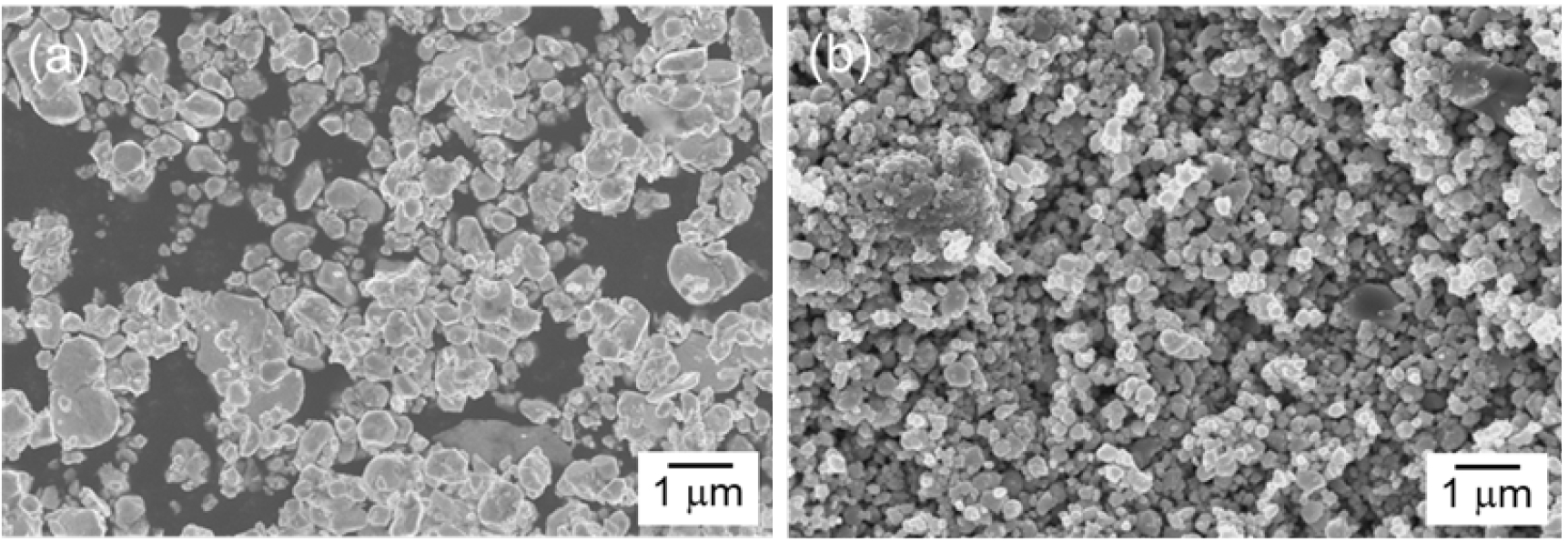
- 금속 또는 산화물 분말을 원료로 사용하여 5시간 동안 볼 밀링한 분말의 형상을 Fig. 1에 나타내었다. 실험에 사용된 Cu 원료분말의 크기가 약 75 μm인 것을 고려할 때, 금속분말을 사용하여 밀링한 분말의 입자크기가 뚜렷하게 감소되었으며 또한 원료분말 들이 균일하게 혼합되었음을 확인할 수 있다. 한편, Fig. 1(b)와 같이 밀링한 산화물 분말은 금속분말과 비교하여 상대적으로 미세한 입자크기를 나타내며 일부 응집체가 존재함을 보여준다. 이러한 결과는 Fig. 2의 입자크기 분석에서도 확인할 수 있다. 금속분말을 밀링한 경우에는 약 7 μm의 평균크기를 나타내나 산화물 분말은 약 0.54 μm와 1.8 μm에서 최빈값을 갖는 전형적인 이중 모드의 입도분포를 보여주고 있으며, 이는 취성을 갖는 산화물 분말이 볼 밀링 과정 중에 상대적으로 더 용이하게 파쇄되었기 때문으로 설명할 수 있다.
- Fig. 3(a)와 (b)는 각각 금속 및 산화물 분말을 800℃의 수소분위기에서 2시간 동안 환원처리한 후 SEM으로 관찰한 미세조직 사진이다. Fig. 1의 밀링한 분말과 비교할 때 환원한 분말에서는 열처리에 의한 입자성장과 함께 입자 간 목(neck) 형성과 성장이 관찰된다. 또한 환원된 산화물 분말의 입자크기가 상대적으로 미세한 것을 확인할 수 있으며 이는 Fig. 2의 볼 밀링한 분말의 크기를 고려할 때 초기 분말의 크기에 기인한 것으로 해석된다.
- Fig. 4는 밀링한 금속분말 및 수소분위기에서 환원된 산화물 분말의 XRD 결과를 각각 나타낸 것으로, 밀링 후에는 원료분말에 해당하는 상이 관찰되나 수소환원 후에는 W 상의 피크와 함께 추가적으로 Ni-Cu 고용체 및 Ni4W 상의 피크가 일부 관찰된다. 기존에 보고된 환원거동을 고려할 때[11, 12], 본 실험조건으로 열처리한 산화물 분말은 순수한 금속 상으로 모두 환원되었음을 알 수 있다. 한편, XRD 결과에서 추가적으로 관찰되는 Ni-Cu 상은 Ni과 Cu의 상호확산에 의한 Ni-Cu 고용체 형성, Ni4W 상은 W과 Ni의 화학적 결합에 의한 금속간화합물의 형성에 기인한 것으로 해석된다[7].
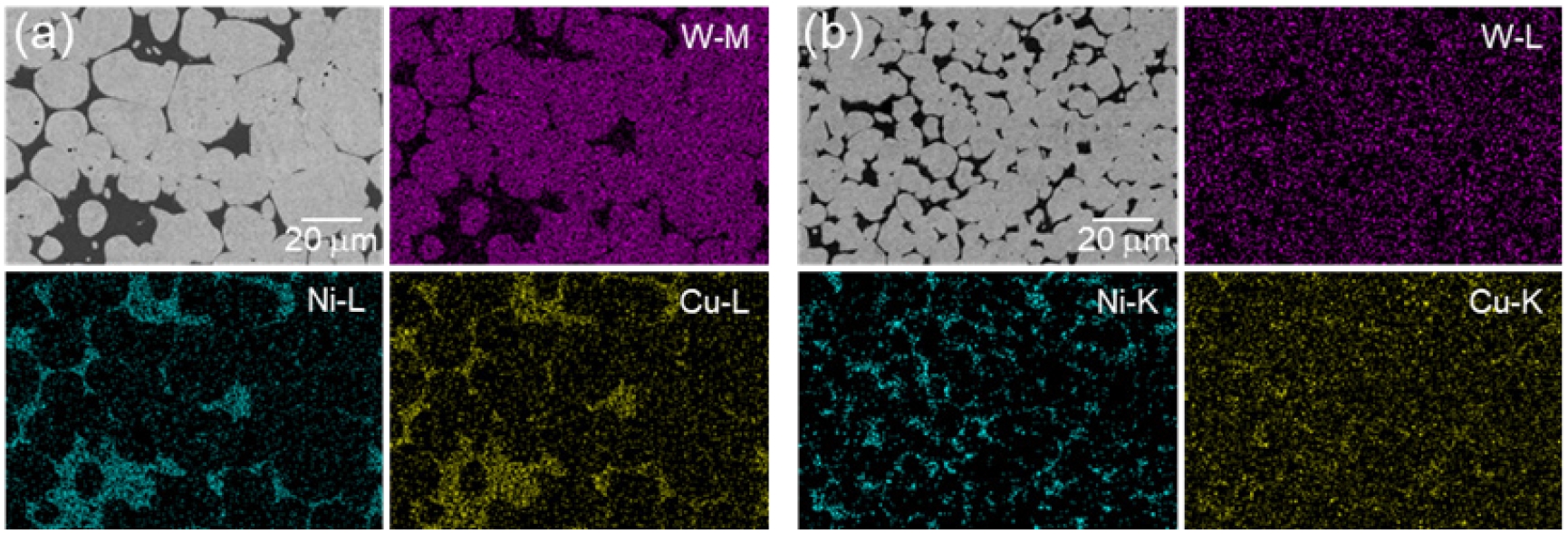
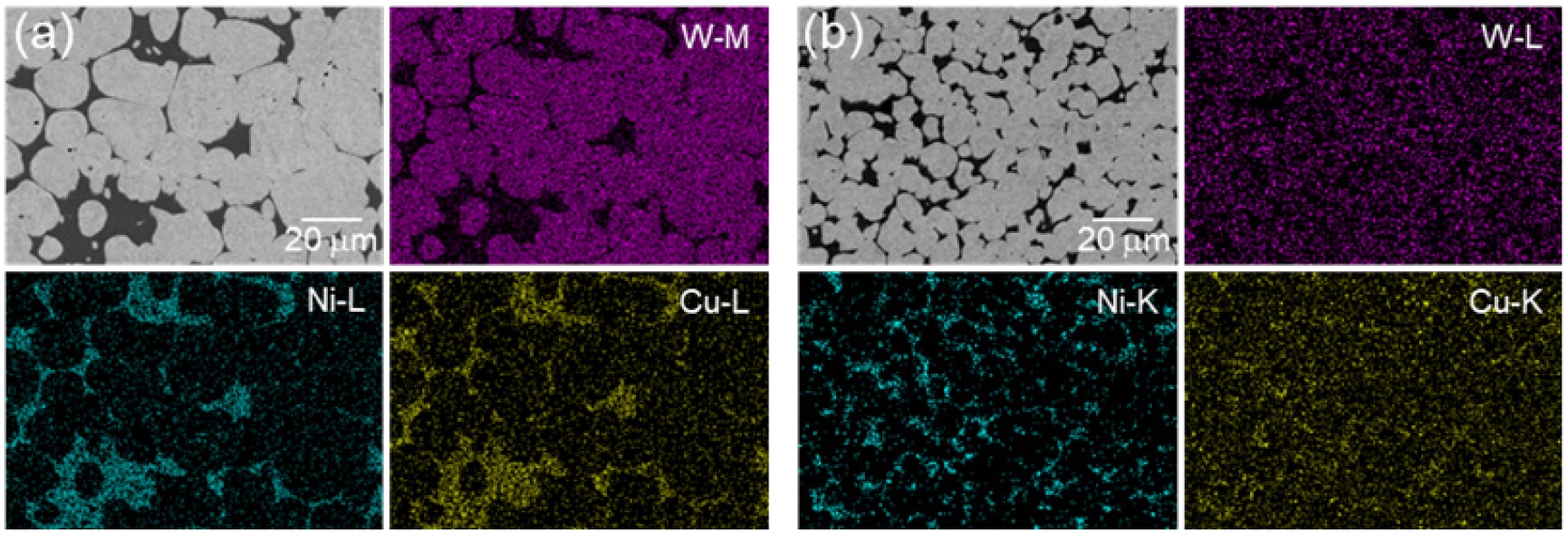
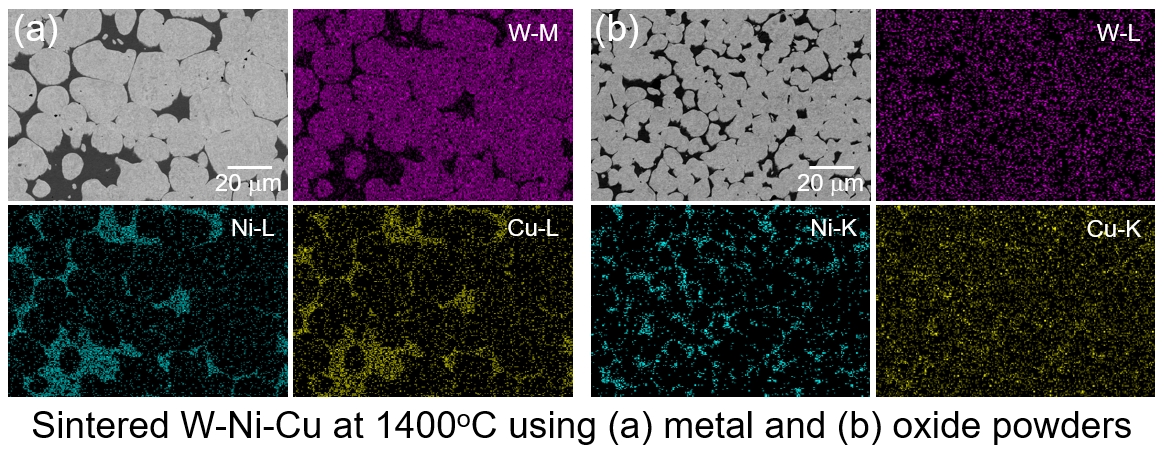
- 원료분말 및 소결온도가 치밀체의 미세조직에 미치는 영향을 분석하기 위해 수소환원한 분말을 성형한 후 1200~1400℃의 온도에서 소결하였다. Fig. 5는 W-7Ni-3Cu 소결체의 표면을 FE-SEM으로 관찰한 것으로, 여기서 (a)는 금속분말, (b)는 환원된 산화물 분말을 원료로 사용한 경우이며 연마면의 미세조직은 명암에 따라 두 가지 영역으로 구분된다. 명암차이에 따른 상을 확인하기 위해 1400℃에서 소결된 시편에 대해 EDS mapping 분석을 실시하여 Fig. 6에 나타내었으며, 상대적으로 밝은 영역은 W 원소가 많이 검출되는 W 상이고, 상대적으로 어두운 영역은 Ni-Cu 상임을 알 수 있다.
- SEM 사진에서 명확히 보여주듯이, 모든 시편에서는 소결온도가 증가할수록 W의 입자크기가 증가하며 1300°C까지는 고상소결 형태의 미세조직을 보여주고 있다[13]. 그러나 1400°C에서는 W 입자가 구형의 형태로 존재하는 전형적인 액상소결의 조직 특성을 나타낸다. 이는 70Ni–30Cu 합금의 고상선 및 액상선 온도가 각각 1348°C 및 1384°C인 것을 고려하면[14], 바인더 상인 Ni-Cu는 소결온도에서 액상으로 존재하기 때문에 본 실험에서의 치밀화는 주로 액상소결을 통해 이루어졌다고 해석할 수 있다. 한편, 환원된 산화물 분말을 이용하여 제조한 소결체는 금속분말을 사용한 경우보다 미세한 W 입자크기와 균일한 Ni-Cu 바인더 상의 분포를 나타내며, 이는 Fig. 3의 SEM 사진과 같이 환원된 분말의 입도차이 때문으로 판단된다.
- 성분원소들의 화학적 결합상태를 확인하기 위해 1300°C에서 소결한 시편의 XPS 분석을 실시하여 W4f, Ni2p 및 Cu2p에 대한 narrow scan 스펙트럼을 Fig. 7에 나타내었다. W4f 스펙트럼에서는 주로 금속결합(W0) 및 Ni4W 결합에너지 값이 관찰되며[15], 환원된 산화물 분말을 원료로 사용한 경우에는 표면산화에 의해 W-O 결합에 해당하는 W4+과 W6+의 피크도 관찰된다[11]. Ni2p 및 Cu2p 스펙트럼에서는 금속결합의 에너지 값과 함께 Ni2+의 피크도 확인되는 바, 이는 Ni-Cu 고용체 및 표면산화에 기인한 Ni(OH)2 상으로 해석하였다[16]. 한편 금속분말을 원료로 사용하여 소결한 시편과 비교했을 때, 산화물 분말을 사용한 시편에서는 Cu2p 스펙트럼의 결합에너지 값이 증가하고 반가폭(FWHM)이 감소하는 것이 관찰되었다. 따라서 Fig. 6의 EDS 결과를 함께 고려하면 환원된 산화물 분말을 원료로 사용한 소결체 내에 상대적으로 균일한 화학분포를 갖는 Ni-Cu 고용체가 형성된 것으로 해석할 수 있으나[15, 16] 정확한 분석을 위해서는 추가적인 연구가 요구된다.
- Fig. 8은 상압소결한 W-Ni-Cu 중합금의 원료분말 및 소결온도에 따른 상대밀도와 비커스 경도 값을 나타낸 것이다. 환원된 산화물을 원료분말로 사용한 경우는 모든 시편에서 99%이상의 상대밀도를 나타내며, 금속분말의 경우는 소결온도가 증가함에 따라 상대밀도도 증가하나 산화물 분말과 비교해서는 상대적으로 낮은 값을 보여준다. 환원된 산화물 분말에서의 높은 상대밀도는 주로 수소환원한 분말의 미세한 입자크기에 기인한 소결 구동력의 증가로 해석된다. Table 1은 소결체의 SEM 미세조직 사진에서 측정한 W 결정립 크기를 나타낸 결과로써, 소결온도가 증가함에 따라 입자크기가 증가하며 동일한 소결온도에서는 환원된 산화물 분말을 사용한 소결체의 입자크기가 더 미세함을 알 수 있다. 비커스 경도는 환원된 산화물 분말을 사용하여 소결한 시편은 3.34~3.92 GPa로 금속분말의 경우인 2.39~3.22 GPa 보다 높은 값을 보여준다. 또한 환원된 산화물 분말을 이용한 소결체의 경우 소결온도가 증가함에 따라 경도가 감소하며 이는 Table 1의 결과와 같이 상대적으로 고온에서의 입자성장에 기인한 것으로 해석하였다.
3. Results and Discussion
- 금속 또는 산화물 분말의 볼 밀링과 수소분위기에서의 상압소결을 통해 W-7 wt.% Ni-3 Cu 중합금을 제조하고 공정조건이 소결체의 미세조직과 경도에 미치는 영향을 분석하였다. 5시간동안의 볼 밀링으로 입자크기가 미세화 되었으며, 800°C에서 수소환원한 분말은 금속 W상과 함께 Ni-Cu 고용체 및 Ni4W 상으로 존재함을 확인하였다. 또한 산화물을 원료로 사용한 분말은 금속분말과 비교하여 상대적으로 미세한 입자크기를 나타내었다. 분말 성형체를 1200~1400°C에서 치밀화한 소결체는 소결온도가 증가할수록 W의 입자크기가 증가하며 1400°C의 소결에서는 W 입자가 구형의 형태로 존재하는 전형적인 액상소결의 미세조직 특성을 나타내었다. 밀링 및 수소환원한 산화물 분말을 이용하여 제조한 소결체는 금속분말을 사용한 경우보다 높은 상대밀도, 미세한 W 입자크기와 균일한 Ni-Cu 바인더 상의 분포를 나타내었다. 환원된 산화물 분말을 사용하여 소결한 시편의 경도는 3.34~3.92 GPa로 금속분말의 경우인 2.39~3.22 GPa 보다 높은 값을 보여주었으며, 이는 주로 원료분말의 균일도 및 입도 등 특성 차이에 기인한 것으로 해석하였다.
4. Conclusion
-
Funding
This work was supported by the National Research Foundation of Korea (NRF) grant funded by the Korea government (MSIT) (RS-2023-00280484).
-
Conflict of Interest
The authors have no conflicts of interest to declare.
-
Data Availability Statement
All dataset files used in this study can be available on request.
-
Author Information and Contribution
Youngmin Kim: MSc student; investigation, writing–original draft.
Ji Young Kim: MSc student; writing–original draft, methodology.
Minju Son: Undergraduate student; investigation, visualization.
Wonyong Kwon: Undergraduate student; investigation, visualization.
Eui Seon Lee: PhD candidate; methodology, validation, writing–review & editing.
Sung-Tag Oh: Professor; conceptualization, funding acquisition, supervision.
-
Acknowledgments
None.
Article information




| Sintering temperature (°C) | W grain size (μm) | |
|---|---|---|
| Metal powder | Oxide powder | |
| 1200 | 2.19 ± 0.60 | 1.48 ± 0.41 |
| 1300 | 3.51 ± 1.38 | 2.12 ± 0.61 |
| 1400 | 17.28 ± 4.96 | 9.21 ± 2.39 |
- 1. N. Senthilnathan, A. R. Annamalai and G. Venkatachalam: Trans. Indian Inst. Met., 70 (2015) 1161.ArticlePDF
- 2. J. Das, G. A. Rao and S. K. Pabi: Mater. Sci. Eng. A, 527 (2010) 7841.Article
- 3. R. M. German: Int. J. Refract. Met. Hard Mater., 108 (2022) 105940.Article
- 4. S.-C. Lee, C.-W. Lee, S.-S. Jung, B.-H. Cha and J.-S. Lee: J. Korean Powder Metall. Inst., 14 (2007) 101.Article
- 5. S. H. Islam, X. Qu, S. J. Askari, M. Tufail and X. He: Rare Metals, 26 (2007) 200.Article
- 6. H. J. Ryu, S. H. Hong and W. H. Baek: Mater. Sci. Eng. A, 291 (2000) 91.Article
- 7. Y. J. Heo, E. S. Lee, J. Byun and S.-T. Oh: Powder Met., 68 (2025) 363.ArticlePDF
- 8. A. Barua, S. Pradhan, M. Priyadarshini, A. Patra and K. Kumari: J. Mater. Eng. Perform., 34 (2025) 8232.ArticlePDF
- 9. Z.-B. Li, H. Zhang, G.-H. Zhang and K.-C. Chou: Metall. Mater. Trans., 53A (2022) 1085.Article
- 10. E. S. Lee, J. Byun and S.-T. Oh: Int. J. Refract. Met. Hard Mater., 134 (2026) 107489.Article
- 11. Y. J. Heo, E. S. Lee, J. W. Choi, J. Byun and S.-T. Oh: Korean J. Met. Mater., 62 (2024) 334.ArticlePDF
- 12. J. A. Rodriguez, J. Y. Kim, J. C. Hanson, M. Pérez and A. I. Frenkel: Catal. Lett., 85 (2003) 247.ArticlePDF
- 13. A. Mondal, A. Upadhyaya and D. Agrawal: Mater. Sci. Eng. A, 527 (2010) 6870.Article
- 14. G. Sethi, S. J. Park, J. L. Johnson and R. M. German: Int. J. Refract. Met. Hard Mater., 27 (2009) 688.Article
- 15. H. Shi, T.-Y. Dai, X.-Y. Sun, Z.-L. Zhou, S.-P. Zeng, T.-H. Wang, G.-F. Han, Z. Wen, Q.-R. Fang, X.-Y. Lang and Q. Jiang: Adv. Mater., 36 (2024) 2406711.Article
- 16. V. R. R. Medicherla, S. K. Parida, P. Bag, R. Rawat, T. Shripathi, N. Sahadev, D. Biswas, G. Adhikary and K. Maiti: AIP Conf. Proc., 1461 (2012) 275.Article
References
Figure & Data
References
Citations

 ePub Link
-
 Cite this Article
- Cite this Article
-
- Close
- Download Citation
- Close
 XML Download
- Figure
-




- Related articles
-
- Effect of the Cross-rolling Process on the Microstructures and Mechanical Properties of 9Cr-1W ODS Steel
- Effect of Sintering Conditions on the Microstructure of an FeCrMnNiCo High-Entropy Alloy
- Effect of WC Particle Size on the Microstructure, Mechanical and Electrical Properties of Ag/WC Sintered Electrical Contact Material
- Effect of Iron Content on Microstructure and Mechanical Properties of Ti-Mo-Fe P/M Alloys






Fig. 1.
Fig. 2.
Fig. 3.
Fig. 4.
Fig. 5.
Fig. 6.
Fig. 7.
Fig. 8.
Graphical abstract
| Sintering temperature (°C) | W grain size (μm) | |
|---|---|---|
| Metal powder | Oxide powder | |
| 1200 | 2.19 ± 0.60 | 1.48 ± 0.41 |
| 1300 | 3.51 ± 1.38 | 2.12 ± 0.61 |
| 1400 | 17.28 ± 4.96 | 9.21 ± 2.39 |
Table 1.
TOP

